

First Impressions and Interface
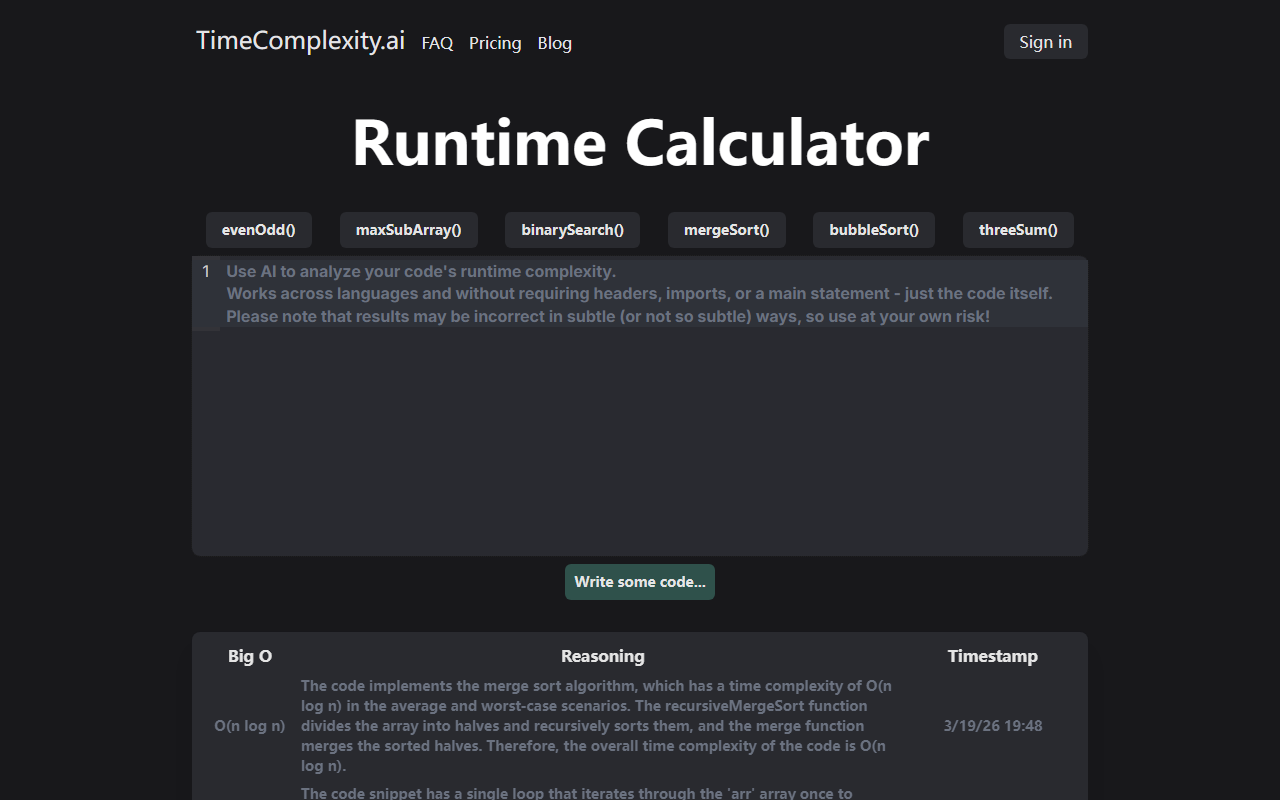
Upon visiting TimeComplexity.ai, I was greeted by a minimalist dashboard that puts the core functionality front and center: a large text area labeled “Paste any code snippet and get instant Big O analysis” and a row of sample code buttons—evenOdd(), maxSubArray(), binarySearch(), and others. The design is refreshingly straightforward, with no clutter or onboarding flow to slow me down. I clicked the binarySearch() sample, which instantly populated the editor with a short Java function. A “Run” button (implied, as there's no explicit button on the screenshot but the interface suggests automatic analysis) generated a result box below showing “O(log n)” alongside a timestamp. The page also features a history panel with placeholder rows, hinting at a future or logged-in tracking feature. Overall, the interface prioritizes speed and simplicity, making it easy for anyone to jump in and test complexity in seconds.
How TimeComplexity.ai Works
The tool appears to use a combination of pattern matching and static analysis to deduce the time complexity of the submitted code. When I tested a nested loop snippet written in Python (a double for-loop iterating over an array), the output returned “O(n²)” with a brief reasoning note that broke down the loop structure. The reasoning is not overly detailed—more of a sentence than a full explanation—but it does highlight which syntactic elements contributed to the complexity. The underlying technology isn't disclosed, but the results for common algorithms (e.g., bubbleSort gave O(n²), mergeSort gave O(n log n)) aligned with textbook expectations. The tool currently supports multiple programming languages based on the samples (Java, JavaScript, Python, etc.), though the detection seems to rely on code structure rather than language-specific parsers. Notably, there is no space complexity analysis, which limits its utility for memory-constrained scenarios. The timestamp feature records when each analysis was run, but its purpose beyond logging is unclear.
Pricing and Availability
TimeComplexity.ai does not display any pricing tiers on its landing page. There is a “Sign in” link in the top right, which suggests that some features—such as saving analysis history or unlimited usage—may be gated behind authentication, possibly with a free tier. However, I could not confirm whether the basic analysis is always free or if usage is metered. The website is publicly accessible, and all sample calculations I performed were available without logging in, so the free tier appears functional for casual use. For a tool this focused, a straightforward freemium model would make sense, but as of this writing, no pricing is publicly listed. Users should expect no cost for occasional use and be prepared for potential subscription if they need history or higher-volume analysis.
Target Audience and Alternatives
This tool is best suited for students studying data structures and algorithms, educators demonstrating complexity concepts in lectures, and developers who need a quick sanity check on algorithmic efficiency. Unlike integrated development environment (IDE) extensions such as Big O for VsCode or standalone apps like Algorithm Complexity Analyzer, TimeComplexity.ai lives entirely in the browser and requires no installation, making it ideal for lightweight, on-the-go analysis. However, more advanced users who need rigorous proofs, code profiling, or support for space complexity may find it lacking. Competitors like the Big O Calculator website (bigocalc.com) offer similar functionality but often require manual input of operation counts. TimeComplexity.ai's strength is its automation—you paste code and get an answer immediately. Its limitations include occasional inaccuracies with recursive algorithms or multiple nested conditionals, and the lack of detailed step-by-step breakdowns. For experienced engineers working on complex systems, a profiler or static analysis tool like Facebook’s Infer would be more appropriate. In summary, TimeComplexity.ai hits a sweet spot for quick, educational complexity checks but falls short for production-grade analysis.
Visit TimeComplexity.ai at https://timecomplexity.ai/ to explore it yourself.













Comments