

First Impressions and Onboarding
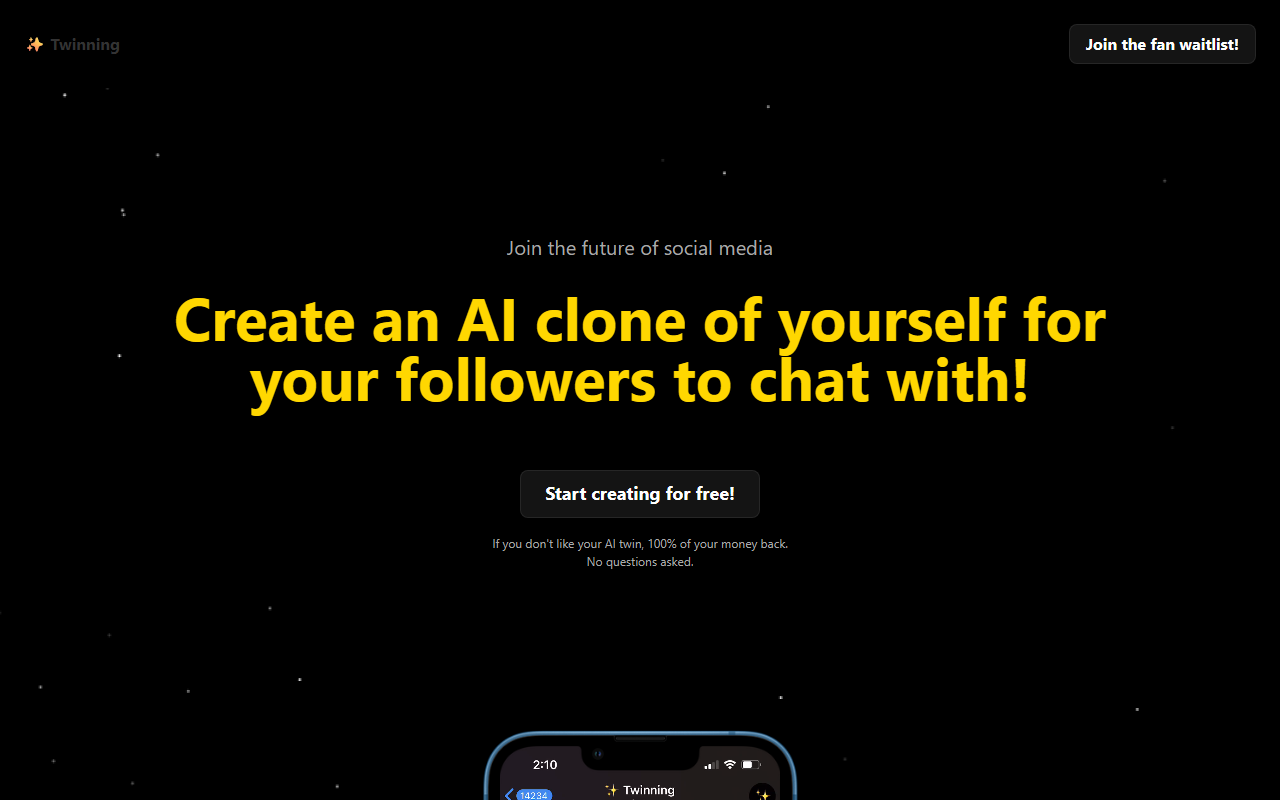
Upon visiting the Twinning website, I’m greeted by a minimalistic landing page with a prominent “Join the fan waitlist” call-to-action. The value proposition is clear: “Create an AI clone of yourself for your followers to chat with.” The onboarding process is described in four simple steps: provide your identity and content type, record a 5-15 minute audio, wait a few minutes for the AI twin to be ready, then share the link. I found the design refreshingly straightforward—no confusing menus or jargon. When I tested the free tier (the “Superstar” plan for influencers with over 1 million followers), the interface guided me through a quick profile setup. The audio recording step was seamless; the tool accepted an MP3 file of me speaking naturally. After a short processing period—roughly three minutes—the AI twin was accessible via a shareable link. The demo conversation showed the twin could respond in both text and audio messages, preserving a decently natural tone. However, the voice cloning quality, while professional, occasionally stumbled on emotional nuance. The dashboard also includes an analytics section that tracks interaction counts, though I couldn’t test paid tiers’ advanced metrics. The overall experience felt polished but focused squarely on large accounts.
Pricing and Revenue Potential
Twinning’s pricing model is refreshingly simple: no monthly fees, just a one-time payment per twin. The tiers are based on follower count: Superstar (free for 1M+ followers), Influencer ($299 for 100K+ followers), and Creator ($499 for 10K+ followers). All tiers include unlimited interactions, professional voice cloning, audio messaging, texting, and analytics. I appreciate the transparency—no hidden charges. The revenue estimation tool is a nice addition: you input your follower count and expected engagement rate to see projected monthly earnings. For example, with 100,000 followers and one in ten chatting for 10 minutes daily, the tool estimates $100/month. While this projection seems optimistic, it’s a starting point for creators to gauge value. Notably, there is no subscription for fans—they interact for free, and the influencer gets paid per interaction via an undisclosed mechanism (likely ad revenue or tipping, though the site doesn’t elaborate). This model is unique compared to alternatives like Character.ai or Replika, which charge users or require monthly subscriptions. However, the upfront cost is steep: $499 for creators with just 10,000 followers may be prohibitive. The money-back guarantee (“100% of your money back if you don’t like your AI twin”) adds a layer of trust, but I wish the exact refund terms were clearer.
Who Should Use Twinning and Final Verdict
Twinning is clearly designed for established influencers and content creators who have a loyal audience. If you have 10,000+ followers and want to monetize one-on-one interactions without scaling your personal time, this tool offers a novel solution. The AI twin can handle basic Q&A, share pre-recorded messages, and engage in chit-chat, freeing up your schedule. I also see potential for educational content creators or public figures who want to offer a “shadow” version of themselves for fan engagement. However, the tool has real limitations: the audio cloning may not capture every vocal inflection, and the responses are limited to the data you provide. There is no API or integration with existing social platforms—you must direct fans to a separate link. Additionally, the pricing excludes smaller creators (under 10K followers) and may be too expensive for those uncertain about return on investment. Compared to competitors, Twinning focuses purely on monetized fan interaction, whereas other AI writing tools like Jasper or Copy.ai emphasize content generation, not clones. In my judgment, Twinning is best suited for mid-to-large influencers who prioritize fan interaction as a revenue stream. If you have a smaller but passionate audience, consider waiting for a lower-tier option. Visit Twinning at https://twinning.me/ to explore it yourself.












Comments