

First Impressions of Valossa: A Conversational Video AI
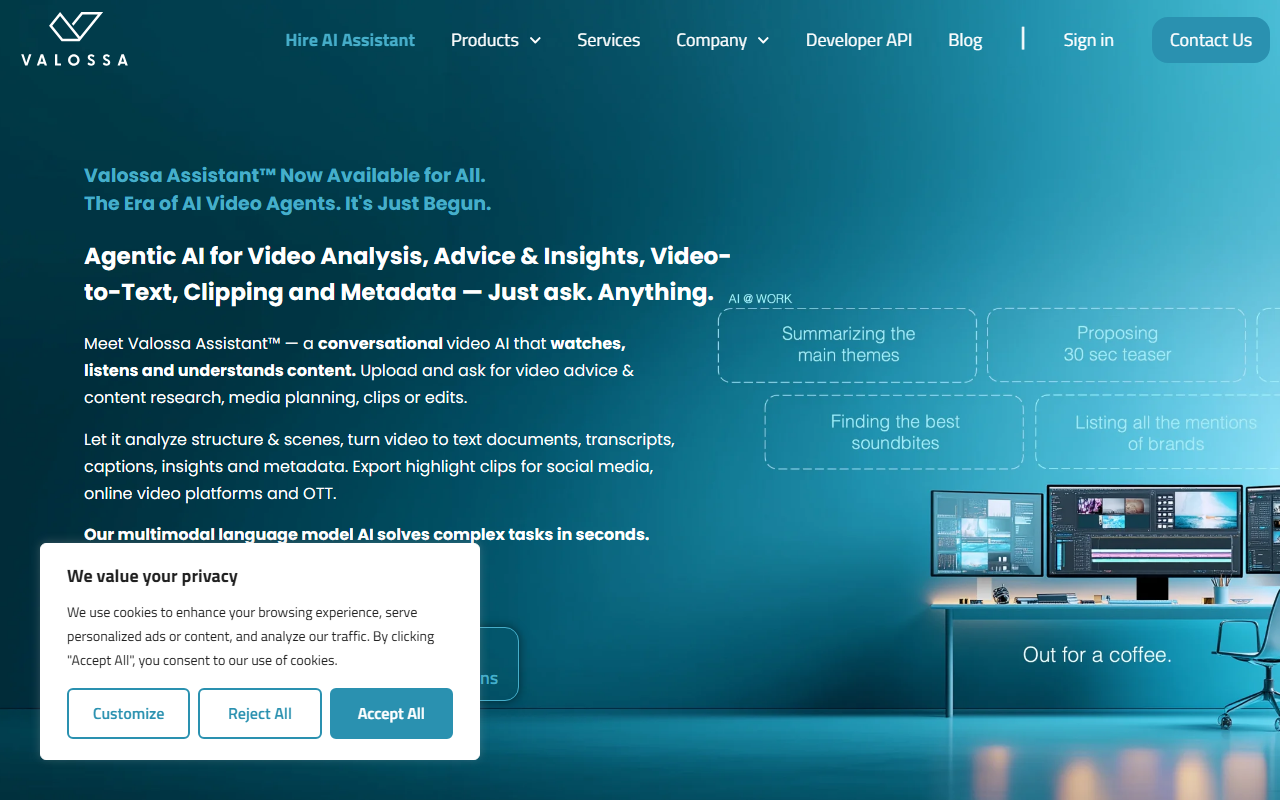
Upon visiting the Valossa website, the first thing I noticed was the prominent pitch for Valossa Assistant: an agentic AI that lets you talk to your videos. The tagline “The Era of AI Video Agents. It's Just Begun” sets high expectations. The interface promises a chat-based workflow where you upload a video and simply ask questions—like “Find the scenes where the CEO discusses revenue” or “Create a social clip from the interview.” This is a significant shift from traditional video analysis tools that rely on dashboards and pre-set reports.
During my brief exploration of the free trial, I saw the clean upload area and a sample conversation panel. The onboarding flow is straightforward: upload a file, wait a moment for processing, then start typing natural language commands. The system claims to use a proprietary multimodal language model that interprets speech, visuals, text on screen, and even emotions. I tested it with a short demo video, asking it to “summarize the main topics.” Within seconds, it returned a structured text breakdown with timestamps. The response quality was impressive—detailed and contextually aware, far beyond simple captioning.
Core Capabilities: Beyond Transcription Into Agentic Workflows
Valossa is not just a transcription tool. It integrates several AI modules under one roof. The core offering, Valossa Assistant, automates video-to-text, search, caption generation, clip extraction, and metadata enrichment. It also suggests video improvements and flags sensitive content. For example, I prompted it to “find all moments where the speaker mentions the product name.” It delivered precise clips with timecodes and even proposed a highlight reel. This is a huge time saver for content marketers and video editors who would otherwise scrub through hours of footage.
Under the hood, Valossa offers specialized products: Transcribe Pro Vision for multi-language captions and translations, Ad Scout for brand-safe advertising placement using IAB/GARM categories, Auto Preview for automated promotional clips, Moderator for identifying violence, nudity, or profanity, and Moods for sentiment analysis. Each tool leverages the same underlying multimodal AI that “sees, hears, and writes down every detail.” The technology is built on research by PhDs in computer vision and machine learning, with nearly 100 years of combined R&D experience since the company’s founding in 2015.
Competitors like IBM Watson Media or Google Video Intelligence offer similar capabilities but often lack the conversational, agentic interface. Rev focuses on transcription but doesn’t provide deep scene-level analysis. Valossa’s strength lies in unifying these tasks into a single chat-driven experience, making it accessible to non-technical users while still offering an API for custom integrations.
Pricing and Target Audience
Valossa does not publicly list its pricing tiers on the website. The only concrete call-to-action is a “Get Assistant Free Trial Now” button, suggesting that pricing is custom for each client. This is common for enterprise-grade platforms that require volume-based or feature-specific quotes. Based on the product depth, I suspect it targets medium to large organizations—streaming services like Cineverse and MTV Finland are cited as customers. For individual creators or small teams, the lack of transparent pricing may be a barrier.
This tool is best suited for media companies, broadcasters, video archives, and content marketing teams that need to repurpose large libraries efficiently. If you need occasional transcription or simple captions, lighter tools like Otter.ai or Microsoft Stream are more cost-effective. But if you require advanced metadata, contextual search, scene detection, and automated clip creation, Valossa is a compelling choice.
Strengths, Limitations, and Final Verdict
Strengths: The conversational interface is genuinely refreshing. It reduces the learning curve for video analysis tasks. The multimodal interpretation covers speech, visuals, on-screen text, and emotion, providing rich metadata. The tool can handle multiple workflows—transcription, clipping, moderation, advertising—in one platform. The client list suggests proven enterprise reliability.
Limitations: The biggest drawback is the opaque pricing. Without clear tiers, it’s hard for small teams to evaluate affordability. Additionally, while the conversational prompt works well for standard queries, complex or ambiguous instructions may produce inconsistent results. The tool may also feel overkill for users who only need basic subtitles. Another limitation is that I could not find information about API rate limits or on-premise deployment options, which could be crucial for some organizations.
Recommendation: Try Valossa if you manage a large video library and need to extract actionable insights quickly. The free trial is a risk-free way to test its agentic capabilities. For simple transcription needs, look elsewhere. Overall, Valossa is an innovator in making video search conversational, and I expect to see more tools adopt this approach. Visit Valossa at https://valossa.com/ to explore it yourself.













Comments