
What Veriom Does and Why It Matters
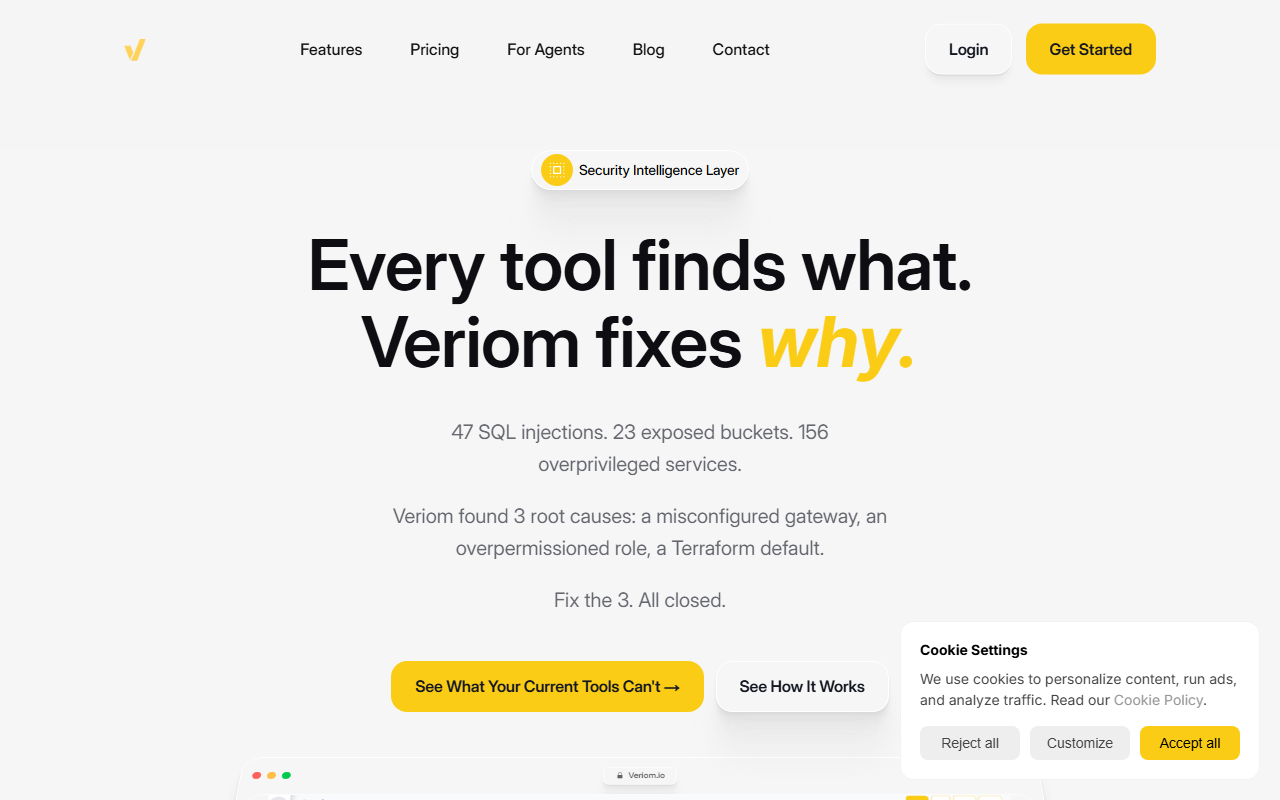
Upon visiting Veriom's website, the message is immediate and provocative: "Every tool finds what. Veriom finds why." The landing page presents a scenario familiar to any security engineer—226 issues flagged by scanners, but only 3 root causes discovered by Veriom. The promise is that fixing those 3 closes all 226, plus catches 14 architectural failures the scanners never saw. This is not a vulnerability scanner; it's a reasoning engine that maps your entire delivery chain—code repositories (GitHub), cloud providers (AWS, Azure, GCP), and CI/CD pipelines—to produce a live architectural model. Then it analyzes that model to pinpoint the structural decisions generating risk. The dashboard, from what I can gather from the site, likely presents a unified view of findings categorized into 10 risk categories, most invisible to traditional tools. The onboarding flow appears to start with a simple connection step, after which Veriom builds the architectural map in under an hour.
Veriom's core technology is an AI that reasons about system architecture rather than scanning for known vulnerabilities. The website does not disclose the specific models used, but the emphasis on "reasoning" suggests a combination of graph analysis and language models. Importantly, Veriom does not replace existing scanners—it sits above them, providing context and closure. The free tier is not mentioned; only a "Get Started" button leads to a contact page. Pricing is not publicly listed on the website, a common pattern for enterprise sales. However, the value proposition is clear: reduce alert fatigue, eliminate entire risk classes, and prove to boards that problems are genuinely resolved, not just patched.
How Veriom Works and Its Technical Depth
Veriom claims to understand your entire architecture in under an hour. The process is broken into four steps: Connect, Map, Fix, and Reason. During Connect, you link GitHub, AWS, Azure, GCP, and your CI/CD pipeline—basically every layer of your delivery chain. Then Veriom builds a complete model of the architecture, covering code, cloud, CI/CD, and production. This model adapts continuously as changes occur. The Fix stage drills down to the exact architectural change needed, who owns it, and which issues it closes.
What sets Veriom apart from tools like Snyk or SonarQube is its focus on architectural root causes. Those tools flag individual vulnerabilities; Veriom groups them by underlying structural failures. The website provides a comparison table: Veriom offers architectural root cause analysis, structural fix guidance, findings verified in your actual environment, elimination of entire architectural risk classes, unlimited workspaces and teams, and unified architectural intelligence. Competitors, in contrast, provide symptom detection, generic risk scores, and an infinite patching loop. This is a strong differentiator for teams buried under alerts from multiple separate tools. The results shared on the site include a healthtech CTO reporting a drop from 800+ alerts to 23 within six weeks, with a clear understanding of why each one existed.
I did not find any mention of an API or direct integration with SIEMs like Splunk, but the connectivity to GitHub and major cloud providers covers the most common environments. The tool is clearly designed for engineering-first organizations, not for pure compliance reporting. Veriom is backed by notable names: the site lists logos for Google Cloud, Barclays Eagle Lab, NVIDIA, and others, indicating some level of validation from industry leaders. For a tool that is still early-stage (no pricing page, no self-service demo), those endorsements lend credibility.
Strengths and Real Limitations
Veriom's greatest strength is its ability to cut through noise. By focusing on root causes, it reduces the number of items a team needs to address by orders of magnitude. The architectural mapping is automated and continuous, meaning it keeps up with code changes. The emphasis on providing both the cause and the fix with ownership assignment is another strong point—security teams can spend less time triaging and more time engineering. The unlimited workspaces and teams model is particularly attractive for MSPs and larger organizations that struggle with per-seat pricing from other vendors.
However, Veriom has limitations. First, it requires deep access to your code repositories, cloud infrastructure, and CI/CD pipelines. Small teams on a single cloud may not need this level of analysis, and the integration setup might be non-trivial. Second, the lack of a free tier or public pricing makes it impossible to evaluate without a sales call. Third, the tool's output is only as good as the data it ingests; if your architecture is poorly documented or chaotic, Veriom may struggle to produce accurate root causes. Finally, the website provides testimonials and percentage claims (e.g., "70% faster assessment") but without sources or methodology—this is typical for marketing, but reduces trust until independently verified.
Who Should Use Veriom and Final Recommendation
Veriom is best suited for mid-to-large engineering organizations that are drowning in security alerts and want to shift from reactive patching to proactive architectural improvements. CISO, VPs of Engineering, and MSPs who manage multiple clients will benefit most. The tool is not for solo developers or small startups without a complex multi-cloud setup—they can probably survive with simpler scanners. If your team has five tools all telling you different things, Veriom could unify the picture and give you a single source of truth.
I recommend trying Veriom if you are tired of security debt and want to prove to your board that root causes are closed. The lack of transparent pricing is a hurdle, but the potential ROI—eliminating entire classes of risk—makes it worth the contact form. Visit Veriom at https://veriom.io/ to explore it yourself.










Comments