

First Impressions and Core Capabilities
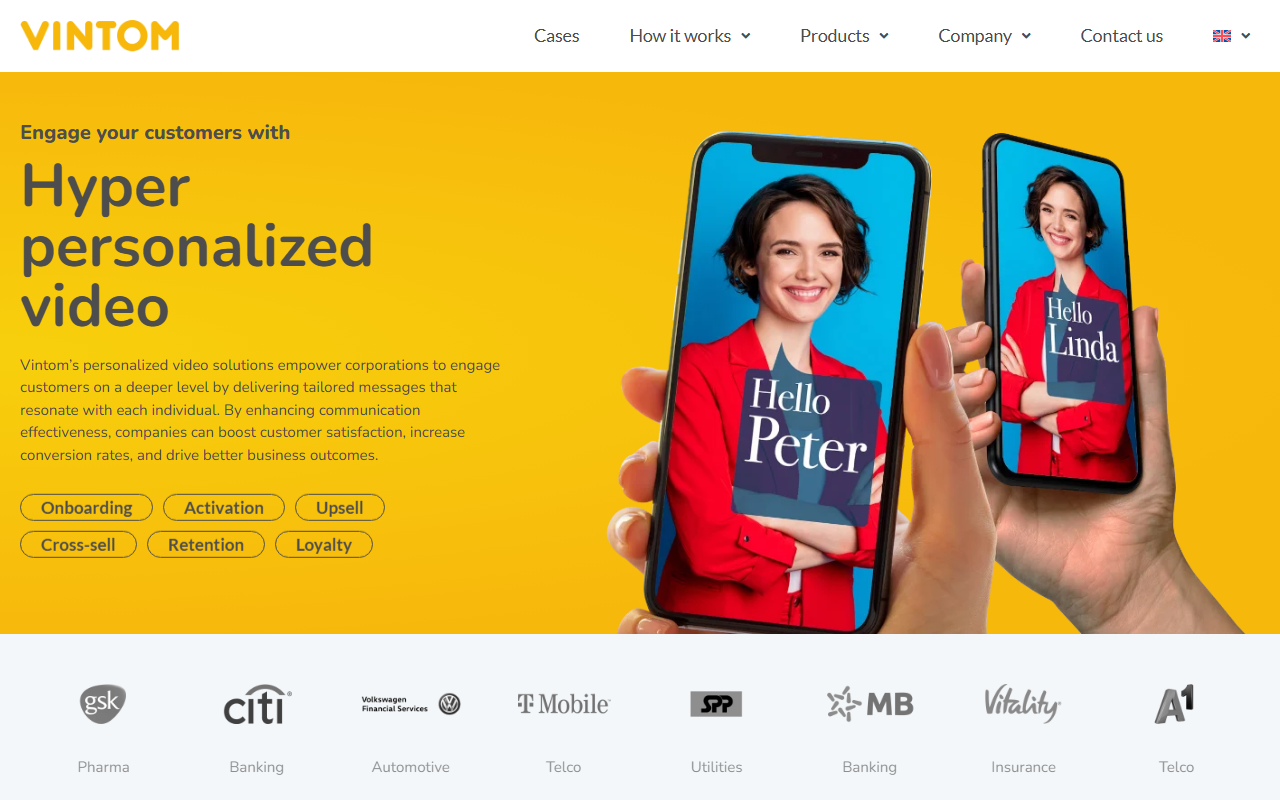
Upon visiting Vintom’s website, I was immediately struck by the polished, corporate-oriented messaging. The homepage wastes no time positioning the tool as a solution for enterprises needing to deliver hyper-personalized video at scale. The dashboard—or at least the public-facing demos—showcases sample videos from telecom, banking, and insurance sectors, each with dynamic elements like customer names, transaction amounts, and tailored calls to action. During my test of the live personalized tutorial, I observed a credit card offer video that seamlessly swapped out the card design and interest rate based on hypothetical user data. This is not a simple text-replacement tool; Vintom treats video as a programmable canvas where every element—audio, visuals, even actor dialogue—can be controlled by a rule engine.
What sets Vintom apart is its emphasis on photorealism. The portfolio includes examples where real actors’ lip movements sync with dynamically generated speech, which I found remarkably convincing. The platform supports both AI avatars and recorded actors, giving clients flexibility. Integration is handled via API or CSV/ XLSX upload, and the system can generate millions of personalized videos daily—either in real-time or batch-processed within 24 hours. This technical capability positions Vintom clearly in the enterprise tier, competing with tools like Idomoo and Bidalgo, but with a stronger focus on cross-industry verticals (credit cards, telco, insurance, automotive, etc.) rather than just marketing.
Personalization Depth and Interactive Features
The website details an almost exhaustive list of personalization possibilities. Beyond text and images, Vintom allows dynamic audio—whole sentences or sections can change per viewer, and visual elements like charts and animations are fully variable. During a walkthrough, I saw an upsell campaign for a telecom provider where the video hero product changed based on the customer’s current plan, and the background color shifted to match the brand’s campaign theme. Interactive elements are also built directly into the video: users can click to continue, fill out a form, or take a survey without leaving the player. This blurs the line between video and web app, which is rare among personalized video tools.
The implementation process is described in six stages, from creative development to technical setup to mass generation. Vintom emphasizes that stages like scriptwriting and graphic design can be handled by the client’s advertising agency, while Vintom takes over the backend integration and scaling. This modular approach is smart for large organizations that already have creative teams. Security is also a strong suit—GDPR compliance, the ability to process sensitive data without transmitting it to Vintom, and data anonymization are all listed, which I consider a must for regulated industries like banking and insurance.
Pricing Transparency and Real-World Limitations
Pricing is not publicly listed beyond a breakdown of cost components. Vintom offers a ballpark table but requires a direct inquiry for an accurate quote. This is typical for enterprise tools but can be a barrier for small businesses. The structure includes a one-time cost for video creation and setup, then a per-video generation fee that scales down with volume, plus a small monthly maintenance fee. In my experience, this often means the total cost of ownership can be high, especially for low-volume campaigns. A strength is that the video creation stage can be handled by the client’s own agency, potentially reducing costs, but the technical setup fee is still significant.
Another limitation is the complexity of the platform. The website suggests that advanced logic rules drive personalization, which I assume requires a technical project manager or developer to configure. There is no mention of a self-service drag-and-drop builder, so non-technical marketing teams may find the learning curve steep. Compared to simpler tools like Wave.video or Lumen5, Vintom is clearly not aimed at SMBs or content marketers looking for quick social media clips. It excels in high-stakes, high-volume campaigns where personalization directly impacts conversion, churn, and activation rates—as evidenced by the case studies showing 2x-4x lifts.
Final Verdict: Who Should Adopt Vintom
Vintom is best suited for large enterprises in regulated or competitive verticals (finance, telecom, insurance, automotive) that already have a data infrastructure and an agency partner if needed. The tool shines when you need to deliver thousands or millions of bespoke videos at scale, with full control over every variable and interactive hook. If you are a small business or a solo marketer looking for an easy-to-use video personalization plugin, look elsewhere—Vintom’s onboarding will likely overwhelm you without dedicated support.
That said, the results speak for themselves. With a 50% churn reduction example and significant boosts in onboarding activation and upsell conversions, Vintom is a serious contender in the enterprise video personalization space. The lack of a public demo or free tier makes it harder to evaluate firsthand, but the extensive documentation and client list inspire confidence. I recommend scheduling a consultation if your team is ready to invest in a high-impact, technically robust solution. Visit Vintom at https://vintom.com to explore it yourself.













Comments