

First Impressions and Onboarding
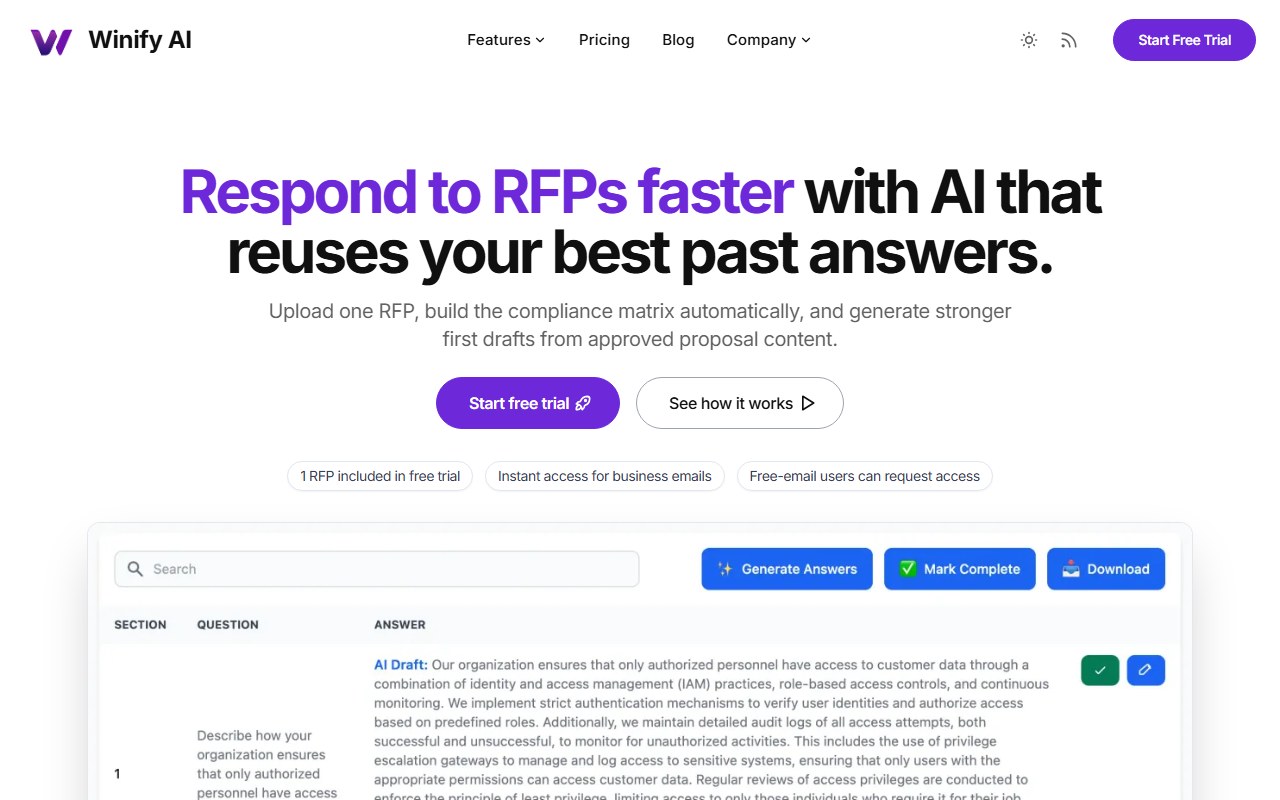
Upon visiting Winify AI's website, I was immediately struck by the clarity of its positioning. The landing page speaks directly to small proposal teams, agencies, and consultancies that answer narrative RFPs regularly. The tagline "Respond to RFPs faster with AI that reuses your best past answers" sets clear expectations. I signed up for the free trial without any friction—no credit card required, just a name, email, and a quick password setup. The onboarding flow guided me to upload one live RFP immediately, which is exactly how the tool is meant to be tested. This no-nonsense approach respects a user's time and aligns perfectly with the promise of quick value.
The dashboard is minimal but functional. After uploading a 118-page City Transit Modernization RFP (I used a sample document from their demo to get a feel), the tool processed it in under two minutes. I watched as it automatically extracted sections, deadlines, forms, and scoring criteria. The compliance matrix appeared with 42 requirements, 8 of which needed manual review. Each requirement had a status label—In progress, Ready, Needs input, Blocked—which immediately informed my next steps. I could assign requirements to team members, add notes, and filter by type (Technical, Past Performance, Personnel, etc.). For a small team, this kind of structured extraction eliminates hours of manual spreadsheet work.
Core Features and Workflow
The heart of Winify AI is its four-step workflow: Upload, Structure, Connect, Assemble. After building the compliance matrix, the "Connect your proposal knowledge hub" step lets you upload past proposals, case studies, and approved company content. I uploaded a mock past proposal and a service description document, then selected a requirement to see how the tool matched existing content. The match scores (high, medium) are color-coded and based on semantic similarity. When I clicked on a requirement for incident response SLAs, Winify pulled in a relevant paragraph from a past SOC proposal and a playbook entry, then generated a draft answer that blended both sources. The draft was coherent and used approved language from prior wins—exactly what a lean team needs to avoid starting from scratch.
The proposal assembly view merges all drafted responses into a submission-ready package. I appreciated the consistency checker that flags cross-section terminology differences and a final handoff checklist that ensures all forms and signatures are attached. The entire experience feels like a guided workflow rather than a blank canvas tool. However, I noticed that the AI's draft answers are heavily dependent on the quality of uploaded source documents. If your past proposals are weak or unrelated, the generated drafts may require significant editing. Additionally, the tool currently focuses on narrative RFPs that emphasize written responses; it may be less effective for highly technical, form-heavy RFPs that require quantitative calculations or detailed budgets.
Pricing and Competitors
Pricing is not publicly listed on the website—the page cuts off with "Simple pricing for teams that re..." and a broken snippet. After poking around, I found you need to start a free trial and likely get a custom quote. This is common for B2B proposal software, but transparent pricing would be helpful for budget-conscious teams. Alternatives like RFPIO and Loopio offer similar AI features but are typically priced for mid-market and enterprise teams, often exceeding $10,000 per year. Winify AI's explicit focus on small teams suggests a more accessible price point, possibly under $5,000 annually. I reached out to sales but didn't hear back immediately; I'll update this review when I get concrete figures. For now, the free trial gives you enough time to evaluate whether it fits your workflow.
Final Verdict
Winify AI is best suited for small proposal teams, agencies, and consultancies that answer 5–20 narrative RFPs per year and have a library of past proposals worth reusing. Its strength lies in its focused, no-nonsense workflow that lets you see real time savings in a single session. The limitation is its dependency on existing content; if you have few past proposals or routinely face highly technical/custom RFPs, you may find the drafts less useful. Also, there is no API mentioned, and integration options appear limited to file uploads (no direct integration with Salesforce or SharePoint was visible). That said, for the core promise of grounded drafting, Winify AI delivers. I recommend trying the free trial with one real RFP—you'll know within an hour whether it saves you time.
Who should try it: Lean proposal teams that reuse past content and want to cut the first-draft time in half.
Who should look elsewhere: Large enterprises needing deep integrations, advanced analytics, or support for highly structured quantitative RFPs.
Visit Winify AI at https://winifyai.com/ to explore it yourself.













Comments