

First Impressions and Onboarding
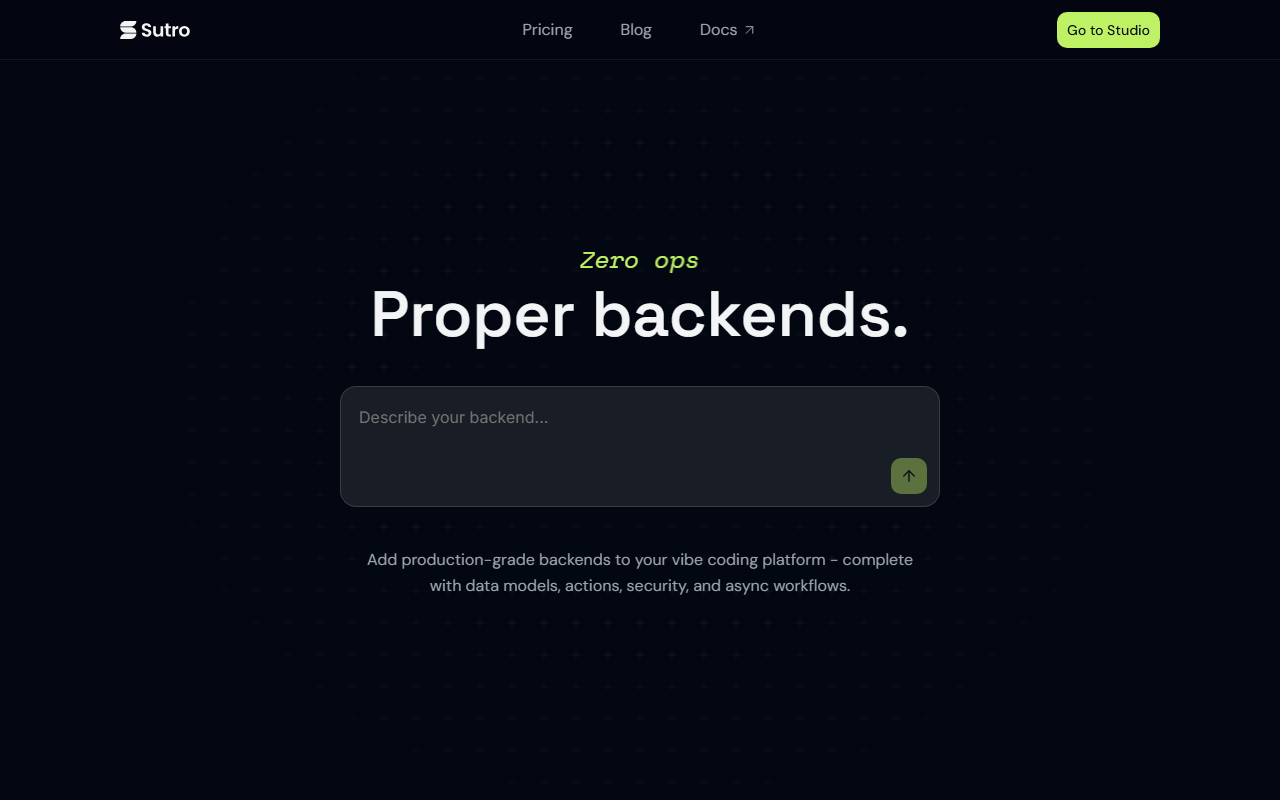
Upon visiting Sutro's site, the landing page immediately pitches "Zero infra, Proper backends" with a clean, developer-focused design. The navigation offers quick access to Studio, Pricing, Blog, and Docs, but no sign-up wall greets you—just a prominent "Go to Studio" button. Clicking through lands you in what appears to be a cloud-based IDE, where you can start defining backends using Sutro's custom language, SLang. The interface feels minimal but purposeful: a code editor on the left, a preview or output pane on the right, and a toolbar for compiling definitions. I tested the free tier by writing a simple data model for a user entity with authentication rules. The compiler accepted the input and generated an API schema and SQL migration almost instantly—no manual configuration required. The onboarding flow is brief: a short "Getting Started" guide appears, but most learning happens through the Docs page, which is well-organized.
Core Features and SLang
Sutro's value proposition revolves around eliminating backend boilerplate for "vibe coding" platforms—AI-powered app generators that need production-grade backends without manual infrastructure setup. The heart of the tool is SLang, a domain-specific language for concisely defining data models, authentication rules, actions, and documentation. Entities describe domain structure and relationships, which Sutro compiles into schemas, APIs, validation logic, and internal wiring. I defined a simple "Project" entity with fields for name and owner, and attached auth rules that only allow authenticated users to read their own projects. The language felt intuitive: keywords like entity, auth, and action map directly to backend behavior. Actions encapsulate logic—like sending a notification or processing a payment—without forcing you to write validation or retry glue. Sutro also promises "documentation that doesn't drift" by embedding descriptions inside the backend definition, keeping docs in sync with code. This is a significant improvement over traditional frameworks where schema and API docs often diverge after refactoring. The tool compiles into a deployable backend (likely serverless functions and a database), though the exact runtime stack is not detailed on the site.
Pricing, Positioning, and Verdict
Pricing is not publicly listed on the website. The only call-to-action is "Go to Studio," which suggests a free tier or trial is available, but detailed tiers—including token or request limits—are absent. For context, competitors like Supabase and AWS Amplify offer similar backend-as-a-service capabilities but require more manual configuration. Unlike these, Sutro focuses on the specific workflow of AI-generated apps, where a prompt outputs a full backend definition. The team claims over 20 years of combined experience on code-generation engines, lending some authority. However, the documentation does not specify which underlying models or infrastructure Sutro uses under the hood. Key strengths: Sutro dramatically reduces token costs for AI-driven code generation by cutting boilerplate, and its security model enforces permissions at the domain level rather than per endpoint. A notable limitation is vendor lock‑in—migrating away from Sutro would require rewriting generated backends in another framework. Additionally, complex custom logic may be constrained by the declarative nature of SLang. This tool is best suited for startup teams building AI code generators or "vibe coding" platforms that need rapid, secure backends. Traditional developers who prefer fine-grained control over every layer should look elsewhere. Overall, Sutro fills a genuine gap for AI-first backend development, but its closed ecosystem demands careful consideration.
Visit Sutro at https://withsutro.com/ to explore it yourself.













Comments