

First Impressions and Onboarding
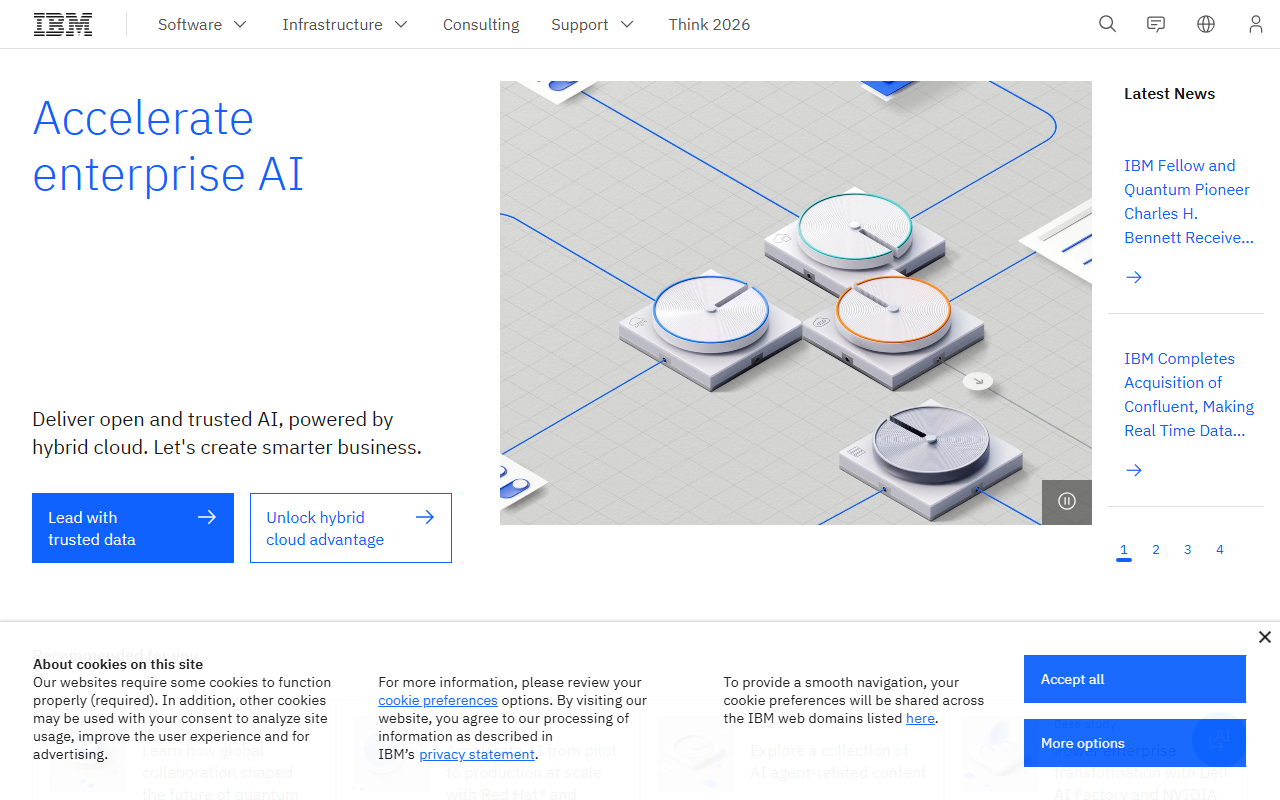
Upon visiting the IBM website, I immediately saw a prominent banner for IBM Bob, described as an SDLC partner that moves beyond code generation. The site positions this as an enterprise-grade tool, with case studies from Ferrari, US Open, and Pfizer. The dashboard is not a typical developer tool interface; instead, IBM presents Bob within a broader ecosystem of AI productivity, data management, and hybrid cloud. The onboarding flow appears to be consultative—IBM emphasizes partnering with enterprises rather than self-serve sign-ups. When I explored the free tier, there is no public option for individual developers. The site directs users to register for a webinar or contact sales. This signals that IBM Bob is tailored for organizations with existing IBM relationships.
Core Capabilities and Technology
IBM Bob is an AI development partner that covers the full software development lifecycle. Unlike single-purpose code generators, Bob aims to take teams from AI-assisted coding to production-ready software. The underlying technology likely leverages IBM's watsonx platform, which includes foundation models optimized for enterprise use. The website highlights 15,000 AI agents proposed by employees during the 2025 watsonx Challenge, indicating a strong agentic AI direction. Key capabilities include code generation, automation, testing, and security detection integrated directly into the SDLC. IBM also offers a range of enterprise technology: AI models, analytics, data management, security, and hybrid infrastructure. Bob is not a standalone product but a component of IBM's comprehensive AI framework. During my review, I noticed that the technical details are sparse—no mention of specific models or benchmarks. The focus is more on business outcomes like productivity gains (USD 4.5 billion unlocked) and user engagement increases (2x daily active users for Ferrari).
Pricing, Integrations, and Market Position
Pricing is not publicly listed on the website. IBM typically uses custom enterprise pricing based on usage and support level. This contrasts with competitors like GitHub Copilot, which offers a flat per-user fee, or Amazon CodeWhisperer, which has a free tier for individuals. IBM Bob positions itself at the high end, targeting large enterprises that need security, governance, and integration with existing IBM Cloud and consulting services. For context, alternatives include GitHub Copilot (for individual developers), Replit AI (for rapid prototyping), and Google's Vertex AI Agent Builder (for custom agents). IBM's strength lies in its holistic approach: Bob integrates with watsonx, hybrid cloud management, and IBM Consulting. However, for startups or solo developers, this is overkill and inaccessible. The tool is best suited for enterprises already using IBM infrastructure or seeking a trusted partner for AI transformation. Organizations looking for a low-cost or open-source alternative should look elsewhere.
Strengths and Limitations
The genuine strength of IBM Bob is its enterprise readiness. It combines AI-assisted development with strong data governance, security, and compliance—critical for regulated industries like finance and healthcare. The case studies show measurable impact: Ferrari saw a 35% increase in time spent in-app after revamping their app with IBM Consulting and AI. Another strength is the agentic focus: Bob goes beyond code completions to propose AI agents that can automate workflows. However, a real limitation is the lack of transparency. The website does not share technical specifics on the AI model, its training data, or how it compares on coding benchmarks. Additionally, the reliance on IBM Consulting and custom pricing makes it impractical for small teams. There is no self-service trial or developer sandbox. For a company evaluating AI tools, the inability to test before purchasing is a barrier. IBM Bob is clearly designed for large enterprises with dedicated budgets and existing IBM relationships.
To summarize: IBM Bob is a powerful enterprise AI development partner, but its value proposition only materializes if you can afford the full IBM ecosystem. I recommend it to CIOs and technical leaders in large organizations who want a unified approach to AI development, governance, and deployment. For everyone else, start with a more accessible tool like GitHub Copilot or Replit and scale up later.
Visit IBM at https://www-01.ibm.com/ to explore it yourself.













Comments