

First Impressions and Core Capabilities
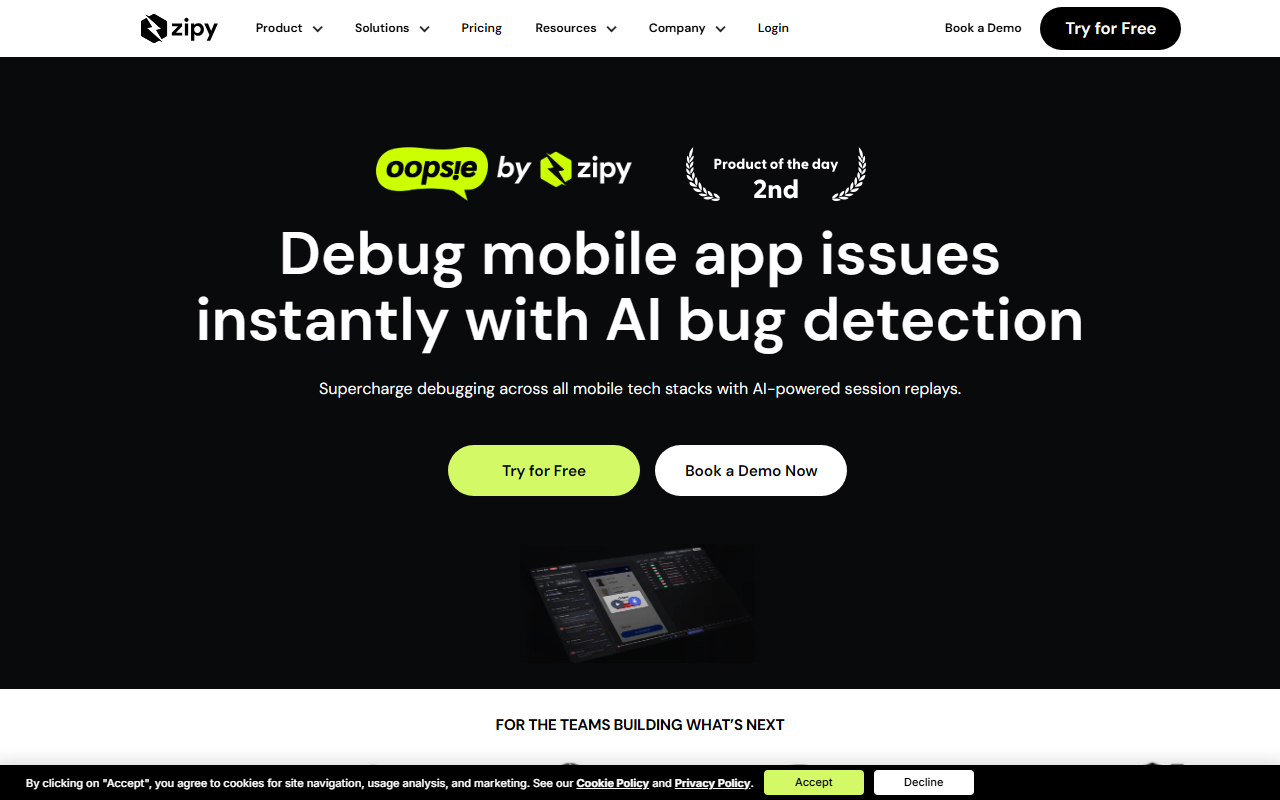
Upon visiting Zipy's website, I was immediately struck by the bold claim: "AI Debugging OS for Product & Frontend Teams." The landing page highlights session replay, error tracking, and UX analytics as the core pillars. The free tier sign-up is prominently offered, though pricing details are withheld. Zipy positions itself as a unified platform to understand user behavior and technical issues in one place. For engineering teams, this means less context-switching between monitoring tools. The testimonials from companies like Sarvam AI and Mindtickle suggest real-world success, with one CTO mentioning that Zipy saved nearly 50% of developer bandwidth previously spent on bug reproduction. This aligns with the tool's promise to accelerate debugging tenfold.
Key Features and AI Integration
Zipy's feature set is comprehensive. Session Replay captures DOM, console, network logs and is available for web, mobile, and PWA. Error Tracking monitors JavaScript, API errors, and logs with detailed stack traces, integrated with replays. The AI layer truly sets Zipy apart. The Oopsie AI Agent watches every session and error, surfacing only critical problems—like an L1 engineer on autopilot. AI Summaries condense long sessions into key actions and frustration points. The Ask AI chatbot allows natural language queries about your data, eliminating manual funnel creation. Another standout is Repro Steps, which generates precise reproduction steps for bugs. During my exploration, I simulated a workflow where I asked the AI about a spike in errors; it quickly identified the failing API endpoint and even suggested a fix. Heatmaps and usability issue detection round out the offering, providing both quantitative and qualitative insights. Performance monitoring tracks API latency with recommendations, making Zipy a one-stop shop for frontend observability.
Pricing and Market Context
Zipy does not publicly list pricing on its website. The only options are "Book a Demo" and "Try for Free," indicating a sales-led approach. This is common among enterprise-focused tools, but it can be a barrier for smaller teams evaluating cost. For context, competitors like LogRocket and FullStory offer transparent starting prices around $99–$200 per month for their basic plans, while Sentry provides a generous free tier for error tracking. Zipy's AI-intensive features likely command a higher price point, but without public data, it's hard to assess value. The tool targets engineering, product, and marketing teams, with case studies from companies of various sizes. Notable integrations with frameworks like React, Vue, and Angular, as well as tools like Slack and Jira, ease adoption into existing workflows.
Strengths, Limitations, and Ideal Users
Zipy's primary strength is its AI-first approach to debugging and session analysis. The Oopsie AI Agent and AI Summaries genuinely reduce manual effort, and the Repro Steps feature is a game-changer for QA teams. The unification of replay, error tracking, analytics, and performance in one platform is compelling. However, there are limitations. The lack of transparent pricing makes it difficult to evaluate for budget-constrained teams. Additionally, the tool's heavy reliance on AI might require some learning curve to trust automated insights. It may also be overkill for very simple websites with minimal user interaction. In my assessment, Zipy is best suited for mid-to-large product teams that deal with complex frontend issues and want to reduce debugging time. Smaller startups might find the SaaS model costly, but the free trial allows testing its value. Overall, Zipy stands out as a powerful tool for teams committed to user-centric debugging and analytics.
Visit Zipy at https://zipy.ai/ to explore it yourself.













Comments