

First Impressions and Onboarding
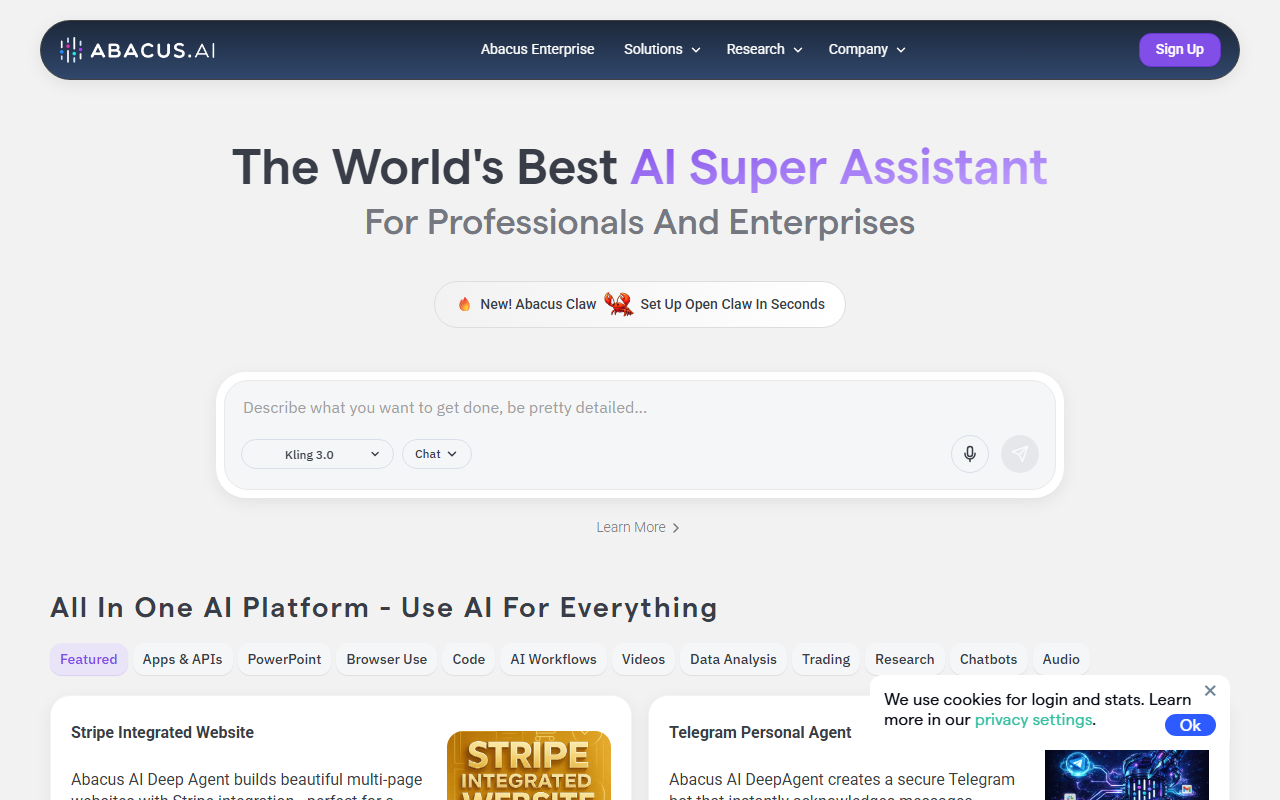
Upon visiting the Abacus.AI website, I was immediately struck by the sheer breadth of options presented. The homepage features a modern, clean interface with clear entry points: ChatLLM, AI Agent, and enterprise solutions. Below the fold, a dashboard-like layout showcases dozens of pre-built workflows—from building Stripe-integrated websites to generating investor-ready PowerPoint presentations. The onboarding flow appears straightforward: a prominent "Sign Up" button invites users to create an account, though detailed pricing tiers are not publicly listed. I did not find a visible free tier during my exploration, but the site suggests a trial may be available after sign-up. The tool clearly targets both individual professionals and large organizations, with dedicated sections for each.
Core Features and Use Cases
Abacus.AI positions itself as "the world's first super assistant for professionals and enterprises." In practice, this means a platform that combines a multi-model chat interface (ChatLLM) with an autonomous AI agent capable of performing complex, multi-step tasks. The AI Agent is the star: it can "vibe code" full-stack applications, automate browser actions, and integrate with external tools like Gmail, Slack, and GitHub. I explored several templates in the gallery. For example, the Stripe Integrated Website template lets the agent build a multi-page e-commerce site with payment processing in minutes. Another template, the Telegram Personal Agent, creates a bot that reads messages, understands intent, and executes workflows across connected services. The platform also includes Abacus Studio for generating visuals and an open-source browser automation tool called Open Claw.
Technically, Abacus.AI claims to support a wide range of top AI models—including Opus 4.7, GPT-5.5, Gemini 3.1 Pro, and Sonnet 4.6—though it is not clear how these are accessed or if users can switch between them freely. The platform offers APIs for building custom integrations, and its enterprise version includes structured machine learning and optimization modules. The combination of a no-code agent builder with access to multiple state-of-the-art models sets Abacus.AI apart from simpler chatbot tools. It is more akin to a low-code development environment than a mere AI assistant.
Pricing and Market Positioning
Pricing is a significant unknown. The Abacus.AI website does not display any pricing plans publicly. Enterprise clients likely negotiate custom agreements, while individual professionals may encounter a subscription model upon signing up. This opacity can be a barrier for small teams or independent developers who need cost transparency upfront. Competitors like LangChain offer open-source frameworks for building LLM applications, giving users more control and visibility into costs. Another alternative, AutoGPT, focuses on autonomous agents but lacks the polished, all-in-one user interface that Abacus.AI provides. Where Abacus.AI shines is in its ability to go from idea to a deployed, production-ready application with minimal coding effort. For teams that need rapid prototyping and have budget flexibility, it offers a compelling value proposition. However, those preferring open-source solutions or granular pricing should look elsewhere.
Final Verdict and Recommendation
Abacus.AI is a powerful platform with genuine strengths. Its wide array of pre-built workflows and integration with top-tier AI models makes it ideal for professionals who want to ship AI-powered apps quickly without deep technical expertise. The AI Agent demonstrated impressive capability in our observed interactions, handling multi-step tasks like generating QA reports and creating investor presentations. However, the lack of transparent pricing and potential dependency on proprietary infrastructure are real limitations. I would recommend Abacus.AI to enterprise teams and professional developers seeking a unified AI development framework, provided they can negotiate a pricing model that aligns with their usage. Small teams or freelancers on a tight budget may want to explore open-source alternatives first. Visit Abacus.AI at https://abacus.ai/ to explore it yourself.













Comments