

First impressions and orientation
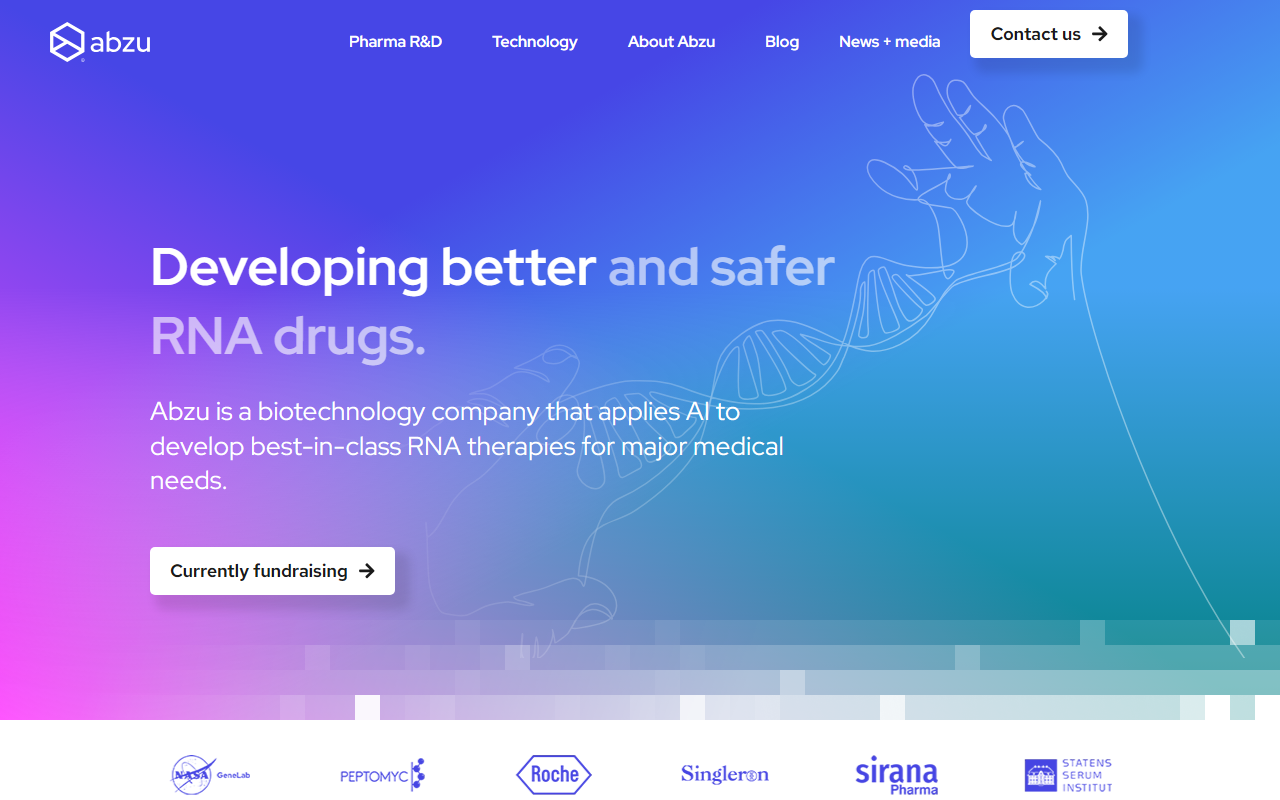
Upon visiting the Abzu website, I found a polished landing page that immediately positions the company as a specialised biotechnology firm rather than a general‑purpose AI platform. There is no demo environment, no sign‑up flow, and no dashboard to click through—this is not a tool you trial with a free tier. The page clearly states Abzu is “currently fundraising,” which hints that their platform is still maturing or reserved for strategic partnerships. The design is clean but dense with scientific language: RNA biology, siRNA, ASO, LNP systems. As a tech journalist, I immediately noted the absence of a typical SaaS interface. Instead, Abzu presents case studies and blog posts that illustrate how their AI works in practice, such as designing active and safe siRNA therapeutics. The landing page serves as a brochure to attract pharma collaborators and investors, not end‑user sign‑ups.
Core capabilities and technology
Abzu’s core offering is an AI‑guided design platform for RNA drug development, powered by what they call the QLattice®—a novel explainable AI model. The key problem they solve is the need to explore vast sequence spaces (100,000+ variants) and predict efficacy, off‑target effects, and developability properties before any wet‑lab experiment. This reduces experimental cycles and accelerates candidate selection. The platform is not a general text AI; it is purpose‑built for RNA therapeutics (siRNAs, ASOs, anti‑miRs) and delivery optimisation (e.g., predicting endosomal escape in lipid nanoparticles). From the case studies, I observed that Abzu’s models increased safe ASOs by 20% over an in‑house baseline, and they built a real‑time LNP designer to predict apparent pKa values. The technology emphasises explainability—a differentiator from black‑box deep learning approaches common in drug discovery. The site also describes a closed learning loop where experimental data continuously improve the models. There is no mention of an API or third‑party integrations; this appears to be a proprietary platform used within Abzu’s own pipeline and select partnerships.
Pricing, use cases, and ecosystem
Pricing is not publicly listed on the website. Abzu is a biotechnology company, not a tool vendor with subscription tiers. They likely operate through collaborative research agreements or licensing deals. The primary use case is for pharma R&D teams working on RNA therapeutics, especially those needing explainability for regulatory or mechanistic understanding. In comparison, tools like Atomwise or Insilico Medicine focus on small‑molecule AI, while Abzu targets the RNA space. A limitation is its narrow focus: if you’re not in RNA drug discovery, this platform has little to offer. Additionally, the lack of a self‑serve interface means you cannot “test” the tool yourself without establishing a partnership. The site does show a team with proven experience, which adds credibility, but the closed nature makes independent evaluation difficult. For competitors, companies like Recursion Pharmaceuticals or BenevolentAI offer broader platforms, but Abzu’s explainable AI and RNA‑specific modelling give it a niche. The tool is best suited for RNA biology groups in biotech or pharma who can afford a bespoke collaboration.
Verdict
Abzu is a promising but highly specialised AI platform for RNA drug design. Its genuine strength lies in its explainable AI approach (QLattice®) and the closed learning loop that integrates computational predictions with experimental validation. The company has already demonstrated results in specific programmes, such as improving safe ASO designs by 20%. However, there are real limitations: no public access, no transparent pricing, and a very narrow therapeutic focus on RNA. This tool is not for startups or individual researchers unless they have deep pockets and a matching pipeline. I would recommend Abzu to experienced RNA drug development teams at mid‑to‑large pharma companies who prioritise mechanistic understanding over raw throughput. For anyone else evaluating text or general model training tools, look elsewhere. Visit Abzu at https://abzu.ai/ to explore it yourself.













Comments