

What Is arXiv and How Does It Work?
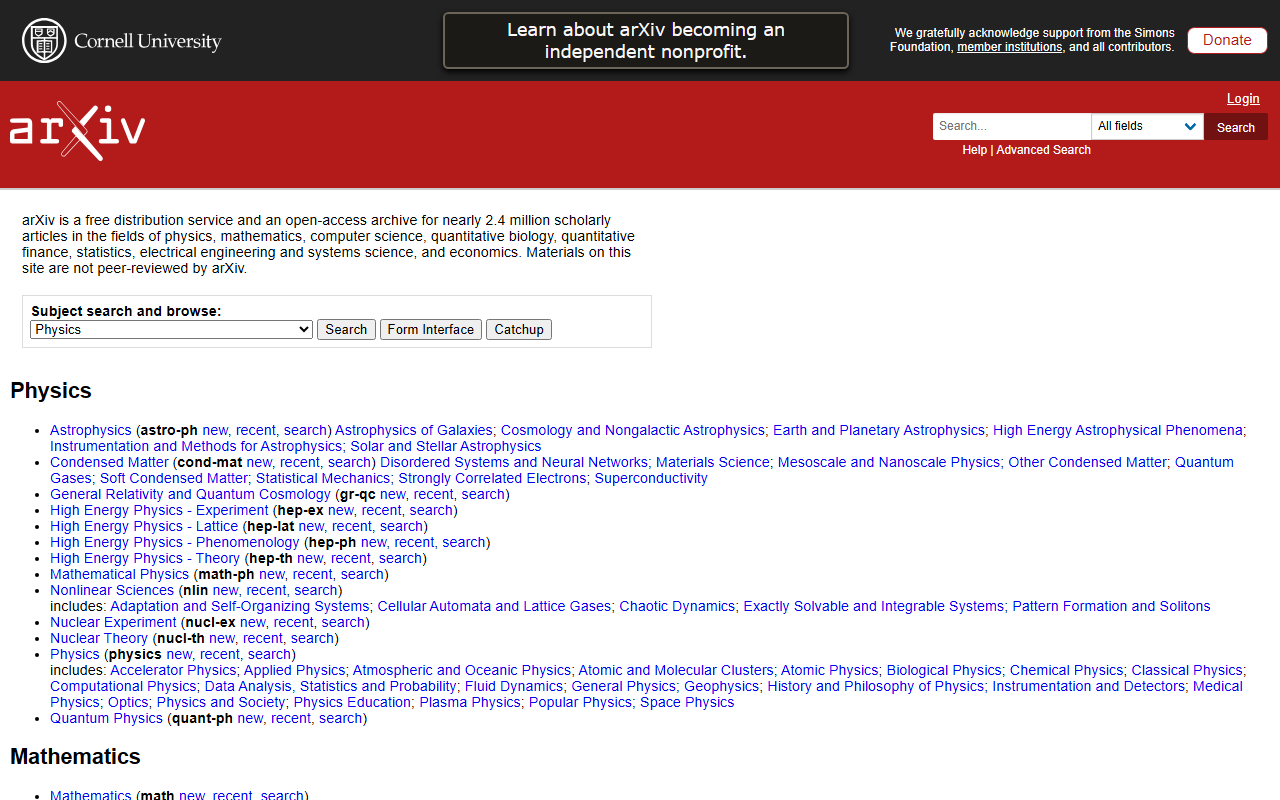
Upon visiting the arXiv website at https://arxiv.org/, you are greeted by a minimalist, text-heavy interface that prioritizes function over form. The homepage presents a simple search bar and a list of subject categories: Physics, Mathematics, Computer Science, Quantitative Biology, and more. The dashboard is essentially a portal to nearly 2.4 million scholarly articles, all freely accessible. As a researcher or enthusiast in AI, this is where you find the latest work on machine learning, natural language processing, and computer vision—often months before official publication.
arXiv is not an AI tool in the traditional sense—it does not generate text or analyze data. Instead, it is a distribution service and open-access archive. Materials on this site are not peer-reviewed by arXiv, which is a crucial point: you get the raw, unvetted research. That is both its strength and its limitation. When testing the free tier (there is no paid tier), I searched for "transformer" and instantly found over 10,000 results, neatly sorted by date. The advanced search options allow filtering by title, author, abstract, and more, making navigation straightforward.
Deep Dive: Features and Workflow
The core feature of arXiv is its comprehensive archive. It covers computer science disciplines including Artificial Intelligence, Machine Learning, Computer Vision, Computation and Language, and many more. The browse function lets you view new submissions, recent papers, or search within a specific subcategory. For example, under cs.LG (Machine Learning), you can see daily listings of new preprints. I clicked on “new” for cs.AI and saw a list of papers with titles, authors, and abstracts. Each paper links to multiple formats: PDF, HTML, and source files.
A notable workflow is the ability to subscribe to RSS feeds or email alerts for specific categories. This allows researchers to stay updated without checking the site daily. Additionally, arXiv provides an API for programmatic access, which many third-party aggregators and academic tools use to build custom reading lists. However, arXiv itself offers no reading assistance, summarization, or AI-powered annotation. The interface is purely archival. That said, its value lies in being the first point of discovery for cutting-edge research.
Pricing, Technology, and Integrations
arXiv is completely free for readers. There are no subscription tiers, no premium features. The service is supported by donations from institutions such as the Simons Foundation and member organizations. Pricing for submission is also free for authors from most institutions, though some memberships cover submission fees. This openness is a major advantage over paywalled repositories.
Technologically, arXiv is a straightforward database with search capabilities. It does not run on a large language model or any generative AI. If you are looking for AI tools to summarize or analyze papers, you would need to pair arXiv with external services like Scholarcy or Connected Papers. arXiv does offer an API (documented on its site) for automated downloads and metadata retrieval. Integrations are common through tools like Zotero and Mendeley, which can import arXiv papers directly.
Unlike commercial services such as Google Scholar or Semantic Scholar, arXiv is not a citation index; it is a preprint server. It does not provide citation counts, related article suggestions based on embeddings, or AI-curated feeds. Its technology is basic but robust for its purpose.
Who Should Use arXiv?
arXiv is indispensable for academic researchers, PhD students, and professionals in AI, physics, and mathematics. It is the quickest way to access the latest research without waiting for journal publication. However, it is not suitable for those seeking curated, peer-reviewed content or for casual readers who want summaries. General consumers looking for AI tools to help read papers might find arXiv overwhelming due to its sheer volume and lack of intelligent filtering.
Alternatives include Google Scholar (broader, but includes peer-reviewed and more context) and Semantic Scholar (AI-powered search and recommendations). arXiv’s main competitors are other preprint servers like bioRxiv, but for AI, arXiv is the dominant platform. A real limitation is the absence of any reading assistance—no built-in summarization, no key term extraction. You must read the PDFs yourself. Also, since submissions are not peer-reviewed, quality varies drastically, and there is no automated quality check beyond spam filtering.
For AI researchers, arXiv is essential. For anyone else, it is a raw resource that demands patience. If you are serious about staying current in AI, you need to use arXiv. My recommendation: start by subscribing to the cs.AI and cs.LG RSS feeds, and use a third-party tool like Arxiv Sanity or Papers With Code to enhance your reading experience.
Visit arXiv at https://arxiv.org/ to explore it yourself.











Comments