

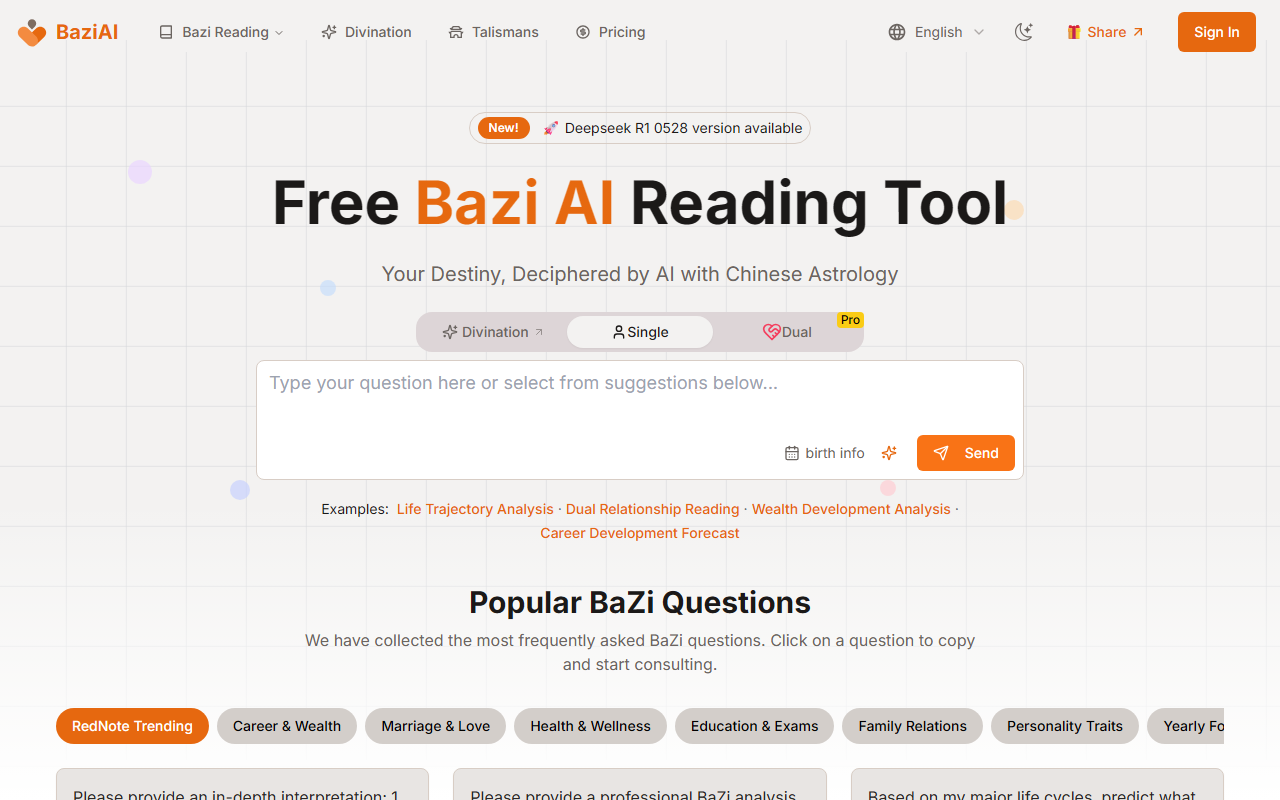
Getting Started with BaziAI: Interface and Onboarding
Upon visiting BaziAI, the landing page immediately presents a clean, modern interface with a prominent input area requesting birth information. The dashboard shows options for single, dual, or professional readings, and a “Send” button triggers the AI analysis. I tested the free tier by entering a sample birth date and time. The site then generated a detailed BaZi reading using the DeepSeek R1 model, including an ASCII-based energy distribution chart and luck cycle breakdown. The response was comprehensive but took about 15 seconds, which is reasonable for such a complex calculation.
Core Features and Technical Details
BaziAI leverages the DeepSeek R1 0528 model to analyze natal charts based on Chinese metaphysics. It offers over 30 dimensions of analysis covering career, relationships, health, and wealth. The platform provides pre-built prompts for common queries like career development, marriage prospects, and past life stories. Notably, it includes a “Historical Verification” feature where the AI attempts to match past events with predictions—a unique approach to validate accuracy. The tool also sells talisman wallpapers at $9.99 each, adding a spiritual commerce layer. Pricing is clearly listed: an AI Pro Monthly plan at $14.99/month (billed monthly) and a yearly plan at $99/year, both offering unlimited readings. The free tier allows basic queries but with limited depth.
Strengths and Limitations
Strengths: BaziAI stands out for its integration of a powerful open-source model (DeepSeek R1) with traditional BaZi principles, providing highly detailed and structured outputs—something most generic chatbots lack. The ASCII energy diagram and luck cycle tables are visually informative. The platform already claims over 500,000 users, indicating notable adoption. The pricing is competitive compared to human astrologers, and the free tier allows genuine testing.
Limitations: The accuracy of BaZi analysis inherently depends on the AI’s interpretation of ancient metaphysics, which may lack the intuition of a human expert. The tool occasionally produces contradictory advice when cross-validating different dimensions. Additionally, the talisman wallpapers feel like an upsell rather than a core feature. Unlike competitors such as Co-Star or The Pattern, which focus on psychological astrology, BaziAI is heavily rooted in Chinese cosmology, which may alienate Western users unfamiliar with terms like “Day Master” or “Ten Gods.” There is no API available for developers, limiting integration possibilities.
Recommendations and Final Verdict
BaziAI is best suited for individuals curious about Chinese astrology looking for an AI-powered, low-cost alternative to human readings. It’s also useful for practitioners who want quick chart calculations and historical verification. However, if you prefer a more humanistic or psychometric approach, tools like AstroMatrix or TimePassages might be better fits. I recommend trying the free tier first—especially the “Life Trajectory Analysis” prompt—to evaluate the depth of output. The yearly plan offers the best value for frequent users. Visit BaziAI at https://bazi-ai.com/ to explore it yourself.













Comments