

First Impressions and Onboarding
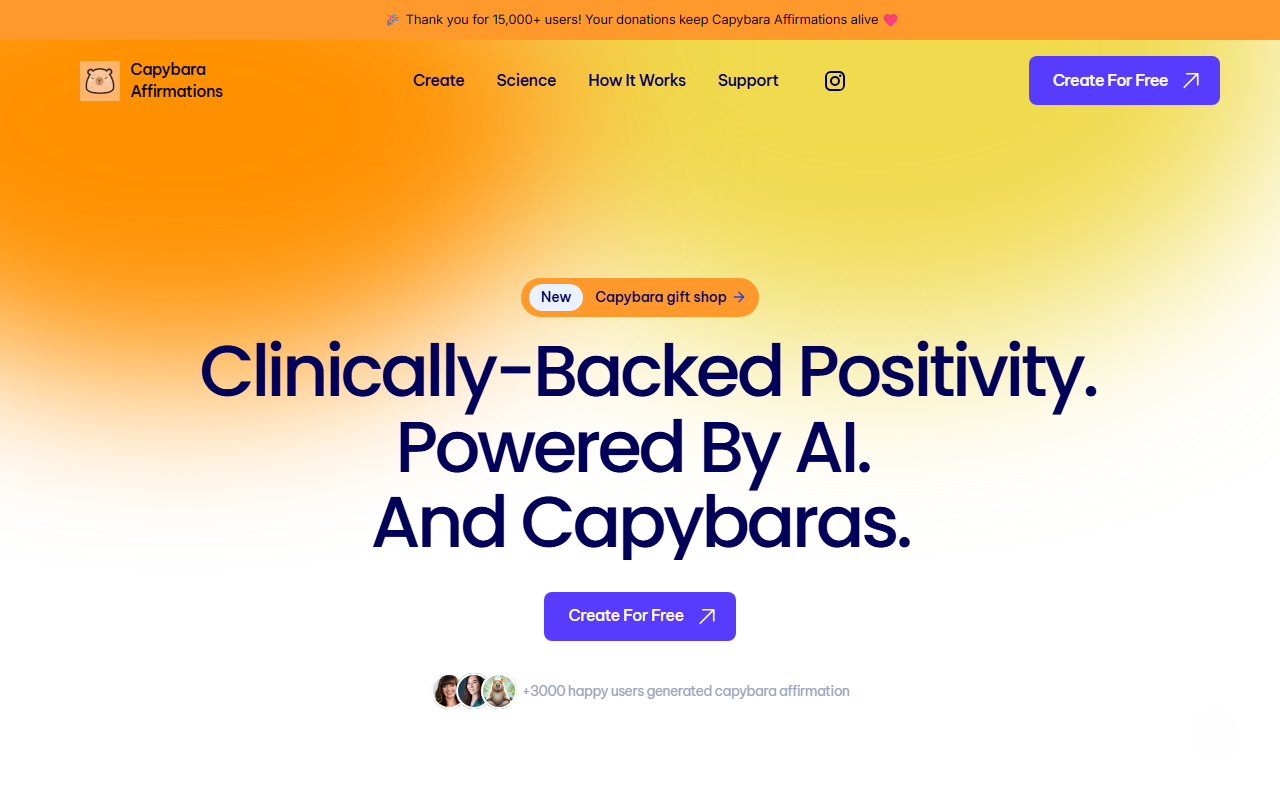
Upon visiting Capybara Affirmations AI, I was greeted by a cheerful capybara mascot and a bold claim: 15,000+ users and counting. The homepage is playful, with repeated calls to action like “Create For Free” and a confetti-like celebration of user milestones. The onboarding is nearly instant. I clicked the button, and a simple form appeared: “Select your concern” with options like “Stressed,” “Anxious,” or “Need a boost.” Within seconds, the AI generated a custom affirmation paired with a cute capybara illustration. There was no account required for the initial generation—just pick a mood, and the tool delivers. The response was a short, thoughtful phrase like “You are enough, just like a capybara by the river.” The capybara image was cartoonish and endearing, adding a layer of whimsy. For such a niche tool, the speed and ease of use were impressive.
Core Features and User Experience
Capybara Affirmations offers several features beyond basic affirmation generation. You can “talk to capybara,” which opens a simple chat interface where the AI responds in character as a capybara offering comfort. It’s not a deep conversational agent—answers are short and always positive. Another option creates custom phone wallpapers featuring your affirmation with a capybara background. You can also send affirmations to friends via a shareable link. The dashboard shows a gallery of previously generated affirmations, though it’s sparse. A newsletter signup promises twice-weekly affirmations in your inbox. The gift shop sells printed merchandise like mugs and tote bags, with a code “THANKYOU” for 15% off. Notably, the entire experience is free—there’s no subscription or paywall. The AI model is not disclosed, but given the quality and range, it likely uses a fine-tuned large language model, perhaps GPT-3.5 or similar, to match user-selected concerns with relevant affirmations. No API documentation or integrations are available.
The Science and Real-World Utility
The site repeatedly cites clinical trials showing affirmations reduce negative emotions and activate positive neural pathways. The twist is that Capybara Affirmations wraps this science in a gimmick: capybaras. The tool’s value is in lowering the barrier to daily positive self-talk. I found the affirmations genuinely upbeat without being saccharine, and the capybara imagery adds a memorable, shareable element. However, the tool is not a substitute for therapy or structured mental health practices. It’s more of a mood booster—like a digital greeting card. The “talk to capybara” feature is too simplistic for real emotional support; it just rephrases affirmations or says “I’m here for you.” The privacy policy is not prominently linked, which is a concern for any AI tool handling user emotions.
Pricing, Audience, and Final Verdict
Pricing is not publicly listed on the website. The primary revenue source appears to be the gift shop and optional donations. This is a positive: the core features remain accessible to anyone. For context, alternatives like “I Am” or “ThinkUp” offer more robust affirmation customization and habit tracking, but they lack the capybara charm and are often subscription-based. Capybara Affirmations AI is best suited for casual users who enjoy novelty and need a quick positivity fix. It is not intended for those seeking deep personal development or evidence-based mental health tools. Strengths include fast generation, free access, and high shareability. Limitations include a lack of transparency about AI models and privacy, and the feature set is shallow. Still, as a fun experiment in AI writing and emotional design, it delivers on its promise. If you love capybaras or want to send a whimsical affirmation to a friend, give it a try. Visit Capybara Affirmations AI at https://capybaraaffirmations.ai/ to explore it yourself.













Comments