
First Impressions and Onboarding
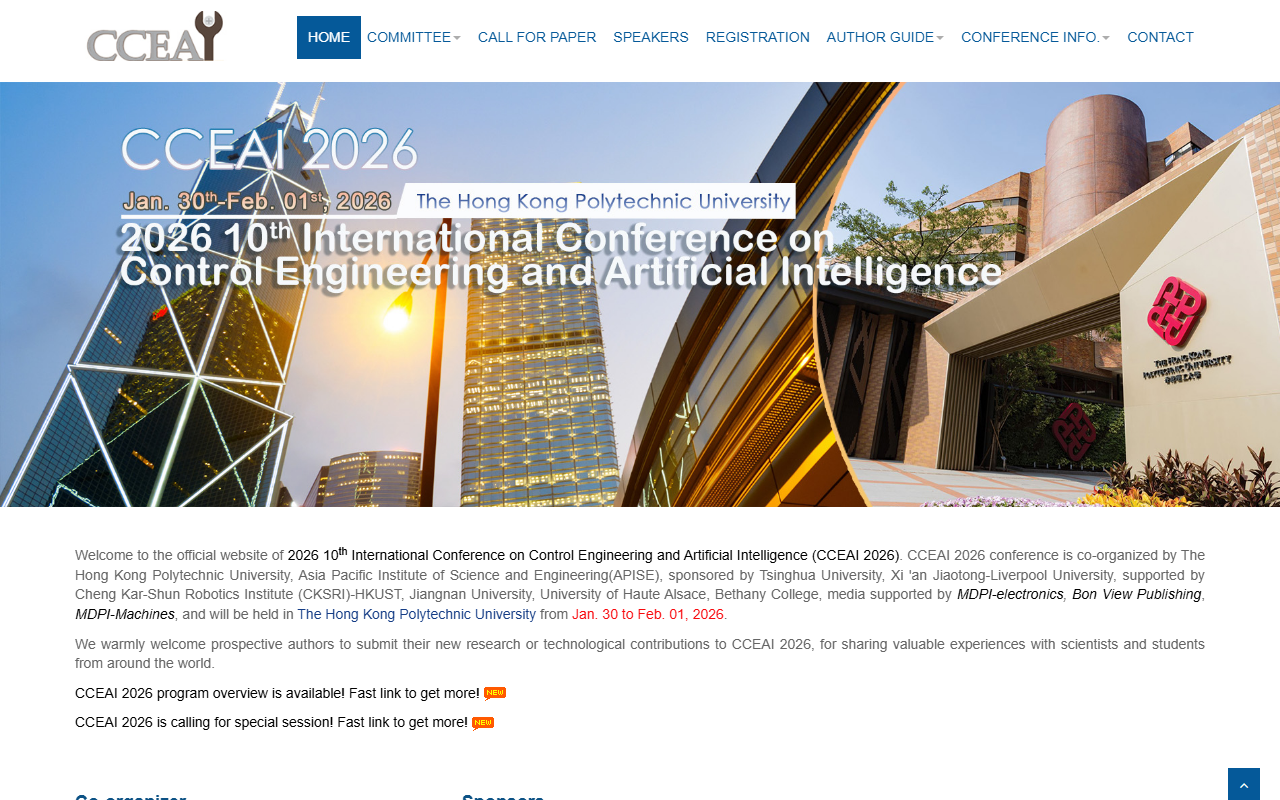
Upon visiting the CCEAI 2027 website, I was immediately struck by its clean, academic-focused layout. The main navigation includes tabs such as Committee, Call for Paper, Speakers, Registration, and Publication. This site is clearly a conference portal, not an interactive AI learning tool in the typical sense. The welcome banner proudly states the conference theme: “Self-governance, Integration and Trustworthiness — Shaping the Future of Next-Generation Intelligent Systems.” The homepage quickly introduces the organizer—Shanghai Jiao Tong University—and the technical sponsor, Asia Pacific Institute of Science and Engineering (APISE). For first-time users like me, the site offers a straightforward path: you can browse the call for papers, check important dates, and access the submission system via CMT. The onboarding is minimal, as the platform is designed for paper submission and event logistics rather than hands-on learning.
Understanding the Platform: Conference vs. Tool
CCEAI is categorised under “Text AI > Learning Platform,” but that label could mislead. This is not a software tool you install or a website where you practice AI skills interactively. Instead, it is an academic conference—the 11th International Conference on Control Engineering and Artificial Intelligence, scheduled for January 21–24, 2027. The “learning” comes from attending talks, workshops, and presenting research. The site hosts all necessary information for researchers: paper templates (Word and LaTeX), peer-review policy, publication history (proceedings indexed by EI Compendex and Scopus), and submission deadlines. Unlike many AI learning platforms such as Coursera or fast.ai, CCEAI does not offer tutorials, labs, or certifications. Its value lies in networking, peer feedback, and ensuring your work reaches reputable indexing databases.
Features and Value Proposition
Several features stand out for an academic audience. First, the publication track record: previous proceedings (2017–2025) are already indexed by EI and Scopus, giving authors confidence. The 2025 proceedings were published in ACM ICPS and are accessible online. Second, the peer review process is detailed: each submission goes to 2–3 independent reviewers, and the requirements stress English language, relevance, innovation, and no plagiarism. Third, the conference offers multiple participation modes—oral presentation, poster, and listener registration. There is also a call for patrons and exhibitors, making it attractive for industry sponsors. However, I noted one significant limitation: pricing is not publicly listed on the website. Registration fees are mentioned only in the “Registration” tab (which leads to a form), but no dollar amounts or tiers are shown. This lack of transparency may deter potential attendees who need budget approval. For context, competitors like the IEEE International Conference on Robotics and Automation (ICRA) or NeurIPS publish early-bird and regular rates prominently.
Who Should Attend and Final Verdict
CCEAI is best suited for academics, postgraduate students, and industry researchers working in control engineering, automation, or artificial intelligence. If you have ready research for publication and want it indexed in reputable databases, this conference is a solid venue. However, if you are a beginner looking for a learning platform with interactive exercises, videos, or a community forum, look elsewhere—try platforms like Kaggle or Elements of AI. The main strengths are the long indexing history and the reputable organisers. The main weaknesses are vague pricing and a website that is purely informational, with no hands-on AI tool. In conclusion, I recommend CCEAI for researchers aiming to publish and present at an established conference, but not for those seeking an educational AI tool with immediate feedback.
Visit CCEAI at https://cceai.org/ to explore it yourself.













Comments