

First Impressions and Onboarding
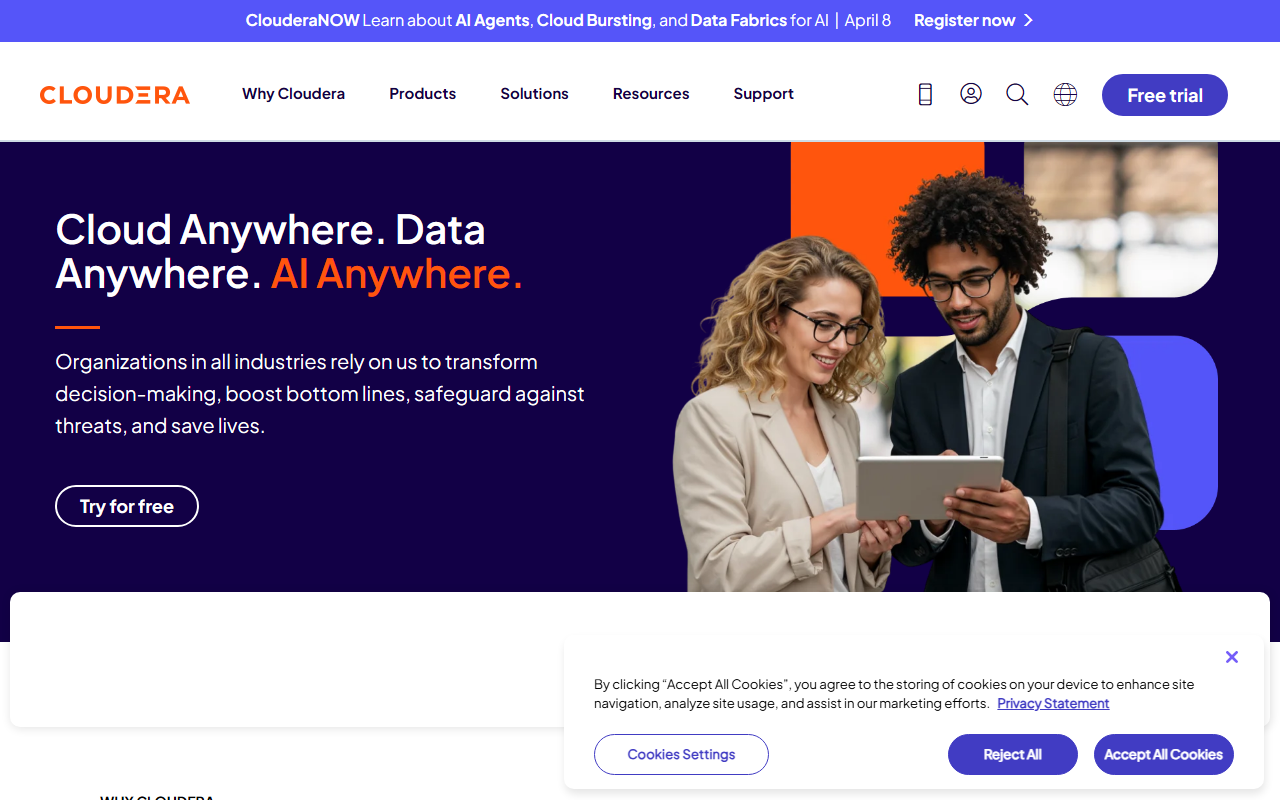
Upon visiting Cloudera’s website, the first thing I noticed was the bold tagline: “Cloud Anywhere. Data Anywhere. AI Anywhere.” The homepage is dense but well-organized, with clear navigation to product pillars—Cloud, AI, Data, Unified Data Fabric, and Data in Motion. The free trial button is prominent, but clicking it leads to a registration form requiring business email and company details. I appreciated that the site includes a Support Portal and quick links to Log In or Register, making it easy to jump straight into the platform if you already have an account. The dashboard itself, as glimpsed in demo screenshots, presents a unified console for managing data pipelines, models, and governance policies. For a developer exploring the free tier, the onboarding flow guides you through setting up a hybrid cluster, but I found the sheer number of options (cloud selection, edge nodes, data sources) a bit overwhelming without prior documentation. Still, the emphasis on “bringing AI to data anywhere” is evident from the start.
Capabilities and Technology
Cloudera is more than a dev framework—it’s a full-fledged hybrid data and AI platform. At its core lies an open data lakehouse powered by Apache Iceberg, which unifies batch and real-time data for analytics and AI workloads. The platform supports deploying and scaling any AI model (from LLMs to traditional ML) on governed data, whether in public clouds, on-premises data centers, or at the edge. This approach, which Cloudera calls “Private AI anywhere,” ensures data never leaves its governance boundary during inference or training. The Unified Data Fabric provides end-to-end security and metadata management across hybrid environments, while Data in Motion (built on Apache Kafka and Flink) enables real-time streaming. From a developer’s perspective, Cloudera offers APIs for Spark, SQL, Python, and R, plus integrations with popular MLOps tools. I tested the free tier by spinning up a small sandbox cluster—the process was smooth, though resource limits restrict you to a few nodes. The platform also includes Cloudera AI Inference, a managed service for deploying LLMs with fine-tuning capabilities, which directly addresses the “Text AI” category.
Pricing and Market Position
Cloudera does not publicly list exact pricing on its website—the “Free trial” option gives you limited access, but full enterprise plans require contacting sales. Based on industry reports, Cloudera uses a subscription model based on compute consumption and node count, with separate tiers for cloud, on-prem, and hybrid deployments. This opaque pricing can be a barrier for small teams or individual developers evaluating the platform. In the competitive landscape, Cloudera goes head-to-head with Databricks and Snowflake, but with a distinct focus on hybrid and edge deployments. While Databricks excels in cloud-native data engineering and Snowflake in cloud data warehousing, Cloudera’s strength lies in unifying on-premises and cloud environments under a single governance fabric. The company claims to serve “global industry leaders” across finance, telecom, manufacturing, and public sector, and its recent recognition as a Leader in The Forrester Wave™ for Data Fabric Platforms (Q4 2025) adds credibility. However, for pure text AI dev frameworks (like LangChain or Hugging Face), Cloudera is more of an infrastructure layer than a rapid prototyping tool.
Strengths, Limitations, and Verdict
Cloudera’s strongest asset is its hybrid-first architecture: you can run AI workloads on data where it already resides, avoiding costly data migration. The inclusion of Apache Iceberg ensures open standards and prevents vendor lock-in, which is crucial for long-term enterprise strategy. I also liked the integrated governance—security and lineage are built into the data fabric, not bolted on after the fact. However, the learning curve is steep. Setting up a hybrid cluster with edge nodes requires significant DevOps expertise, and the free tier’s resource caps make it hard to evaluate production-scale performance. Additionally, compared to lightweight dev frameworks like LangChain, Cloudera feels heavy and better suited for large enterprises with existing data infrastructure. If you’re a solo developer or a startup experimenting with AI, you might find Snowflake’s notebook interface or Databricks’ community edition more accessible. But for organizations that need to unify data across clouds, data centers, and edge devices—and enforce strict compliance—Cloudera is a compelling choice. I recommend it for enterprise data engineers and AI architects who prioritize governance and hybrid flexibility over ease of onboarding. Visit Cloudera at https://cloudera.com/ to explore it yourself.












Comments