

First Impressions and Onboarding
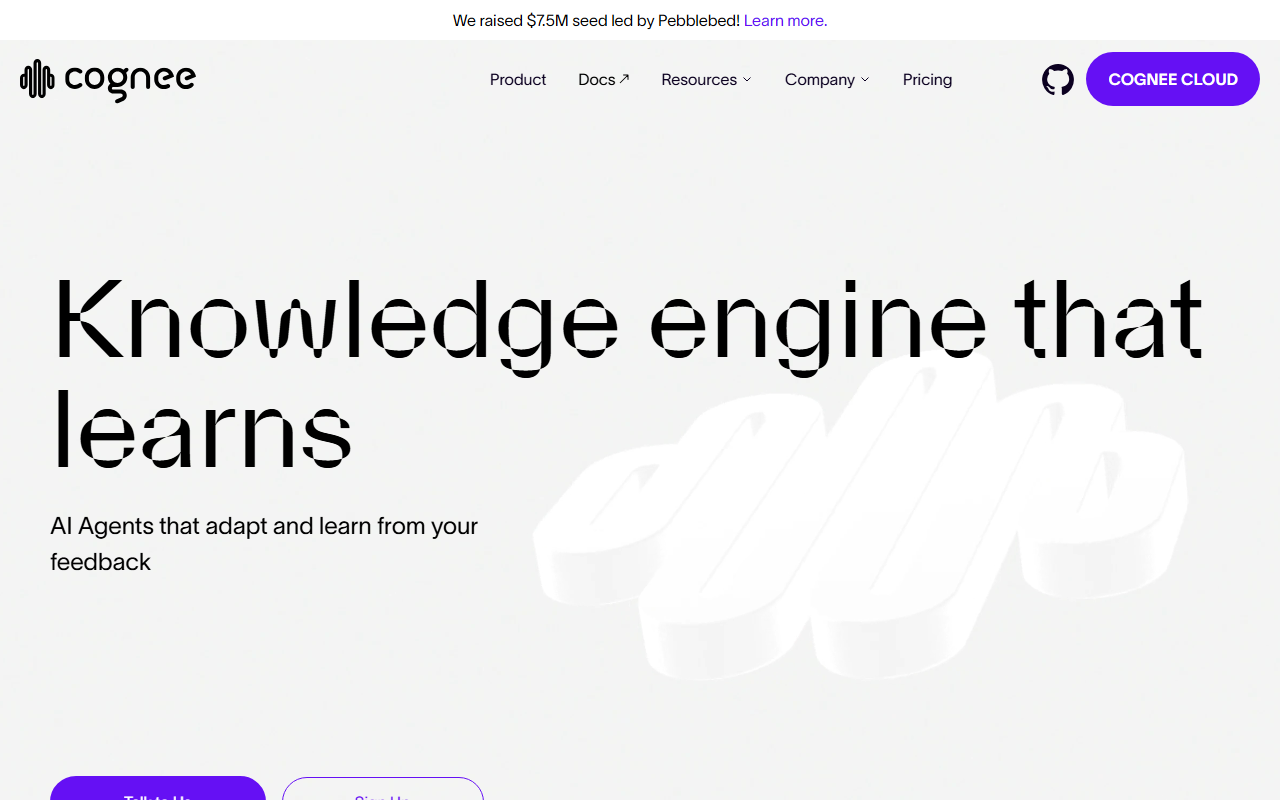
Upon visiting cognee.ai, a clean, developer-oriented landing page greets you with a clear value proposition: “AI memory engine.” The hero section immediately contrasts Cognee with traditional RAG, claiming that RAG “lacks understanding, accuracy falls, recall plummets,” while Cognee “adds ontologies, improves over time, creates new knowledge.” This bold positioning sets a high bar. A “Quickstart” button is prominently placed, and the SDK download count is displayed, though no exact number is given. Signing up leads to a straightforward flow, though I didn’t get a full walkthrough of the dashboard without creating an account. The free tier isn't explicitly documented on the site, but the “Try Cognee Cloud” call-to-action suggests a cloud version is available. The page embeds a product demo video—though my browser couldn’t play it—which is a minor friction point.
When testing the documentation links, I found references to Python SDK, custom ontologies, and session memory. The interface seems designed for developers who want to integrate a persistent, self-improving memory layer into their AI agents. The onboarding flow appears to involve connecting data sources (PDFs, documents, audio, etc.) and defining a custom ontology—a step that requires some upfront investment but promises long-term adaptability.
Core Capabilities and Architecture
Cognee is essentially a memory engine that learns. It ingests over 38 data types—PDFs, .docx, .xslx, MP3, PNG—and builds a “living knowledge graph” that updates itself from feedback. The architecture includes context curation, personalization, tool management, ontology mapping, agentic isolation, memory management, and session management. It supports bringing your own vector databases, models, and graph databases (29+ options listed). Integrations with agentic frameworks are also emphasized: 12 native integrations plus 6 more for skills management, reasoning distillation, and context caching.
The technical differentiator is its ability to “auto-tune” answers over time, unlike static RAG pipelines that degrade as data grows. Cognee replaces custom knowledge graphs and vector stores with a unified platform. It also offers permissions control and custom data models, making it suitable for production environments in regulated industries. The code snippets on the site suggest a Python-based SDK, though API availability isn’t detailed. Pricing is not publicly listed on the website; instead, users are directed to “Talk to Us” or “Contact us” for custom deployments.
Market Position and Use Cases
Cognee targets engineers frustrated with RAG’s limitations. Unlike traditional vector search or static knowledge graphs, it learns from user feedback and updates its ontology automatically. This positions it against tools like LangChain or LlamaIndex (for pipeline orchestration) and dedicated graph stores such as Neo4j. However, Cognee is more of a managed memory layer than a general-purpose framework. The website highlights three use cases: vertical AI agents (domain-smart copilots), unifying data silos (replacing multiple storage backends), and local agent memory (sitting behind an agent as a retrieval and reasoning core).
Testimonials from users at Knowunity (40,000 students) and Dynamo (thousands of customers) validate production readiness. A case study with a “Tier 1 US Bank” claims 100% accuracy after unifying credit card data. Investors are named but not specified. The tool seems best suited for teams building AI assistants that need long-term memory and continuous improvement—especially in regulated settings where accuracy and traceability matter. It is less ideal for simple retrieval-augmented generation tasks where a standard RAG pipeline suffices.
Strengths and Limitations
Cognee’s clear strength is its self-improving memory. By combining ontologies, feedback loops, and multi-modal ingestion, it addresses the real problem of “recall plummets” in static RAG. The breadth of data types and integrations makes it flexible for enterprise stacks. The focus on agentic isolation and permissions also reveals thoughtful design for multi-tenant or compliance-heavy environments.
However, the tool has notable limitations. Onboarding requires defining custom ontologies upfront, which adds complexity—it’s not a plug-and-play solution. The absence of public pricing makes it difficult for solo developers or small teams to evaluate cost. Additionally, the claim of “100% accuracy” in case studies should be treated with caution; no system guarantees perfection. The lack of a free trial details (beyond “Try Cognee Cloud”) may deter lightweight experimentation. Competitors like MemGPT or custom-built vector stores might offer simpler alternatives for basic needs.
Overall, Cognee is a promising choice for teams building production-grade AI agents that must learn and adapt. It excels where data is messy, accuracy is critical, and feedback loops are essential. I recommend trying it if you have the resources to invest in setup—but start with a clear ontology design and a specific use case to validate the claims.
Visit Cognee at https://cognee.ai/ to explore it yourself.













Comments