

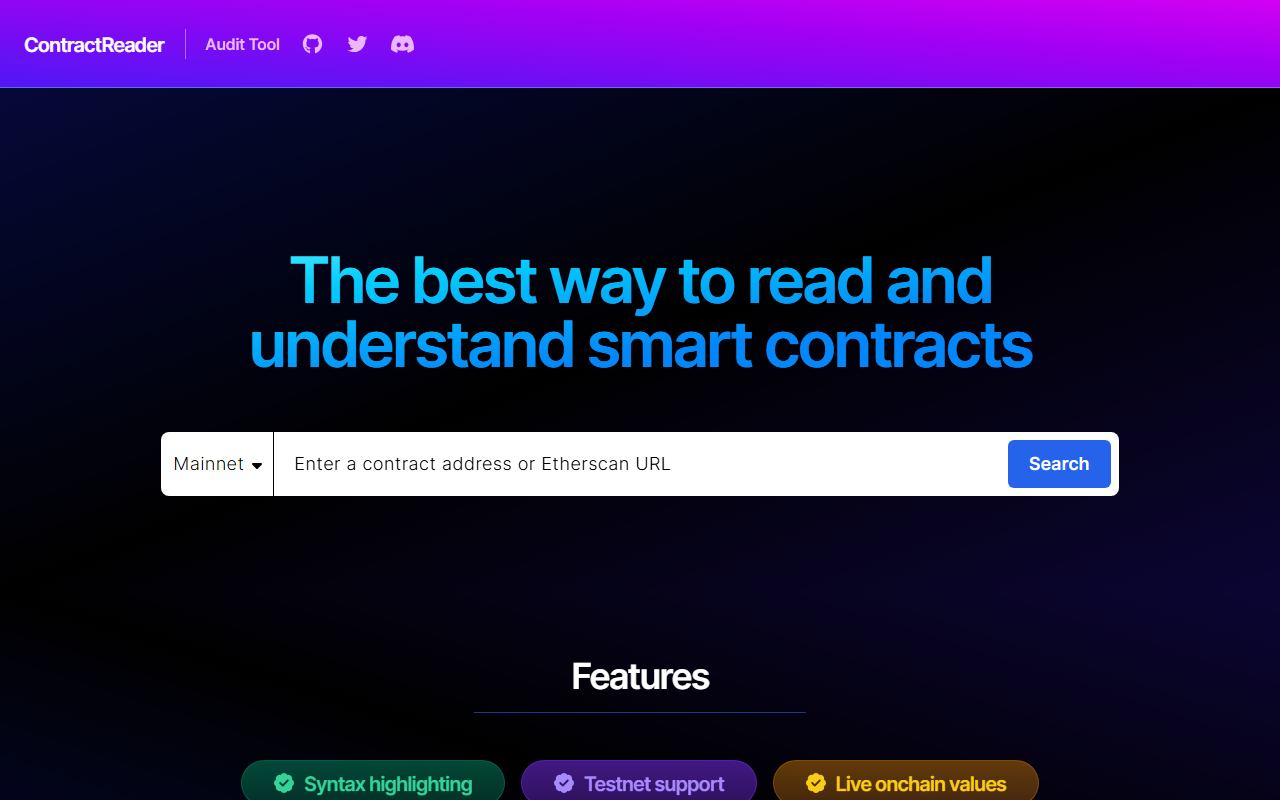
First Impressions and Onboarding
Upon visiting ContractReader.io, I was greeted by a minimalist landing page with a single search field and the tagline “The best way to read and understand smart contracts.” No sign-up, no paywall — just an input box asking for a contract address or Etherscan URL. I entered the address for the WETH9 contract, one of the sample contracts listed on the homepage. Within seconds, the page transformed into a code viewer with syntax highlighting, line numbers, and a sidebar showing live onchain values like total supply, name, symbol, and decimals. The onboarding is frictionless: no account creation, no API key required. For a tool that aims to demystify smart contracts, this zero-barrier entry is a strong first impression.
The two co-founders, Backseats and Plaid Shaman, are mentioned at the bottom of the page with brief bios. Backseats has been in crypto since 2013 and is a Solidity developer; Plaid Shaman focuses on UI/UX. This background explains the tool’s developer-friendly yet polished interface. The tool is clearly built for Ethereum Virtual Machine (EVM) chains, supporting Mainnet, Sepolia, OP Mainnet, Polygon, Arbitrum One, BNB Smart Chain, and Base. That list covers most major EVM networks, making it versatile for multi-chain dApp explorers.
Core Features and Workflow
When I tested the Terraforms Smart Contract, I immediately noticed the syntax highlighting — a feature many blockchain explorers lack. Variables are color-coded, and functions are collapsible. The “Live onchain values” panel on the right refreshes automatically when you select a different network; I switched from Ethereum Mainnet to Base, and the contract address resolved in the new chain’s state. The “Compare code in-browser” feature lets you open two contracts side-by-side — useful for verifying proxy patterns or forking audits. I tried comparing the NounsToken contract with a fork of it on Sepolia; the diff view highlighted differences in constructor arguments and admin addresses.
Testnet support is another standout. Most contract readers either ignore testnets or bury them in settings. ContractReader has a dropdown at the top that lets you switch between supported testnets (Sepolia, OP Sepolia, etc.) instantly. This is a boon for developers testing deployments before mainnet. The tool also injects live values directly into the code — for example, hovering over a state variable shows its current on-chain value, not just the storage slot. This is similar to what you get with Tenderly’s debugger, but ContractReader does it without requiring an account or uploading ABIs.
Supported Networks and Use Cases
ContractReader currently supports seven networks: Ethereum Mainnet, Sepolia, OP Mainnet, Polygon, Arbitrum One, BNB Smart Chain, and Base. Notably absent are Avalanche C-Chain or Fantom, but the team may expand. For most EVM developers and auditors, this coverage is sufficient. The tool is particularly useful when you need to quickly verify a contract’s source code without navigating Etherscan’s cluttered interface. Since it pulls data directly from the blockchain (and from verified source submissions on Etherscan), there’s no dependency on a centralized database — a trust-minimized approach.
I also experimented with the “Try with our favorite contracts” list: Checks, Terraforms, NounsToken, WETH9, and DelegationRegistry. Clicking any of these instantly loads the contract, demonstrating the tool’s speed. The absence of any loading spinner or delay suggests the backend is efficiently caching popular contracts. For a free tool (I could find no pricing page), performance is impressive. However, there are limitations: ContractReader does not parse bytecode source code if the contract is unverified, and it offers no deep security analysis (reentrancy checks, gas optimization suggestions, etc.). It is a reader, not an auditor. For advanced users, tools like Mythril or Slither are still necessary.
Strengths, Limitations, and Recommendations
ContractReader’s biggest strength is its simplicity. It strips away the noise of Etherscan’s transaction list and token transfers to focus purely on the source code and its live state. The syntax highlighting and inline variable resolution make it easier to follow complex smart contracts. Another strength is the cross-network portability; switching chains is seamless, and testnet support is robust.
On the downside, pricing is not publicly listed on the website. There’s no indication whether the tool will remain free or introduce paid tiers. The team’s backgrounds suggest they’re building for the community, but sustainability is unclear. Additionally, the tool only works with verified contracts — if a contract hasn’t been verified on Etherscan, ContractReader cannot display it. Lastly, it lacks integration with popular developer tools like Hardhat or Foundry; you can’t paste a local contract for analysis.
Compared to alternatives like Etherscan’s contract reader or Dedaub’s Decompiler, ContractReader feels more modern and developer-focused. Etherscan’s interface is cluttered with ads and extraneous tabs; Dedaub specializes in decompiling unverified contracts. ContractReader fits a middle ground: best for developers and auditors who need a quick, clean read of verified contracts across multiple EVM chains. If you are a Solidity developer, an auditor reviewing code on multiple networks, or a crypto investor wanting to understand a token contract before interacting, this tool is worth bookmarking. For those needing decompilation or paid support, look elsewhere. Visit ContractReader at https://contractreader.io/ to explore it yourself.













Comments