
First Impressions and Site Navigation
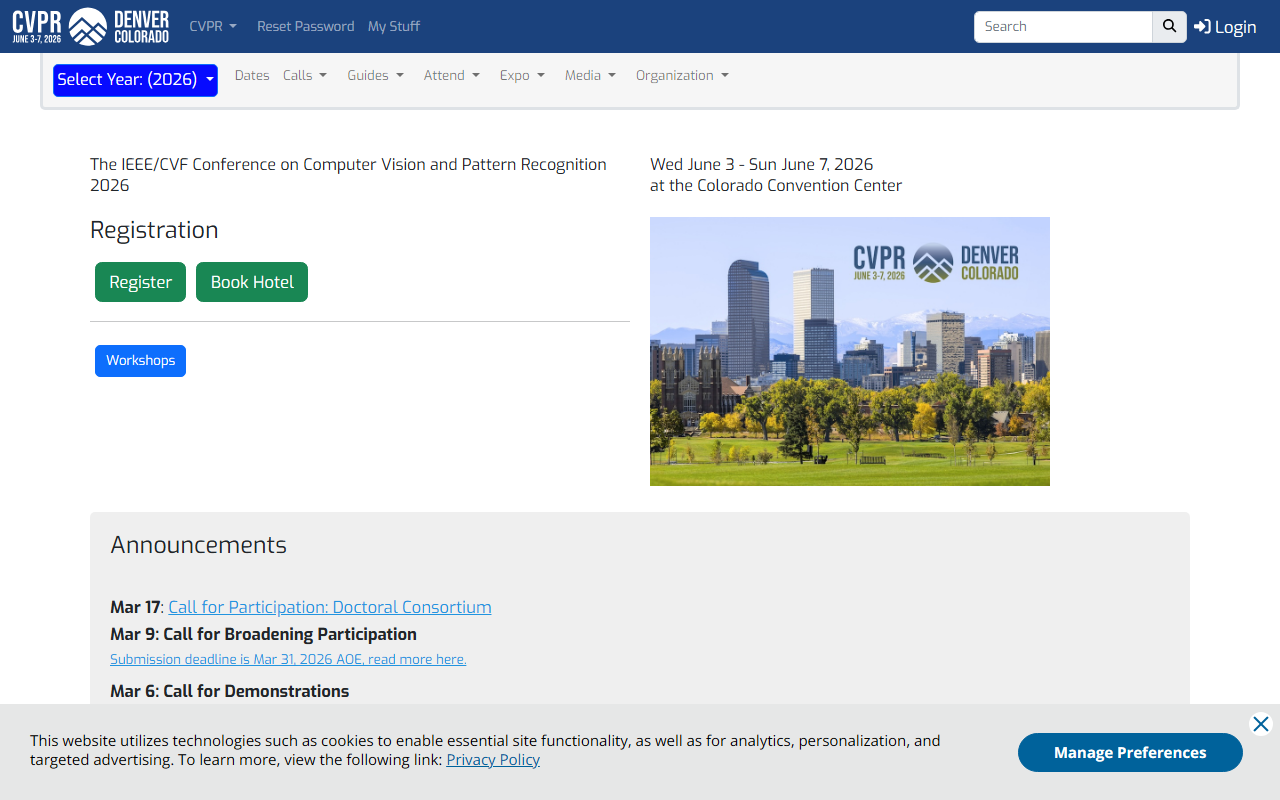
Upon visiting cvpr.thecvf.com, I was greeted by a clean, information-dense landing page focused entirely on the upcoming 2026 conference. The top navigation bar offers links to registration, hotel booking, a tentative schedule, workshops, and tutorials. The layout is functional but not overly polished; it prioritizes announcements and important dates. The homepage scrolls through a series of static elements: the conference tagline, the venue (Colorado Convention Center), and a running list of announcements dating back to October 2025. The dashboard is essentially a bulletin board for updates, including the notable OpenReview security incident that occurred in November 2025. The site also provides forms for author enrollment, profile setup, and submission support. As a first-time visitor, I found the information architecture adequate for a conference portal, though it could benefit from quicker access to past proceedings or paper archives. The help desk and FAQ sections are tucked under the main menu, but the contact form is prominently linked. Overall, the experience is straightforward: this is a conference management site, not an interactive learning platform.
What CVPR Offers as a Learning Platform
Strictly speaking, CVPR is not a tool you can run or interact with—it is a premier academic conference organized by the IEEE/CVF. However, for anyone in computer vision, it functions as a critical learning resource. The conference releases hundreds of peer-reviewed papers each year, covering everything from image classification and object detection to 3D reconstruction and generative models. The website serves as the central hub for submission guidelines, deadlines, and calls for workshops, tutorials, and demonstrations. For researchers, attending—or even just following the proceedings—provides a condensed snapshot of the state of the art. The site also links to OpenReview for the review process, which is a platform for double-blind peer review. The announcements include technical details like compute reporting forms and handling of system issues during submission. While the site itself contains no tutorials or learning modules, the actual learning happens through the papers presented at the conference and the workshop materials that are often made publicly available. Alternatives such as NeurIPS (Neural Information Processing Systems) and ICCV (International Conference on Computer Vision) offer similar value, but CVPR is specifically focused on computer vision and pattern recognition, making it the default starting point for researchers in this subfield. The 2026 conference will include a Doctoral Consortium and dedicated calls for broadening participation, indicating a commitment to community development.
Pricing and Access Considerations
Pricing is not publicly listed on the website beyond a mention of an early registration deadline (April 23, 2026) and a cancellation deadline (May 13, 2026). Typical CVPR registration fees for non-members range from $800 to $1,200 for in-person attendance, with reduced rates for IEEE members and students. Virtual attendance options have been offered in previous years but are not explicitly stated for 2026. Access to the proceedings is free for all after the conference ends (through the CVF open access repository). The site does not offer any premium subscription or API; it is purely an event landing page and submission system. For those who cannot attend, the real value comes from accessing the papers online—but that requires navigating to a separate domain (e.g., openaccess.thecvf.com). The website lacks a searchable archive or learning path, which limits its utility as a standalone learning platform. However, for active researchers who need to submit papers or register for the event, the site provides all necessary functionality. The transparent handling of the OpenReview security incident is a strength, demonstrating a commitment to integrity—though the incident itself reveals a vulnerability in the ecosystem.
Final Verdict and Recommendations
CVPR is best suited for graduate students, academics, and industry researchers in computer vision who need to stay current with cutting-edge research. It is not a tool for beginners looking for hands-on tutorials or interactive demos. The genuine strengths are its authority—CVPR is the top venue in the field—and its free access to all accepted papers post-conference. A real limitation is that the website itself offers minimal educational content; you must rely on external resources and the conference schedule to derive learning value. Who should look elsewhere? Practitioners seeking a structured curriculum or code examples will find more value in platforms like Fast.ai or Coursera. For researchers, attending CVPR or browsing its proceedings is almost mandatory. The website experience is functional but not immersive. If you are serious about computer vision, bookmark this site for deadlines and announcements, but supplement your learning with actual paper reading and hands-on projects.
Visit the official CVPR website at https://cvpr.thecvf.com/ to explore upcoming conferences and access resources.













Comments