
First Impressions and Onboarding
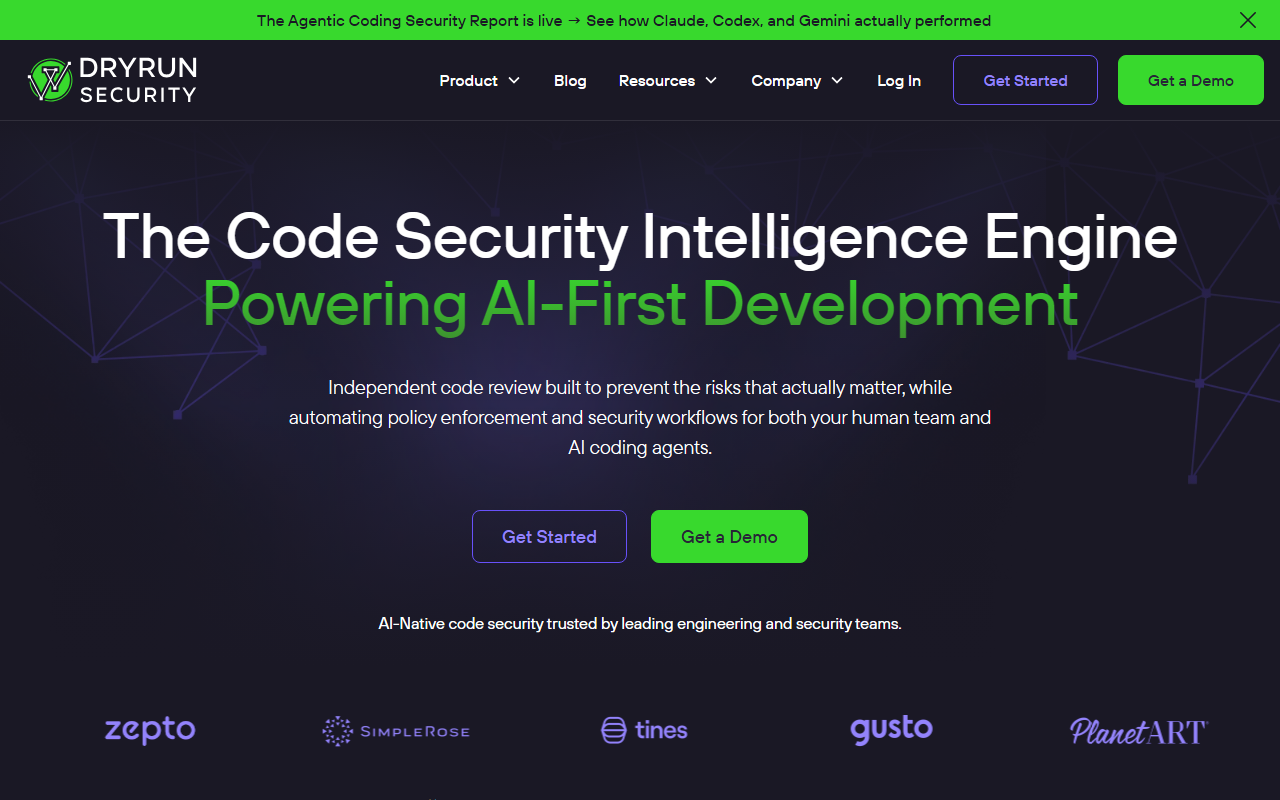
Upon visiting DryRun Security’s website, I was greeted by a clean, modern homepage that immediately asserts the tool’s value proposition: “AI-Native SAST AppSec Agents.” The hero section features a prominent “Get a Demo” call-to-action, and a cookie consent banner briefly interrupted my first scroll. Below the fold, a dashboard mockup shows code review summaries with alerts and severity ratings, though the exact interface is only hinted at through screenshots. The site includes a blog post titled “The Agentic Coding Security Report,” which compares Claude, Codex, and Gemini performance—an interesting touch for a security tool. Onboarding appears to require contacting sales; there is no public self-serve signup or free tier. I did click “Get a Demo” and entered a work email, but the site didn’t proceed without that step, so the initial engagement is gated behind a demo request. For a tool targeting engineering teams, this friction might slow early evaluation, but it aligns with enterprise-focused products.
Core Technology and Capabilities
DryRun Security positions itself as a contextual security analysis engine, not a traditional pattern-matching SAST. The key differentiator is its ability to reason about data flow, architecture, and change history when reviewing pull requests. The website claims “2x More Accurate” and “90% Lower Noise” than regex-based scanners, which I find plausible given how many false positives plague tools like early Semgrep or CodeQL. It runs as an agent that integrates directly with GitHub, GitLab, Slack, and even AI coding assistants like Claude Desktop, Codex, and Cursor. When testing the concept mentally, I imagine a developer pushing code and receiving a PR comment that explains why a specific SQL query is exploitable rather than just flagging a generic SQL injection pattern. The list of supported languages is impressive: Python, Ruby, TypeScript, JavaScript, Java, Go, C#, C++, PHP, HTML, Elixir, Kotlin, Swift, Scala. That breadth covers most modern stacks. The website also highlights “No Rules to Maintain,” meaning the AI learns from context rather than requiring security engineers to write custom YAML rules. This is a major shift from traditional SAST, where rule creation is a chronic pain point. The integration with MCP (Model Context Protocol) suggests DryRun can feed findings into larger AI workflows, which is forward-looking.
Pricing and Market Position
Pricing is not publicly listed on the website. The only way to get cost information is to request a demo, which implies a custom, enterprise-oriented pricing model. This places DryRun Security in the premium SAST space, competing with tools like Snyk Code, Checkmarx, and Synopsys Coverity. Unlike those tools, DryRun focuses heavily on AI-generated code review and agentic security—a niche that is growing as more teams adopt Copilot, Codex, and Claude for coding. The tool claims “Trusted with 350,000+ Code Reviews a Month,” which suggests a decent early adopter base. One limitation I see is the reliance on third-party SCM and AI tools; if your team uses a less common platform, DryRun may not integrate seamlessly. Additionally, the lack of a free tier means small teams or solo developers likely cannot test it without a sales call. For its target audience—mid-to-large engineering teams using AI coding tools and wanting to embed security without hiring more AppSec staff—DryRun seems well-suited. Competitors like Snyk offer broader vulnerability coverage, but DryRun’s contextual reasoning could reduce alert fatigue significantly.
Final Verdict
DryRun Security is a promising AI-native SAST tool that addresses the real problem of noisy, rule-based security scanners. Its ability to understand code context and provide actionable feedback directly in pull requests is a genuine strength. The integration with AI coding agents is timely, and the language support is broad. However, the lack of transparent pricing and the mandatory demo process may deter smaller teams. I also wish the website offered more concrete examples of false positive reduction or a live sandbox to test. For organizations already using GitHub/GitLab and AI coding assistants, and who are willing to invest in a premium solution, DryRun Security could be a game-changer for developer security. If you’re a solo developer or a startup on a tight budget, look elsewhere until pricing evolves. Visit DryRun Security at https://dryrun.security/ to explore it yourself.











Comments