

First Impressions: A Developer-Centric Landing Page
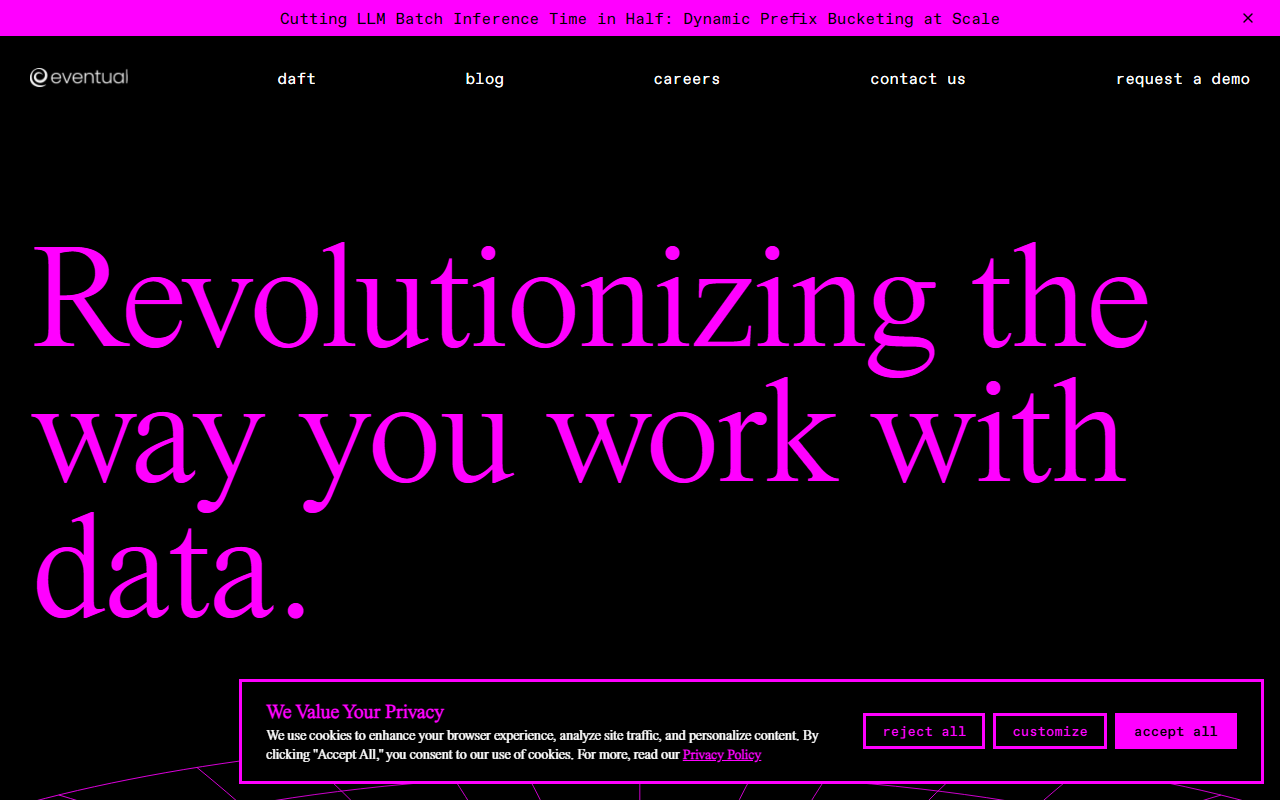
Upon visiting Eventual's website, the initial impression is that of a focused infrastructure startup. The hero section immediately declares its mission: revolutionizing data work by building a query engine that handles multimodal data with the same simplicity SQL brought to tabular data. The tone is ambitious and technical, clearly aimed at engineers who have struggled with distributed systems. I noted the prominent "Open Source" link in the menu, which suggests Daft is available for community use, but details are not provided on the landing page itself. The site includes a careers section with open roles in San Francisco, indicating the company is actively growing.
What Eventual Actually Does: The Daft Engine
Eventual is building Daft, a distributed query engine designed to process petabytes of multimodal data — images, video, audio, and text — using declarative queries. The core problem it solves is the high infrastructure overhead that AI teams face when working with real-world, non-tabular data. The website explains that engineers currently spend 70% of their time on infrastructure rather than solving AI problems. Daft aims to eliminate that friction by providing a single system that "just works" for multimodal workloads. While the site doesn't list specific APIs or model integrations, the claim of being used at companies like Amazon, Mobileye, and CloudKitchens lends credibility. The technology seems to be in active production at scale, which is a strong signal for reliability.
Market Positioning and Alternatives
In the Dev Framework space for data processing, Eventual faces competition from established systems like Apache Spark and newer specialized tools like LanceDB. Unlike Spark, which is a general-purpose compute engine often repurposed for AI data pipelines, Daft is built from the ground up for multimodal data. The declarative query approach also differentiates it from lower-level frameworks like Ray Data. However, Eventual's pitch is that it removes the need to become a distributed systems expert — a clear value proposition for AI teams. The fact that it is open source (though the exact license isn't detailed) could accelerate adoption among developers who want to self-host. Pricing is not publicly listed on the website, which is typical for enterprise-focused infrastructure tools; interested users likely need to contact the team.
Strengths, Limitations, and Final Verdict
Eventual's strongest advantage is its specialization. By focusing solely on multimodal data, it promises a streamlined experience that general-purpose engines cannot match. The endorsement from large-scale users like Amazon and MobileEye suggests real-world reliability. On the downside, the documentation, tutorials, and concrete technical details are absent from the promotional page. I was unable to find a clear pricing model or even a link to a free trial. This lack of transparency may deter small teams or individual developers who want to evaluate Daft before committing. Eventual is best suited for enterprises and data-intensive AI startups that process large volumes of diverse data types. If you are working with tabular data only, traditional SQL databases or Spark remain solid choices. For those building AI systems on messy multimodal data, Daft is worth a serious look — just be prepared to reach out to the team for access details. Visit Eventual at https://eventual.ai/ to explore it yourself.













Comments