

First Impressions and Onboarding
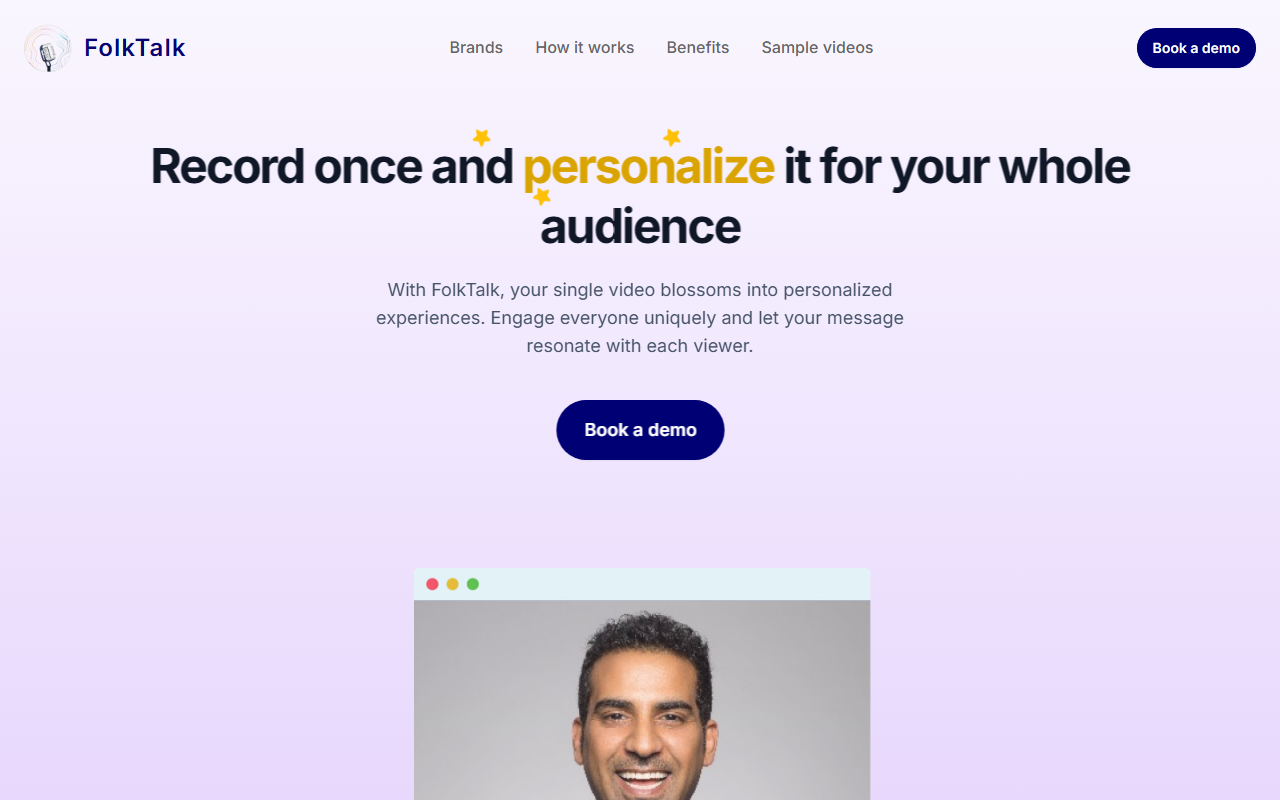
Upon visiting the FolkTalk landing page, I was greeted by a clean, modern interface that immediately showcases the core value proposition: “Record once and personalize it for your whole audience.” The homepage features a looping demo that shows how a single video dynamically inserts different names like “Hi Lavanya” or “Hi Jyotidev.” The site navigation includes sections for Brands, How it works, Benefits, Sample videos, and a Book a demo button. There is no self-service sign-up or free tier visible; the only call-to-action is booking a demo. This suggests FolkTalk is positioned as an enterprise solution rather than a DIY tool for individual creators.
When I explored the “How it works” section, it outlines a three-step process: record your media, let FolkTalk know the details (names, product name, company name), and then the AI tweaks your media to include all personalized information. The interface shows placeholder examples like “User name”, “Product name”, “Company name” with sample fill-ins such as “Himank” or “FolkTalk”. It’s intuitive enough, but without a live demo, I couldn’t test the actual AI generation firsthand. The sample videos section is also static — no embedded player, just descriptive text. Overall, the onboarding is heavily gated behind sales conversations.
How FolkTalk Works and Core Technology
FolkTalk’s technology is centered on transforming a single recorded video or audio file into numerous AI-powered personalized versions. It uses voice and video variables to dynamically insert personalized elements like the recipient’s name, the product name, and the company name. According to the site, the AI “tweaks your media” to seamlessly integrate these variables. While the exact underlying model is not disclosed, the tool likely leverages text-to-speech and video editing AI to modify the original recording without requiring re-recording.
Unlike competitors such as Vidyard or Synthesia that offer browser-based video creation and personalization, FolkTalk seems to focus on post-production personalization of existing recorded media. It claims omnichannel capabilities, allowing personalized messages to be deployed via email, SMS, social media, and websites. The site mentions integration with existing systems, though no specific APIs or third-party integrations are named. For a tool in the “Cross-border AI” category, it remains unclear how language or accent personalization works — the examples only show English names. This could be a limitation for global teams.
The trust section lists brands like Coca-Cola, MG Motors, and McDonald’s as clients (though no logos were displayed on the scraped content). If accurate, this adds credibility. However, without case studies or quantified results, the claims of “boosting loyalty and conversions” lack hard evidence.
Use Cases and Target Audience
FolkTalk is best suited for sales teams, marketing departments, and customer success managers who need to send personalized video messages at scale. For example, a sales rep could record a standard product demo and then send a tailored version to each prospect with their name and company inserted. Similarly, a brand could use it for personalized onboarding videos or event invitations. The tool claims to save time by handling personalization automatically, which is a clear advantage over manual editing.
However, FolkTalk is not ideal for users who need real-time personalization or interactive video experiences — it seems focused on batch processing of pre-recorded media. Individual creators or small businesses on a tight budget may find the “book a demo” approach off-putting. There is no public pricing, so it’s likely enterprise-level and may be cost-prohibitive for freelancers. The website also lacks information on supported languages, audio quality, or video resolution options, which could be concerns for cross-border users.
Pricing, Limitations, and Final Verdict
Pricing is not publicly listed on the website. The only path to getting a price is booking a demo, which indicates a sales-driven model typical of B2B SaaS products. This is a significant limitation for curious buyers who want to evaluate cost upfront. Additionally, the lack of a free trial or self-service sandbox makes it hard to assess the tool’s quality before committing.
Strengths include a clear value proposition, impressive claimed client list, and a time-saving workflow for personalization at scale. Weaknesses are the opaque pricing, no direct access to the tool, and limited technical details (e.g., AI models, integrations, supported languages). FolkTalk could be a valuable addition for enterprises ready to invest in personalized video outreach, but smaller teams should look at alternatives like Vidyard (which offers free starter plans) or even manual personalization tools like Loom with dynamic placeholders.
I recommend FolkTalk for marketing teams at mid-to-large companies that prioritize one-to-one video personalization and have the budget for a dedicated sales process. For everyone else, wait until more details become public or request a demo with specific questions about your use case.
Visit FolkTalk at https://folktalk.in/ to explore it yourself.













Comments