

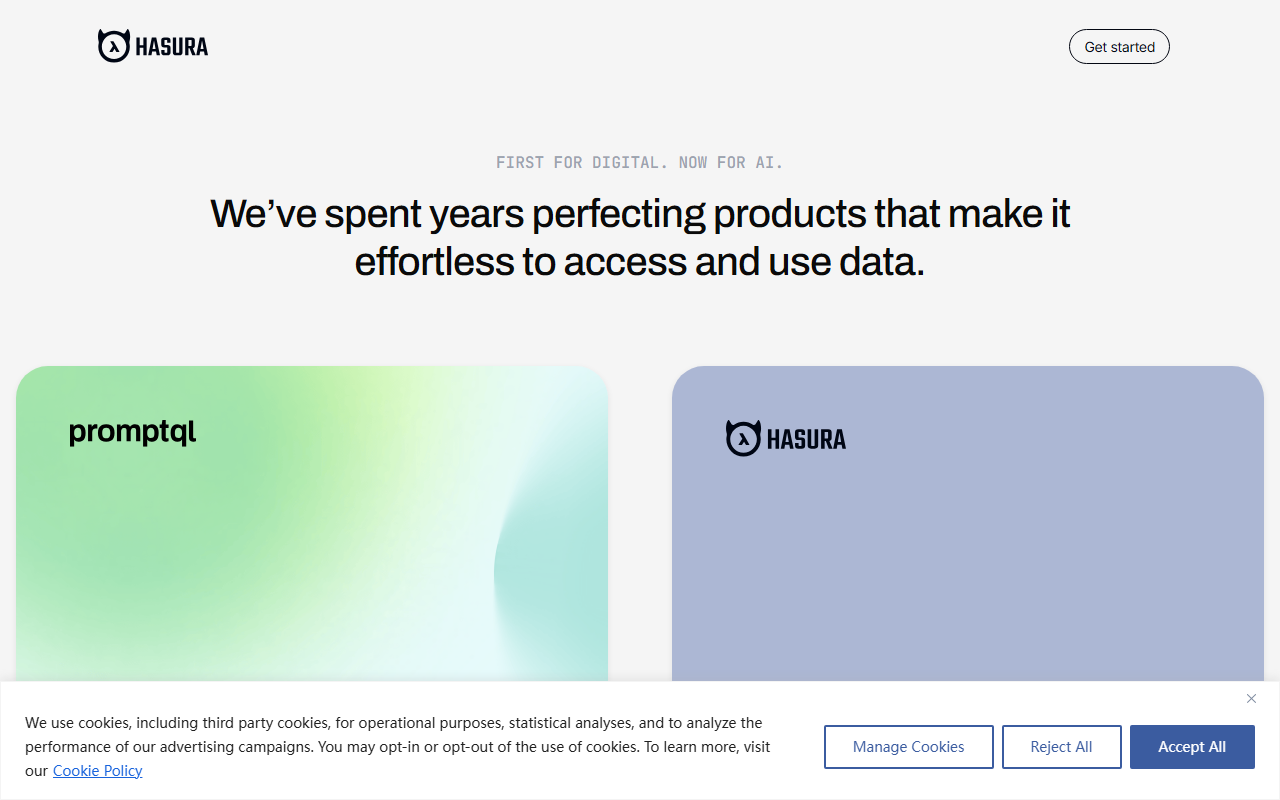
Upon visiting the Hasura website, I was immediately struck by the pivot toward AI. The hero section features 'PromptQL for AI' alongside the classic 'Hasura for APIs and GraphQL.' It’s clear the company is trying to bridge the gap between instant data delivery and AI-powered querying. The landing page is clean, with a strong call-to-action to talk to their AI Catalyst Team. But to really understand what Hasura offers today—beyond the marketing—I dug into the product itself.
First Impressions: A Developer's First Look at Hasura
The dashboard is where the real story begins. After signing up for Hasura Cloud (the free tier gives you one project with limited resources), I was walked through a quick onboarding flow. The UI is intuitive: a left sidebar with options for Data, API, Actions, Remote Schemas, and now an 'AI' section if you enable PromptQL. I started by connecting a sample PostgreSQL database. Within minutes, Hasura auto-generated a full GraphQL API with queries, mutations, and subscriptions. The auto-generated documentation is a nice touch—it updates in real-time as I modify tables. For anyone who has wrestled with REST endpoints or manual GraphQL resolvers, this is a breath of fresh air.
PromptQL, the newest addition, appears as a separate tab in the console. The interface is minimal: a query builder where you can type natural-language questions and get structured GraphQL responses. I tested it with a simple dataset of orders. I typed “Show me the top 5 customers by total spend,” and within seconds it returned a proper GraphQL query plus the results. Behind the scenes, it’s leveraging your database schema and relationships to build the query—essentially an AI assistant that learns your data model. The response was accurate, though I noticed it struggled with complex joins involving multiple foreign keys. Still, the potential is promising.
Core Capabilities: What PromptQL and GraphQL Engine Deliver
Hasura’s GraphQL Engine has been around for years. It connects to PostgreSQL, MySQL, SQL Server, BigQuery, and even REST endpoints. It automatically generates a real-time GraphQL API with built-in authorization, caching, and pagination. The engine is battle-tested—those 'millions of user experiences' they claim are credible, given the number of production deployments I’ve seen in the wild. The open-source version is available on GitHub, and the cloud offering adds collaboration, monitoring, and scaling.
PromptQL is the twist. It’s positioned as 'Accurate AI by continuously learning the unique context of your business.' It doesn’t just accept natural language; it maps that input to your database schema, existing GraphQL queries, and even previous PromptQL interactions. This means it gets smarter as your team uses it. From a technical standpoint, it sits on top of the same Hasura engine, so there’s no separate infrastructure to manage. For teams already using Hasura, enabling PromptQL is a toggle in the settings. For new users, you’ll need to set up the GraphQL Engine first—it’s not a standalone AI product.
Pricing is not publicly listed on the website for PromptQL. The GraphQL Engine itself is open source (free). Hasura Cloud has a generous free tier (1 GB data, 10 MB file uploads) and paid plans starting at around $99/month for Pro, with Enterprise for custom pricing. The AI Catalyst Team is available only for demo requests, suggesting PromptQL is still in early access. This lack of transparent pricing for the AI feature is a limitation for teams trying to budget.
Strengths, Limitations, and Who Should Use It
Strengths: The biggest advantage of Hasura is speed of development. You can go from a database schema to a production-ready API in under an hour. The auto-generated queries and subscriptions reduce boilerplate code dramatically. PromptQL adds a layer of abstraction that could lower the barrier for non-technical stakeholders to query data safely. The tool is also well-documented and has a large community. For GraphQL enthusiasts, it’s the gold standard.
Limitations: The learning curve is real. While the basics are easy, advanced use cases—custom actions, event triggers, remote schemas—require solid understanding of GraphQL and your database design. The PromptQL feature is still maturing; complex queries with multiple JOINs or nested aggregations sometimes fail. Additionally, relying on Hasura means you’re tightly coupling your API layer to the framework. Competitors like AWS AppSync or Postgraphile offer similar functionality, but AppSync ties you to AWS, and Postgraphile is PostgreSQL-only and less performant at scale. Hasura sits somewhere in between, but its strength is database-agnostic support and the new AI angle.
Who should use it: Hasura is ideal for full-stack teams building data-intensive applications that require instant GraphQL APIs. It’s especially powerful for startups and mid-size companies that need to iterate quickly. PromptQL is best suited for organizations with clear data schemas and a desire to enable self-service analytics for non-developers. If you’re a solo developer on a simple project, the overhead might not be worth it—consider a simpler REST framework instead.
In summary, Hasura delivers on its promise of making data accessible. PromptQL is a forward-looking feature that could redefine how teams interact with databases, but it’s not yet fully baked. I recommend trying the free tier to see if the workflow clicks for your stack. Visit Hasura at https://hasura.io/ to explore it yourself.













Comments