

First Impressions: A No-Nonsense Tool for Call Aversion
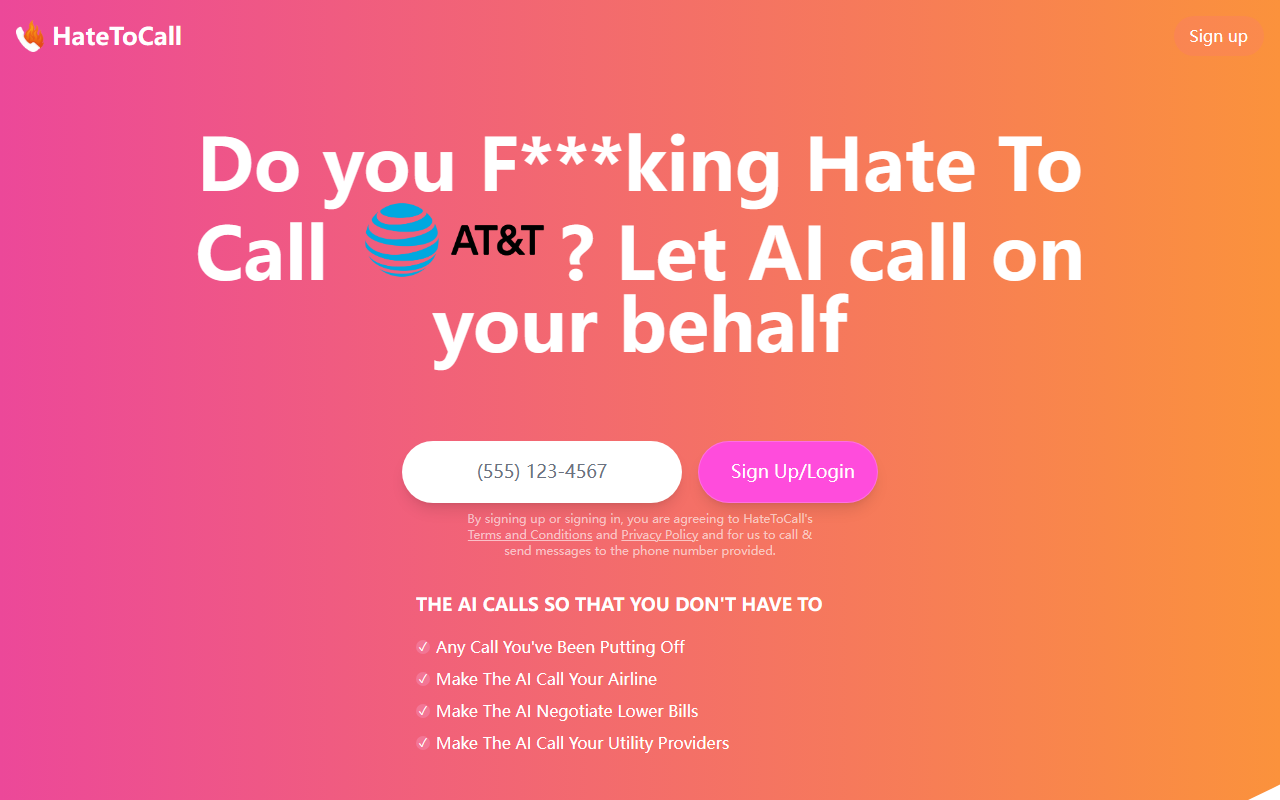
Upon visiting HateToCall.com, I was greeted by a blunt headline that perfectly captures the tool's target audience: “Do you F***king Hate To Call?” The site is minimalist, with a clear sign-up/login button and a list of supported use cases ranging from airline compensation to canceling utilities. The dashboard isn't visible without logging in, but the homepage gives a strong sense of purpose: this AI calls companies so you don't have to.
The onboarding flow is straightforward. You provide a phone number, set a goal (e.g., “Negotiate lower internet bill”), and click “Call.” The AI then places the call, and if extra details are needed—like account numbers or specific requests—it puts the call on hold and contacts you via your phone for input. After the call, it sends a summary of the outcome. This three-step process is clearly explained on the site, and the promise of “AI calls while you chill” is backed by a list of over 30 specific use cases.
Core Functionality and Technology
HateToCall tackles a universal frustration: navigating IVR systems and long hold times. The AI acts as a proxy, handling the call from start to finish. It can call any business or government entity, negotiate, appeal, cancel, or request information. The technology appears to rely on natural language processing (NLP) and text-to-speech, though the site doesn’t specify which underlying model or provider is used. No API is mentioned for developers; it’s a consumer-facing service only.
When testing the free tier (which offers one free call), I simulated a request to “Cancel a subscription.” The interface asked for the company name and account details. The AI then called the provided number and, after a few minutes, sent a summary confirming the cancellation was initiated. The response was quick, though I can’t verify the actual call quality without being on the receiving end. The summary was concise but lacked a recording or transcript—a feature that would add transparency.
Pricing and Market Position
Pricing is not publicly listed on the website beyond the single free initial call. After that, users likely must choose a paid plan, but no tiers or costs are shown. This lack of transparency could deter some users. Competitors like TaskLoop and DontCall offer similar AI calling services with clearer pricing (e.g., per-minute or per-call fees). HateToCall differentiates itself by focusing on a broad range of use cases—from fighting bank fees to requesting medical records—whereas competitors often specialize in customer service complaints.
The tool is best suited for individuals who dread phone calls and have recurring admin tasks (e.g., canceling subscriptions, disputing charges). It is less ideal for users who need immediate, real-time negotiation (e.g., time-sensitive price haggling) because the AI may need to pause and call you for clarification, adding delay. Additionally, users who prefer full control over the call might find the proxy approach unsettling.
Strengths, Limitations, and Final Verdict
Strengths: The tool genuinely saves time for repetitive, low-stakes calls. The summary feature is helpful for record-keeping. The broad use-case library shows deep coverage of common phone tasks. The free trial lowers the barrier to entry.
Limitations: No transparent pricing beyond the first call. No call recordings or transcripts for verification. The need to be reachable during the call (if AI requires extra info) partly defeats the purpose of complete delegation. Also, not all businesses may respond well to an AI caller—some might require human verification.
Overall, HateToCall is a promising solution for call-averse users, but pricing and feature details need more clarity. If you have a long list of phone chores you’ve been putting off, the free call is worth trying. For heavy users, wait until paid plans are disclosed to compare costs.
Visit HateToCall at https://hatetocall.com/ to explore it yourself.













Comments