

First Impressions and Onboarding
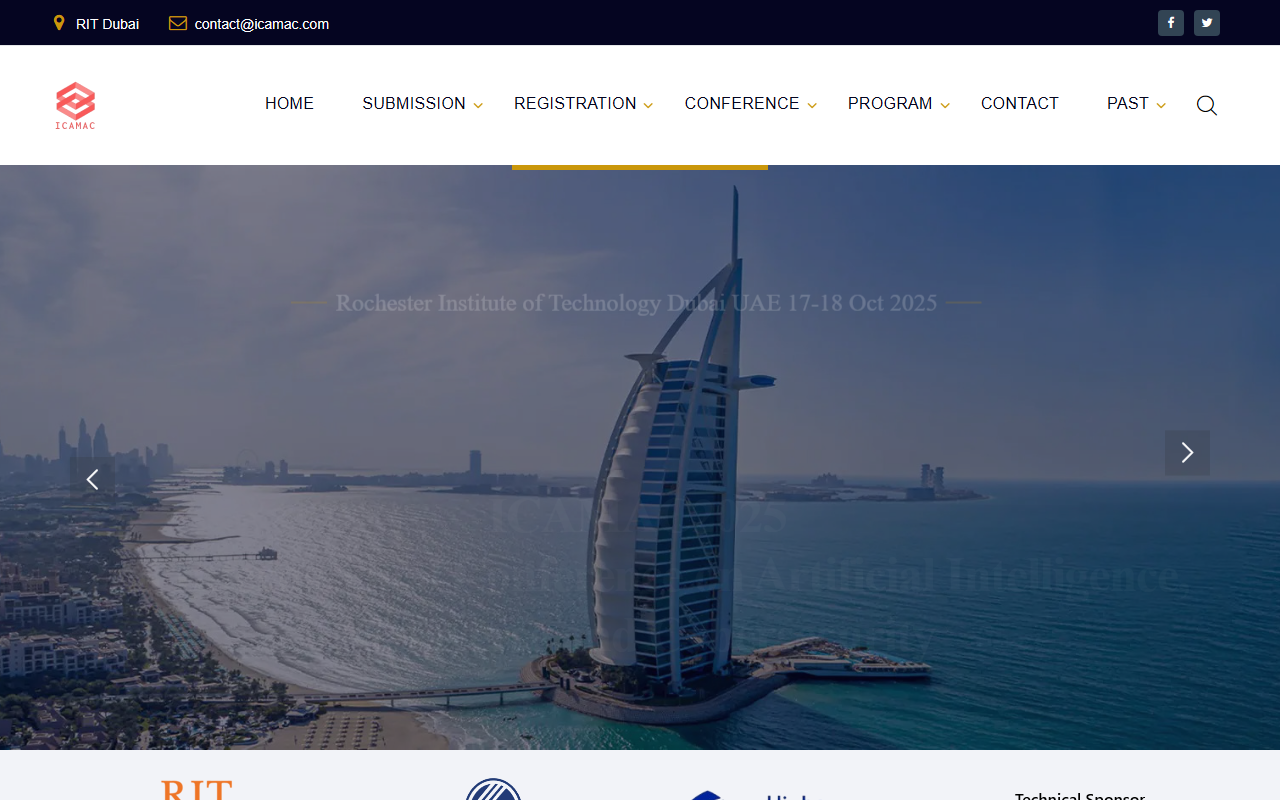
Upon visiting the ICAMAC website, I was greeted by a clean, conference-style landing page with repeating banners promoting the event. The site is straightforward—no login, no dashboard, just a single-page layout with essential tabs for home, keynotes, important dates, and submissions. As a senior tech journalist, I expected a learning platform with interactive courses, but ICAMAC is actually a physical academic conference hosted by Rochester Institute of Technology Dubai in October 2025. The homepage lists the IEEE conference record number #67779 and emphasizes an in-person event format. The navigation is minimal, making it easy to find submission guidelines and keynote speaker bios. However, the site lacks any tutorial, API, or subscription model—this is not a self-paced AI tool but a live learning event for AI, metaverse, and cybersecurity researchers.
What ICAMAC Offers and Its Core Problem
ICAMAC solves the problem of disconnected knowledge sharing in convergent fields. It brings together faculties, instructors, scientists, and industry representatives to discuss theoretical and practical studies in artificial intelligence, the metaverse, and cybersecurity. The conference includes special sessions on AI applications in education, sustainability, healthcare, and robotics. Submissions are peer-reviewed, and selected extended papers are published in the Scopus-indexed Sakarya University Computer and Information Sciences Journal. Unlike typical online learning platforms like Coursera or Udacity, ICAMAC focuses on live presentations and networking rather than structured curricula. Its technical merit lies in the quality of keynotes—this year features Eman El-Sheikh, Associate Vice President from the University of West Florida, and Gina Petersen, Senior Vice President of Mastercard. The conference uses a standard paper submission process with a 6-page limit in English, and the organizers include academics from RIT Dubai, Higher Colleges of Technology, and Sakarya University.
Pricing, Accessibility, and Limitations
Pricing is not publicly listed on the website. The site does not mention registration fees, early-bird discounts, or student rates. This is a significant limitation for budget-conscious researchers or those seeking transparent costs. Additionally, the conference is in-person only at RIT Dubai, which restricts access to attendees who can travel to the UAE. The website also lacks an archive of past proceedings or recorded talks, so you cannot sample content before committing. In contrast, similar conferences like the IEEE International Conference on AI (ICAI) often provide virtual attendance options and fee schedules upfront. ICAMAC’s strengths include its focused theme on cybersecurity for 2025, reputable institutional backing, and the promise of Scopus-indexed journal publication for selected papers. However, the lack of online resources and unclear pricing makes it unsuitable for those seeking immediate, low-cost learning tools. The target audience is clearly academic researchers, PhD students, and industry professionals with travel budgets who want to publish papers and network face-to-face.
Verdict and Recommendation
ICAMAC is a legitimate academic conference, not a traditional AI learning platform. It excels in creating a targeted forum for discussing cutting-edge AI, metaverse, and cybersecurity topics, especially with high-profile keynote speakers from Mastercard and the University of West Florida. The opportunity for Scopus-indexed publication adds real career value. However, the lack of online content, unclear pricing, and in-person-only format limits its utility as a learning tool for a broad audience. Researchers focused on cybersecurity and AI in education will find it worthwhile, but self-paced learners or remote participants should look elsewhere—for example, the IEEE AI Learning Platform or Coursera's AI for Everyone. If you can attend in Dubai in October 2025 and have a paper ready, ICAMAC offers valuable networking and publishing potential. For everyone else, wait for virtual editions or recorded sessions. Visit ICAMAC at https://icamac.com/ to explore it yourself.













Comments