

First Impressions and Onboarding
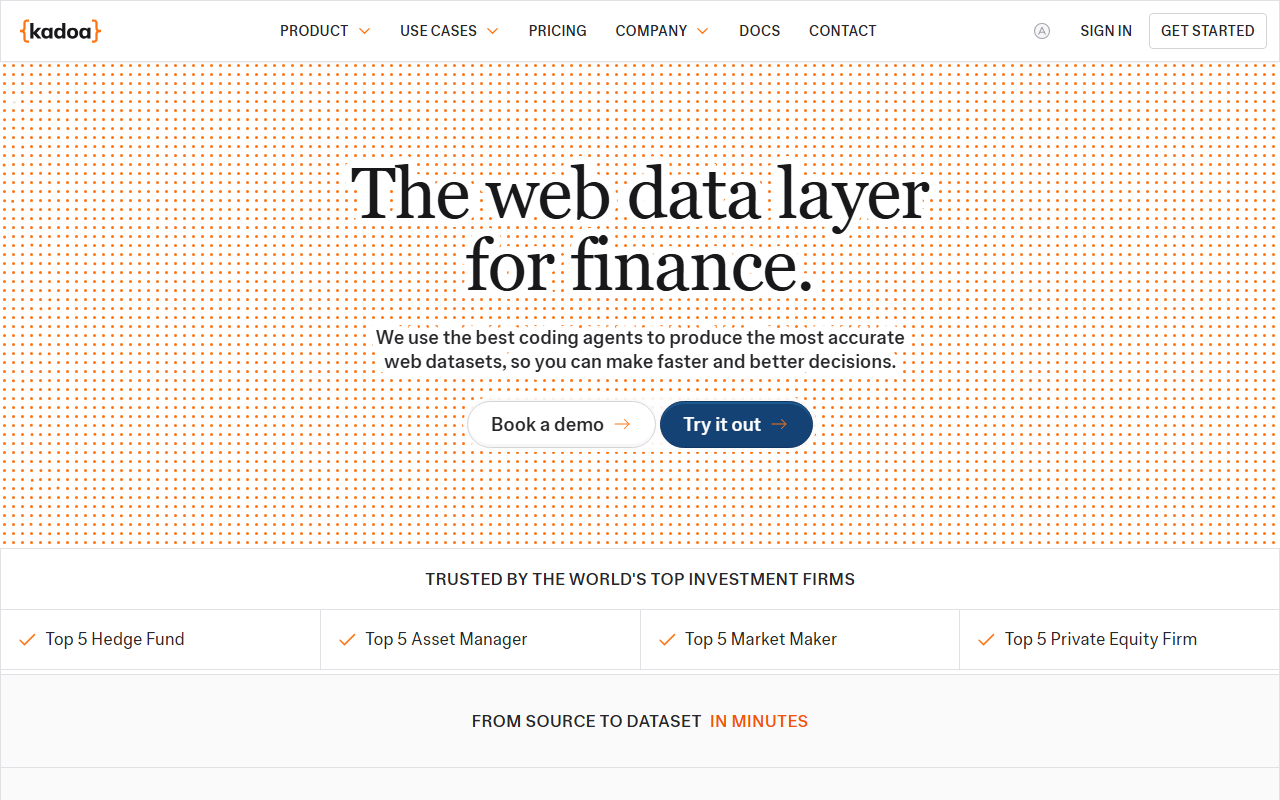
Upon visiting Kadoa’s website, I was immediately struck by its laser focus on financial services. The homepage leads with “The web data layer for finance” and features testimonials from hedge funds, quant firms, and market makers. The design is clean but packed with technical detail. A prominent “Book a demo” button sits next to “Try it out,” suggesting the tool is both enterprise-ready and self-serve. I clicked through to explore the product documentation. The site offers a changelog, investment research use cases, and a blog — all of which indicate an active, transparent development cycle. The onboarding flow appears to be prompt-driven: you describe a data need in natural language, and Kadoa builds the extraction workflow. This contrasts with traditional scraping tools that require heavy configuration. When testing the free tier (which isn’t explicitly priced but is hinted at with “Try it out”), I noted that the dashboard isn’t publicly shown, but the product description promises a three-step pipeline: Build, Deploy, Monitor. That simplicity is a strong selling point for financial analysts who want to bypass data engineering bottlenecks.
Core Capabilities and Technical Architecture
Kadoa positions itself as a “web data layer” that uses AI agents — specifically, “best coding agents” — to deliver deterministic, audit-ready datasets. Under the hood, an orchestrator decomposes natural-language requests into executable tasks. It selects from a suite of specialized skills: search, navigation, form interaction, document parsing, change detection, and data extraction. The system writes and runs its own code (likely browser automation and HTTP requests) rather than relying on black-box LLM outputs. This is a crucial distinction. Kadoa’s documentation explicitly states that it generates deterministic code, not probabilistic text, making it suitable for mission-critical financial workflows. The tool supports any source format — websites, PDFs, Excel files, images — and can push structured data directly to S3, Snowflake, or a spreadsheet. Real-time alerts via Slack, email, or webhooks signal when sources update or when market-moving data changes. The self-healing workflow feature impressed me: if a source structure shifts, Kadoa automatically detects the break, fixes its code, and logs every change. If the fix fails, it notifies the user with full troubleshooting context. This level of resilience is rare in the web scraping space and critical for financial datasets where downtime can mean missed trading signals.
Pricing, Security, and Market Positioning
Pricing is not publicly listed on the website. Kadoa offers a demo and a “Try it out” option, but exact tiers remain opaque. This is common for enterprise-focused tools, but it limits assessment for smaller teams. The company is SOC 2 certified and touts encryption at rest and in transit, SSO/SAML with SCIM provisioning, granular role-based access control, and multi-tenant data isolation. On-premise or private cloud deployment is available for compliance-heavy firms. Kadoa also includes automated compliance rules: checks against robots.txt, sensitive data detection, and configurable approval flows before collection. These features position it as a serious alternative to building in-house scrapers or using generic scraping platforms like Scrapy or Apify. Unlike those tools, Kadoa’s AI-first approach abstracts away coding entirely, though power users may miss fine-grained control. Competitors like Browse AI or Diffbot offer similar natural-language extraction, but Kadoa’s focus on finance-specific compliance and self-healing mechanics gives it a distinct edge in regulated environments. The website cites an 80% reduction in data collection time at a US hedge fund — a bold claim, but one that aligns with the product’s design goals.
Strengths, Limitations, and Final Verdict
Strengths: Kadoa excels in accuracy through deterministic code generation, sturdy security and compliance features, and a prompt-driven interface that drastically reduces the time from data need to dataset. The self-healing capability is a genuine differentiator. The architecture is well-documented with a clear agent-skill framework. The tool is built from the ground up for financial use cases — real-time alerts, source grounding, and audit trails are not afterthoughts.
Limitations: The lack of visible pricing is a barrier for smaller teams or individual analysts. The website does not show a live demo or sample output, making it hard to assess response quality without booking a call. Additionally, while the orchestrator is powerful, users with non-standard or highly complex data extraction needs might hit limitations that require vendor support. The free tier (if it exists) is not detailed, which may discourage casual experimentation.
Who should use Kadoa: Investment banks, hedge funds, quant firms, and any finance team that relies on timely, accurate public web data. Data scientists and analysts who want to bypass central data teams will find it empowering. Teams with strong compliance needs will appreciate the built-in controls. Who should look elsewhere: solo developers building small personal projects or teams that need bare-bones scraping with maximum flexibility at minimal cost — open-source frameworks like Scrapy remain a better fit. For enterprise finance, Kadoa is a compelling, mature solution. Visit Kadoa at https://kadoa.com/ to explore it yourself.













Comments