

First Impressions and Onboarding
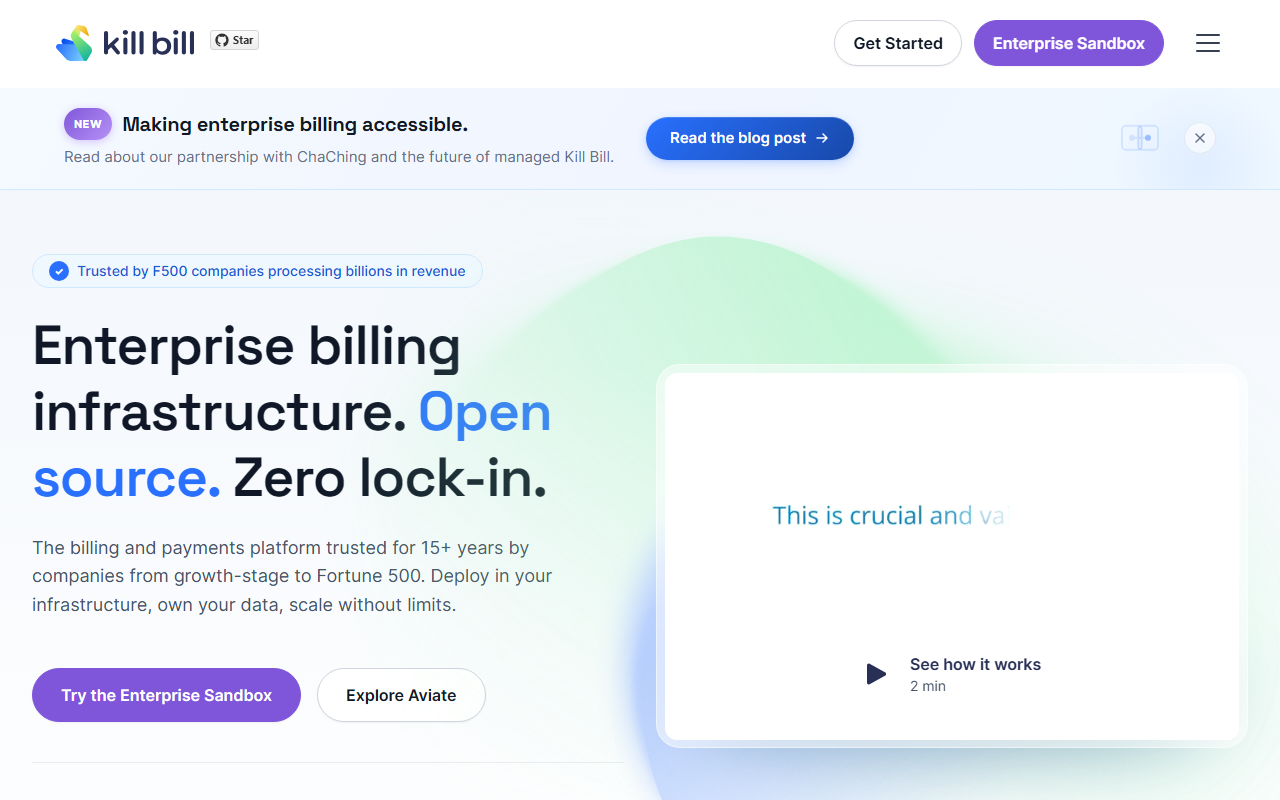
Upon visiting the Kill Bill website, the first thing I noticed is how squarely it targets engineering leaders and finance teams tired of vendor lock-in. The landing page immediately showcases a live demo and open-source download button, making it clear this is not a typical SaaS billing tool. The open-source nature is front and center—you can launch on open source and add enterprise tooling later. I clicked through to the "Start Open Source" option and found a straightforward GitHub repository link, though the real onboarding depth lives in the documentation and the Kaui admin UI demo. For a developer framework, the site does an excellent job bridging technical depth with business value. The dashboard is not something I could access directly without deploying, but the curated test drive video and live demo give a practical sense of the workflow. What struck me most is the emphasis on infrastructure ownership: they want you to deploy in your own environment, keep your data, and avoid per-transaction fees. That's a bold claim in a market dominated by usage-based pricing giants.
Core Capabilities and Technology
Kill Bill is an open-source billing and payment platform built for complex recurring revenue models: SaaS subscriptions, usage-based billing for AI tokens, multi-tenant white-label platforms, and prepaid/postpaid scenarios. Its core engine handles subscription management, payment gateways, and financial reporting. The technology stack is based on a plugin architecture that integrates natively with Adyen, Stripe, Braintree, PayPal, and more. Developers can extend everything through plugins—custom business logic, tax engines, or infrastructure connectors. The built-in Kaui admin UI provides a back-office interface for customer success and finance teams to manage price books and subscriptions. What sets Kill Bill apart from alternatives like Chargebee or Recurly is its open-source core: you own all billing data, can customize the logic directly, and avoid vendor roadmaps. However, that control comes at a cost—you need engineering resources to deploy and maintain the self-hosted system. The Aviate enterprise accelerator is offered as a production-ready bridge for teams that need faster deployment without a full platform team. From a technical perspective, the platform runs in Java and uses a relational database, with APIs available for integration. There is no mention of an AI-native model or LLM backend, as this is squarely a dev framework for billing infrastructure.
Pricing and Market Positioning
Pricing is not publicly listed on the website in traditional tier tables. Instead, Kill Bill emphasizes predictable costs: no per-transaction fees and no revenue-based pricing. For the open-source version, you pay only for your own infrastructure. The Aviate enterprise accelerator has "fixed pricing (not a percentage of revenue)" and is described as far cheaper than commercial offerings. This positions Kill Bill as a cost-effective alternative for companies scaling past $250M ARR that would otherwise face six-figure vendor bills. The site states it is "trusted by F500 companies processing billions in revenue" and has been in production for 15+ years. Competitors like Stripe Billing or Recurly charge per transaction and often have revenue-sharing models, which can become expensive at large scale. Kill Bill's model flips that: you pay for infrastructure and optional support, not per-dollars-processed. The main limitation is the upfront engineering investment required. Teams without a dedicated platform or devops support may struggle with initial setup. Additionally, the open-source community is active but not as large as some SaaS alternatives, meaning documentation and plugins may lag behind proprietary offerings.
Who Should Use Kill Bill?
Kill Bill is best suited for growth-stage and enterprise companies that need full control over their billing stack and are scaling beyond what vanilla SaaS can handle. Engineering leaders who want to avoid vendor lock-in and can deploy in-house infrastructure will find it empowering. Finance teams that require granular revenue recognition, audit trails, and complex billing logic (usage-based, multi-tenant, white-label) will appreciate the flexibility. On the other hand, startups with very simple billing needs or teams without a dedicated platform engineer should look elsewhere—using something like Stripe Billing or Recurly out of the box will be far faster. Kill Bill is a serious tool for serious scale: it's open-source, battle-tested for billions in revenue, and gives you ownership of your data. If you have the engineering bandwidth and need to escape transaction-based pricing, this is a compelling choice. Visit Kill Bill at https://killbill.io/ to explore it yourself.













Comments