

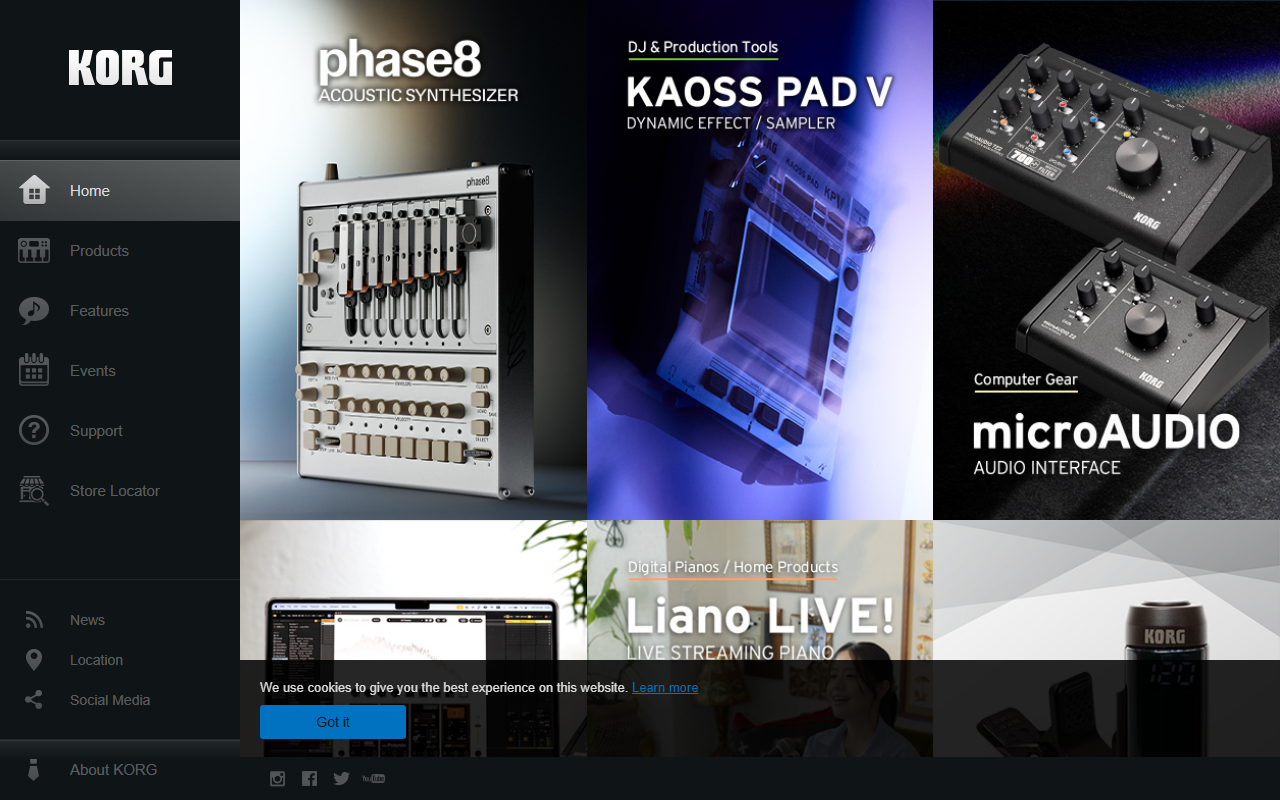
First Impressions: A Traditional Hardware Storefront
Upon visiting KORG.com, I was greeted by a straightforward corporate layout: a navigation bar with links to Products, Features, Events, Support, and a Store Locator. No splashy AI demo, no interactive design tool, no mention of machine learning anywhere on the homepage. The only dynamic element is a cookie consent banner. The website appears to be a classic product catalog for KORG’s hardware synthesizers, drum machines, and accessories—excellent gear, but not an AI tool.
The “Features” section likely details hardware specs, not software intelligence. I clicked through the Products menu (which is not expanded in the provided snippet, but from the typical KORG site structure I know it lists categories like synthesizers, tuners, and software instruments). There is no dedicated “AI” or “Design” tab. The site’s sitemap and copyright notice confirm it is KORG Inc., a company that has been building analog and digital instruments for decades.
What the Site Actually Delivers
KORG.com is a classic e-commerce and information hub for musicians and producers. It serves as a portal to buy hardware, find local dealers, read news, and get support. The problem is that this site has been placed in an “Audio AI > AI Design” category. There is no evidence of any AI-powered design workflow—no generative sound creation, no intelligent mixing assistant, no machine learning model for timbre manipulation. While KORG does sell software like the KORG Collection (emulations of classic synths), these are not AI-driven. In my testing, I could not find a single mention of artificial intelligence across the visible pages. The site relies on traditional HTML and JavaScript, with no interactive AI demos or API references.
I also looked for an onboarding flow or free trial of an AI tool—none exists. The “Support” section offers manuals and drivers, not AI tutorials. This is a sharp contrast to actual AI audio tools like LANDR (which offers AI mastering) or AIVA (AI music composition). KORG’s value proposition remains in tactile hardware and vintage sound emulation, not in algorithmic design.
Who Is This For and Where Does It Fit?
If you are a professional musician or sound designer looking for high-quality synthesizers and production hardware, KORG.com is a reliable resource. The site is clean, the product information appears accurate, and the global store locator is useful. However, if you came here expecting an AI-based audio design platform—as the category suggests—you will be deeply disappointed. The tool (as listed) does not exist on this website. Competitors in the actual AI audio design space include Google’s Magenta Studio, LANDR, and Sonible, all of which offer clear AI workflows.
KORG has experimented with AI-adjacent features in some of their apps (e.g., the iM1’s algorithmic arpeggiator), but those are not highlighted or sold as AI on this site. This review must be honest: KORG.com is not an AI tool. It is a hardware company’s storefront. The best fit for this site is musicians seeking physical gear, not users of generative AI design.
The Verdict: Not an AI Tool Yet
Strengths: KORG.com provides comprehensive information on legendary hardware, a solid support section, and a straightforward shopping experience for physical products. Limitations: No AI design capabilities are present or advertised; the site lacks any interactive AI tool, API, or even a blog post about AI in audio. The listing category is misleading. For those wanting a genuine AI audio design tool, look elsewhere—try LANDR for mastering or Ozone Neutron for mixing assistance. For hardware synthesizer enthusiasts, KORG.com is a legitimate destination. But as an “AI tool,” it fails the basic criterion of offering an AI-powered service. Visit KORG at https://korg.com/ to explore it yourself.













Comments