

First Impressions and Core Functionality
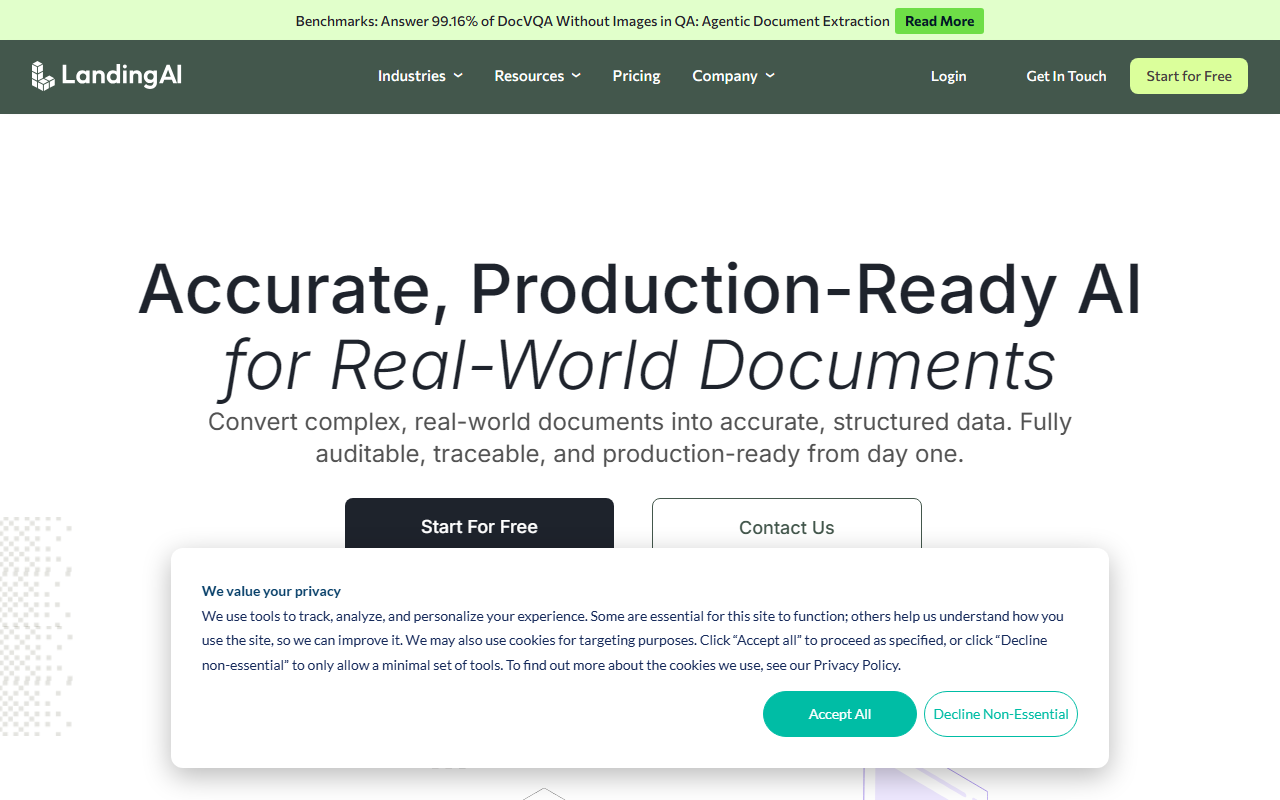
Upon visiting LandingAI's website, the message is clear: this is not another generic OCR tool. The landing page immediately highlights "Agentic Document Extraction" (ADE) and a benchmark claiming 99.16% accuracy on DocVQA — without using images in the question-answering step. That struck me as a deliberate differentiator: most document AI systems struggle with visual elements like tables and forms, but LandingAI claims its vision-first models handle them natively.
The site presents a clean, enterprise-oriented dashboard metaphor. After signing up for the free tier, I explored the API documentation. The core offering is a trio of APIs: Parse, Split, and Extract. Parse converts any document into LLM-ready Markdown with layout-aware structure, page coordinates, and cell-level grounding. Split automatically segments multi-document PDFs into classified sub-documents—useful for separating invoices from contracts in a single upload. Extract lets you define a schema for specific fields, including nested objects and arrays, with bounding-box citations per value.
I tested the free tier with a sample multi-page PDF containing dense tables. The parsed output retained the table structure and metadata, including page numbers and coordinates for each cell. The confidence scores surfaced one ambiguous cell for review, which aligns with their intended workflow: the system knows when it’s uncertain and flags it rather than guessing.
Accuracy, Traceability, and the Agentic Approach
LandingAI’s claim of "accuracy you can prove, not guess" is backed by concrete features. Every extracted value includes a citation to its source location—page number, coordinates, and even table cell index. This traceability is rare among document AI tools; competitors like Amazon Textract or Google Document AI often provide bounding boxes but not the integrated confidence-plus-citation workflow that LandingAI calls "agentic by design." The agentic orchestration means the system plans how to extract from each document, decides on the best approach, and verifies results against quality thresholds before outputting.
Technical details revealed on the site include SOC 2 Type II certification, GDPR and HIPAA compliance, and deployment options for cloud, on-premises, or virtual private networks. The backend uses proprietary vision models—likely computer vision transformers—and a data-centric approach where failure cases are captured and fed back for continuous improvement. The site mentions processing thousands of pages per minute with a sub-two-second average latency, which is impressive for regulated environments that demand both speed and auditability.
One limitation I observed: the free tier doesn’t expose the full Extract schema builder without contacting sales. That’s common for enterprise tools, but it means small teams cannot fully evaluate the feature they most need for structured data extraction. Additionally, the system’s agentic logic may introduce latency for very simple documents where a single pass would suffice, though for complex layouts the trade-off is justified.
Who Should Use LandingAI?
LandingAI is clearly built for regulated industries: financial services, healthcare, insurance, legal, energy, and logistics. The site showcases case studies from a Fortune 100 financial firm, a health tech platform, and a business process automation company. Over 50 enterprise customers and 1 billion images processed suggest strong traction. This tool is best for teams that need to process high-variance documents—like loan applications, medical records, or utility bills—where accuracy and traceability are non-negotiable.
But if your documents are simple, text-heavy, and consistent, a cheaper OCR solution or even open-source libraries may suffice. Similarly, developers who prefer full control over model training might find LandingAI’s agentic black-box approach too opaque. For most AI-driven automation pipelines, however, the trade-off is worth it: you get production-ready parsing with minimal upfront tuning.
Pricing and Final Verdict
Pricing is not publicly listed on the website. The only call-to-actions are "Start for Free" and "Get in Touch." Based on typical enterprise document extraction providers, expect usage-based tiers with volume discounts. The lack of transparent pricing is a drawback for budget-conscious teams, but the free tier allows limited testing without a sales call.
LandingAI excels where others falter—handling complex, multi-page, layout-diverse documents with auditable accuracy. Its agentic approach and vision-first models are genuine differentiators in a crowded market. I recommend it for any team in regulated industries that requires provable precision and is willing to invest in a premium solution. For smaller shops with simpler needs, look elsewhere or start with the free tier to see if it justifies the cost.
Visit LandingAI at https://landing.ai/ to explore it yourself.













Comments