

First Impressions and Onboarding Experience
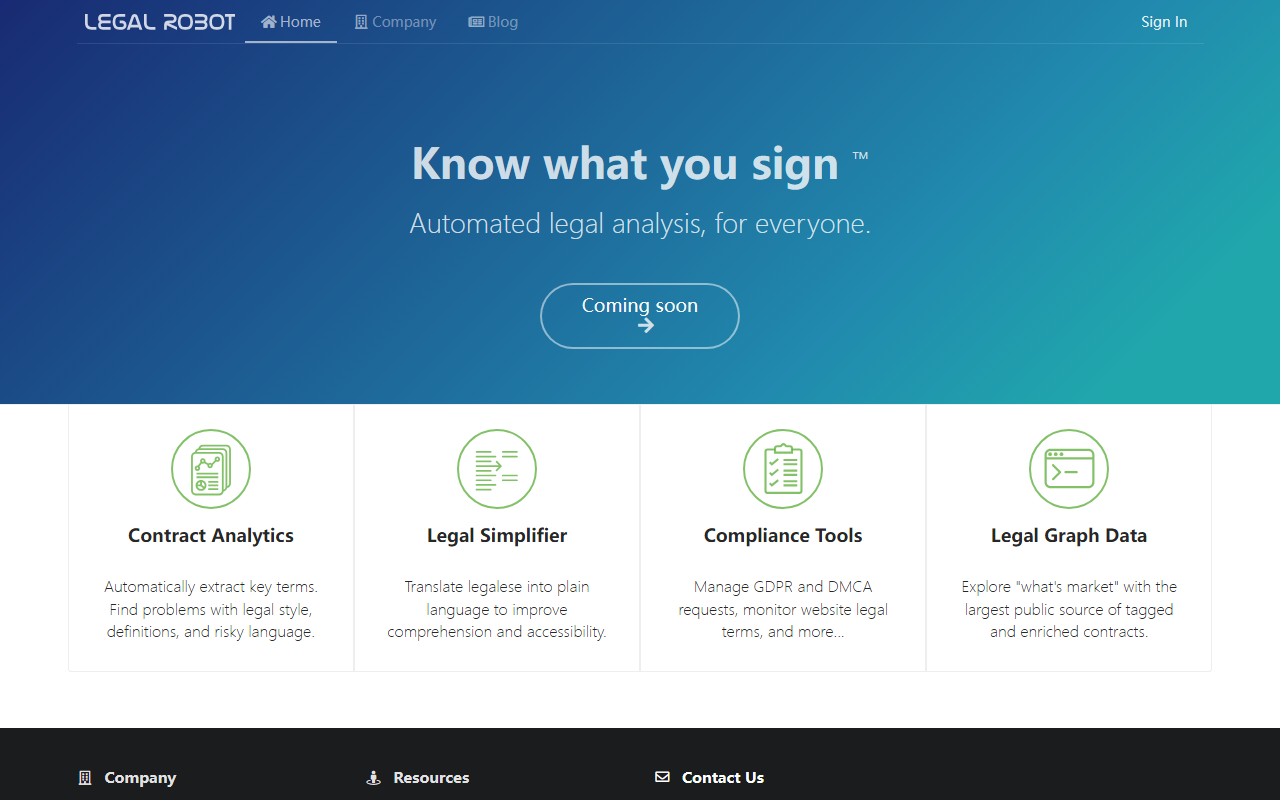
Upon visiting the Legal Robot website, I was greeted by a clean, modern dashboard that immediately communicates the platform's core value proposition: automated legal analysis for everyone. The homepage prominently features a “Coming soon” banner, which suggests the tool is not yet fully launched or is in a limited beta phase. Despite this, the site provides a clear navigation menu with links to Company, Blog, Careers, Press, Security, Resources, FAQs, Support, Legal & Privacy, and Sign In.
The dashboard itself shows four main feature modules: Contract Analytics, Legal Simplifier, Compliance Tools, and Legal Graph Data. Each is presented as a card with a brief description. For example, Contract Analytics promises to automatically extract key terms and identify problems with legal style, definitions, and risky language. Legal Simplifier aims to translate legalese into plain language, which could be a game-changer for non-lawyers. Compliance Tools mention managing GDPR and DMCA requests, and Legal Graph Data offers the largest public source of tagged and enriched contracts.
During my exploration, I attempted to sign in or sign up, but the link redirected to a placeholder page. Without active user accounts, I could not test the actual AI responses or workflows. The site does have a contact email and physical address, indicating a real company behind the product.
Core Features and Technical Underpinnings
Legal Robot is positioned as a comprehensive AI reading and analysis tool specifically designed for legal documents. The four main features suggest a deep focus on contract lifecycle management and legal compliance automation. The Contract Analytics feature likely uses natural language processing (NLP) to parse contracts, extract clauses, and flag risky language—similar to what tools like Kira Systems or Luminance offer, but aimed at a broader audience.
The Legal Simplifier feature is particularly interesting: by converting legalese into plain language, it addresses a common pain point for individuals and small businesses who cannot afford lawyers to review agreements. The Compliance Tools for GDPR and DMCA are timely, given the increasing regulatory demands on companies of all sizes. The Legal Graph Data feature hints at a data-driven approach, perhaps using machine learning to analyze patterns across millions of contracts to determine what is "market" in specific industries.
Technically, while the website does not explicitly mention which AI models or APIs power the platform, the technology likely involves transformer-based language models (like GPT variants or BERT) fine-tuned on legal corpora. The mention of “Legal Graph Data” suggests a graph database or knowledge graph backend to link clauses, terms, and legal concepts. There is no information about API availability or integrations, but given the category, one might expect future integrations with document management systems.
Pricing and Market Positioning
Pricing is not publicly listed on the website. The “Coming soon” status and lack of a pricing page indicate that Legal Robot is either in a pre-launch phase or still finalizing its business model. This is a significant gap for potential users who need to evaluate cost-effectiveness. For context, competitors like LawGeex and Kira Systems typically charge per-document or subscription fees ranging from hundreds to thousands of dollars per month, often targeting enterprises. Legal Robot’s “for everyone” tagline suggests it may aim for a more accessible price point, perhaps freemium or affordable monthly tiers.
Compared to alternatives, Legal Robot’s focus on plain-language simplification and compliance tools (especially GDPR and DMCA) sets it apart from pure contract review platforms. However, without pricing details or a live product to test, it is difficult to assess its value proposition fully. The company is based in Vallejo, California, and lists a contact email ([email protected]). The site’s blog and press sections are empty placeholders, so there is limited evidence of user base or funding.
Strengths, Limitations, and Final Recommendation
The genuine strength of Legal Robot lies in its ambition to democratize legal analysis. The combination of contract analytics, simplification, compliance, and data enrichment covers a wide range of use cases. The UI is intuitive and the feature set is well-organized, which suggests thoughtful product design. If the AI performs as advertised, it could save time and money for startups, freelancers, and small legal teams.
However, the major limitation is the lack of a working product. As of this review, the platform is essentially a landing page with no demo, trial, or visible outputs. The “Coming soon” notice makes it impossible to evaluate accuracy, speed, or supported document formats. Additionally, the absence of pricing, user testimonials, or case studies undermines trust. While the concept is promising, it remains unproven until we can actually interact with the AI.
Who should try Legal Robot? If you are a small business owner, freelancer, or non-profit that regularly signs contracts but cannot afford a lawyer, this tool could be a valuable resource once launched. Legal tech enthusiasts and early adopters should also keep an eye on it. Who should look elsewhere? Anyone needing a live, production-ready solution today should consider proven alternatives like LawGeex, Ironclad, or DocuSign's agreement cloud. Legal Robot may be worth a bookmark and a follow-up in 6–12 months.
Visit Legal Robot at https://legalrobot.com/ to explore it yourself.













Comments