

First Impressions and Onboarding
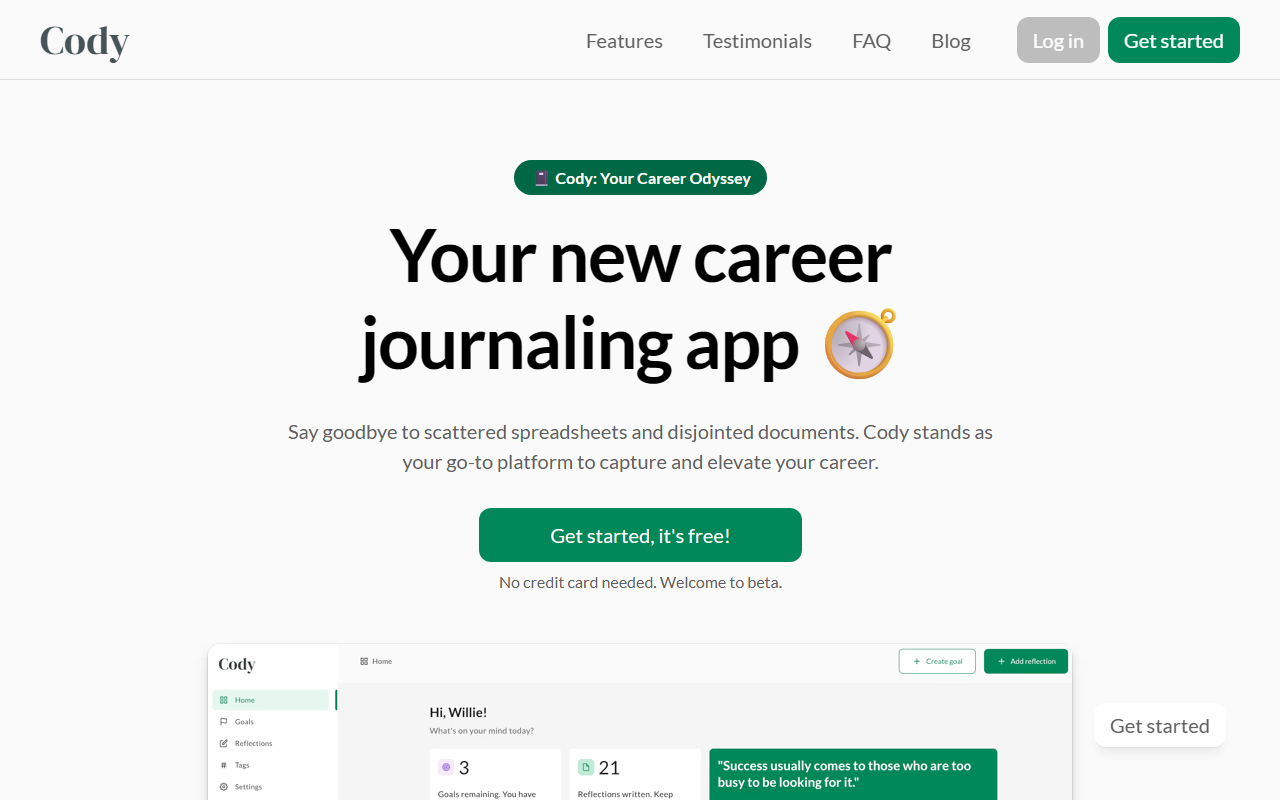
Upon visiting mycody.io, I was greeted with a clean, minimalistic landing page that immediately sets expectations: this is a career journaling app, not a generic note-taker. The call-to-action is prominent: "Get started, it's free!" with a note that no credit card is needed, which is refreshing for a beta. The brief tagline—"Say goodbye to scattered spreadsheets and disjointed documents"—makes the pain point clear. I clicked "Get started" and was walked through a very short sign-up flow requiring only an email and password. No lengthy questionnaires. The dashboard then appeared, displaying a simple interface with a sidebar for journal entries, goals, tags, and a section labeled "Insights." There is a prominent button to add a new reflection, which opens a clean text editor with optional tags and goal association. While testing the free tier, I quickly saw how the app prompts you to log what you worked on, any wins, and learnings. The whole process felt more guided than a blank journal, which is exactly the problem the tool claims to solve.
Core Features and Technical Observations
Cody is fundamentally a structured career journal augmented by AI. The core workflow: you write daily reflections, tag them by skill/project/lesson, align them with goals, and later surface insights. The AI analysis is not generative in the sense of creating new content from scratch; rather, it appears to summarize your entries over time and identify patterns. The website mentions "personalized and actionable feedback," and during my short test, after logging three entries, the Insights tab showed a preliminary summary of my recurring themes. It is not clear which underlying AI model powers this—likely a GPT variant or a fine-tuned language model, but the site does not specify. The app also offers goal-setting: you can create career objectives and link reflections to them. Tags are fully customizable, which is useful for organizing by skill, project, or any taxonomy you prefer. The mobile-friendliness is genuine—the web app is responsive and usable on a phone browser. There is no native mobile app yet, but the beta status explains that. Additionally, there is an email reminder feature to prompt daily logging, which I found thoughtful. Notably, there is no import/export feature or API mentioned; it appears to be a closed, standalone tool for now. Compared to more mature journaling apps like Day One or Journey, Cody's focus on career context and AI analysis sets it apart, though those competitors offer richer media support and cross-platform sync.
Pricing, Market Position, and Suitability
At the time of review, Cody is completely free during beta. The website states, "No credit card needed. Welcome to beta." There is no indication of future pricing tiers, but given the features, a freemium model with paid plans for advanced analytics or unlimited reflections is likely. The tool is best suited for professionals who struggle to remember their achievements for performance reviews, job interviews, or career planning. Product managers, engineers, designers—anyone with a project-based workflow—would benefit. It is less suited for creative free-form journaling or for teams (there is no collaboration feature). The tool is still early; some user testimonials on the site mention a learning curve and a desire for video/audio logging. If you need robust offline support, heavy data export, or integration with calendars/task managers, Cody will currently fall short.
Strengths, Limitations, and Recommendation
The genuine strength of Cody is its singular focus on career reflection. By combining structured journaling, goal alignment, and AI-powered pattern recognition, it fills a niche that generic journal apps ignore. The interface is intuitive and fast, and the free beta access lowers the barrier. However, limitations are clear: the AI insights are still somewhat shallow—the site promises "personalized and constructive feedback" but in my test the summaries were basic. Also, the lack of a native mobile app and limited export options may deter power users. The tool is very much in its infancy; the roadmap is not shared, so it is unclear how quickly features will evolve. That said, for someone looking to rebuild their career reflection habit from scratch, Cody is a promising start. I recommend trying it if you often forget your weekly wins or dread filling out self-assessments. It is not yet a mature career-coaching replacement, but it is a solid foundation.
Visit Cody at https://mycody.io/ to explore it yourself.













Comments