

First Impressions: Onboarding and Interface
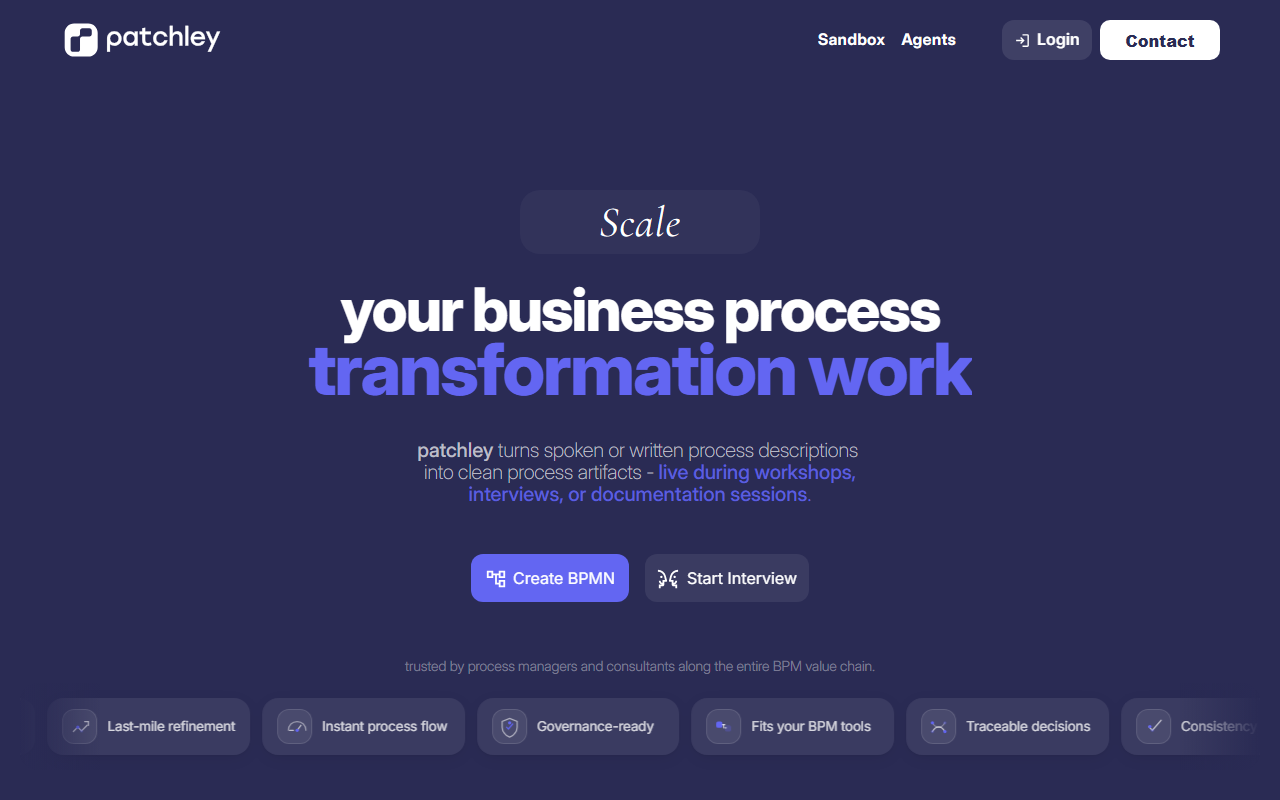
Upon visiting patchley.com, the landing page immediately greets you with a bold tagline: "Transform your business process transformation work." The layout is clean and modern, with two primary call-to-action buttons: "Create BPMN" and "Start Interview." I clicked "Start Interview" to simulate a live discovery session. A modal asked me to describe a process in plain language or upload notes. I typed a short procurement workflow, and within seconds the platform generated a basic BPMN diagram. The real-time response was impressive, though I noticed the diagram needed minor refinements for gateways. The top navigation includes "Sandbox" and "Agents," hinting at deeper functionality. For a first-time user, the onboarding feels intuitive, though no tutorial video is provided. The embedded "Test now" buttons for each agent suggest a tiered approach to exploring features.
Core Features and Technology
patchley is purpose‑built for process managers and consultants who need to turn spoken or written descriptions into BPMN 2.0‑compliant diagrams during live workshops, interviews, or virtual meetings. The platform offers three main agents: AI‑guided Process Discovery (moderates conversations or passively listens), BPMN 2.0 Process Map Generator (converts text to diagrams), and Image‑to‑Process Map Converter (extracts models from workshop photos). Under the hood, the NLP engine appears to be a large language model fine‑tuned on business process patterns; it supports any language and provides consistency checks. The output is governance‑ready and fits automation tools like Camunda or Signavio. Notably, patchley emphasizes “traceable decisions,” meaning every arrow in the diagram can be linked back to a stakeholder statement. Integration options aren’t explicitly listed, but the site claims the output is “automation‑ready.”
Pricing and Market Positioning
Pricing is not publicly listed on the website, which is a notable gap for budget‑conscious buyers. The tool likely targets enterprise teams already investing in BPM software. Competitors such as Signavio offer full suite management but are heavy and expensive, while Miro provides whiteboard collaboration without BPMN compliance. Unlike both, patchley focuses exclusively on real‑time capture of human conversations into structured process artifacts. It is best suited for process consultants running discovery sessions, internal BPM teams conducting workshops, or anyone needing to quickly document as‑is and to‑be processes. Teams seeking a low‑cost or self‑hosted solution will need to wait for transparent pricing. The “trusted by process managers” claim suggests early adoption in consulting firms, but no specific user numbers are provided.
Strengths, Limitations, and Verdict
Strengths: Speed – generates a first process map in seconds; real‑time capture reduces post‑meeting documentation effort; BPMN 2.0 compliance ensures compatibility with existing automation stacks; multiple working modes (workshops, interviews, virtual meetings, solo) cover almost every scenario. The sandbox and agent sections hint at a flexible architecture for different use cases.
Limitations: Without transparent pricing, evaluating ROI is difficult. The free tier (if any) is not visible – I could only access limited testing via the landing page buttons. For complex processes with many decision points, the AI occasionally misinterpreted logical flows, requiring manual correction. No API details or export formats beyond BPMN are mentioned, which may hinder integration into wider toolchains.
Verdict: patchley is a promising tool for teams that need to convert messy, conversational process knowledge into structured BPMN diagrams quickly. It shines in the discovery and documentation phase, but users should test it on their own real‑world scenarios before committing. If transparent pricing and API access become available, it could become a staple in the BPM consultant’s toolkit.
Visit patchley at https://patchley.com/ to explore it yourself.













Comments