

First Impressions: A Purpose-Built Analytics Hub for Ecommerce
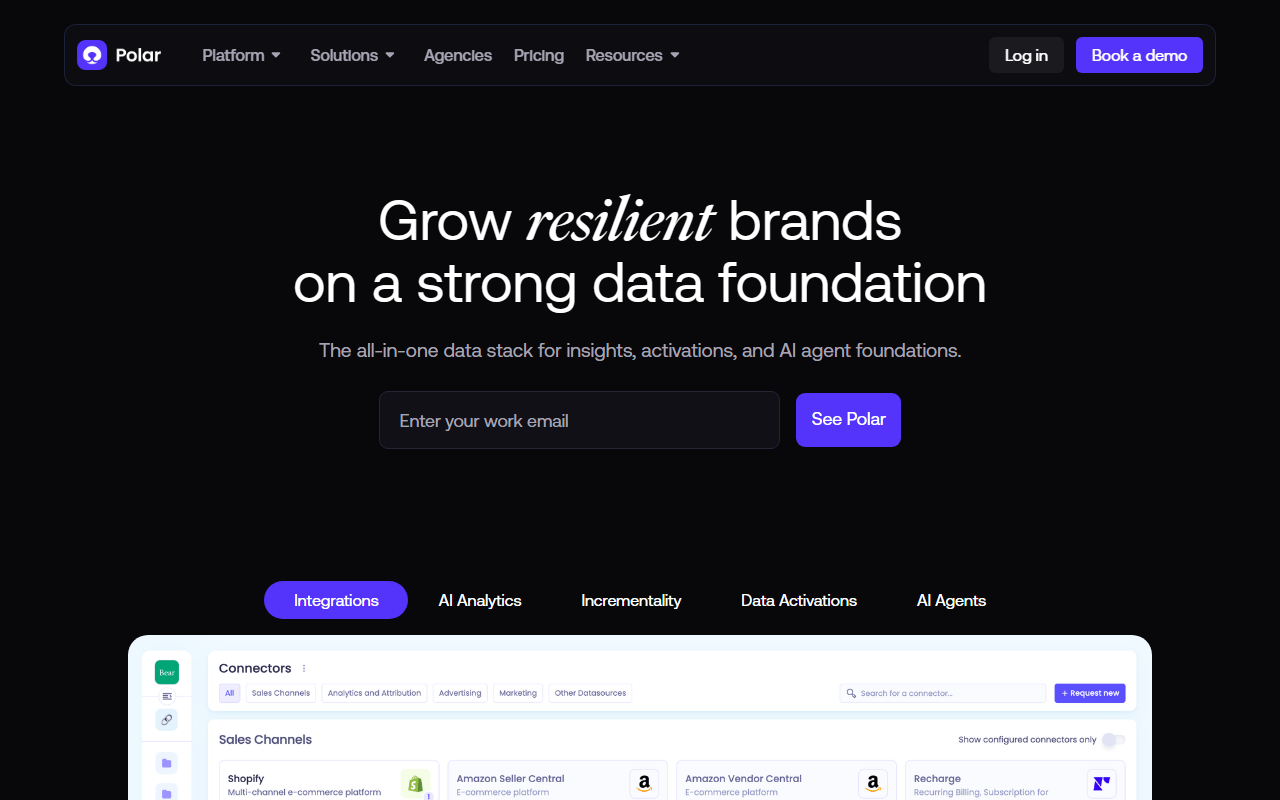
Upon visiting polaranalytics.com, I was struck by how clearly the platform positions itself for ecommerce. The homepage immediately highlights integrations with Shopify, Klaviyo, Meta, and Google, and the tagline—'Grow resilient brands on a strong data foundation'—sets expectations for a serious analytics tool. I clicked the 'Instant demo' button, which let me test-drive the tool with demo data without signing up. No friction, no credit card. That level of accessibility is rare for enterprise-grade analytics.
The dashboard I saw was clean and focused on commerce metrics: revenue, ROAS, customer acquisition cost, and inventory levels. The interface uses a left-side navigation with sections for Insights, Data Activations, and AI Agents. Even from a 10-minute demo walkthrough, I could see Polar collects data from multiple sources into a single Snowflake data warehouse, normalizes it with a semantic layer of pre-built metrics, and surfaces actionable insights. The onboarding experience felt intuitive—I could drag and drop metrics, apply filters, and create custom reports without reading a manual.
Core Platform: From BI to AI Agents
Polar is not just a reporting tool; it’s a full data platform. Under the hood, each customer gets their own Snowflake instance, which is a serious technical foundation. Connectors include one-click integrations for Shopify, Klaviyo, Meta, Google Ads, and more. The semantic layer automatically maps hundreds of dimensions and metrics (e.g., 'Gross Profit Margin by Channel' or 'Incremental ROAS'). This eliminates the messy data modelling we often see with looker or Power BI.
Where Polar differentiates is its AI Agent suite. I explored the Data Analyst Agent: I typed a question in plain English—'What was my blended ROAS last week by campaign?'—and within seconds, the agent returned a table with exact numbers and a brief written analysis. The Media Buyer Agent, Email Marketer Agent, and Inventory Planner Agent work similarly, each trained on commerce-specific logic. The standout for me was Polar MCP (Model Context Protocol), which lets you feed clean commerce data directly to Anthropic’s Claude. In the demo, I saw a 'Profitability deep-dive' Claude prompt that analysed margin trends across SKUs. For agencies and brands that rely on AI copilots, this integration is a huge win.
Other features include Incrementality Testing (causal lift to measure true marketing impact), Data Activations like Klaviyo Audience syncs and enhanced conversion signals for Meta/Google, and a First-party pixel for cross-device tracking. Polar claims to be trusted by 4,000+ ecommerce brands and agencies, and the case studies on site show impressive results: +54% email revenue, 36% CAC reduction, $300K saved by replacing an in-house BI setup. Even without my own data, these numbers suggest a robust platform.
Pricing, Competition, and Final Verdict
One major limitation: pricing is not publicly listed. The site has a 'Pricing' link that leads to a 'Book a demo' page. This is common among analytics platforms that require custom quotes based on data volume and feature access, but it’s a barrier for smaller businesses that want to calculate ROI upfront. Based on third-party sources, Polar typically starts around $500–$1,000 per month for mid-sized stores, but I cannot confirm that from official materials. The demo process gives you a tailored quote, not a scalable self-service tier.
Competitors in this space include Triple Whale (strong on marketing attribution) and Northbeam (focused on incrementality). Unlike those, Polar emphasizes an all-in-one stack that includes BI, AI agents, data activations, and a dedicated Snowflake warehouse. It’s more comprehensive but may be overkill for a single-store owner with basic reporting needs. The tool shines for agencies managing multiple Shopify brands and for ecommerce teams needing to unify marketing, finance, and operations data into one view.
Strengths: deeply integrated with Shopify, AI agents that actually return commerce-aware answers, instant demo with no signup, and a semantic layer that saves hours of data prep. Limitations: Shopify-centric (other platforms are supported but the core is Shopify), opaque pricing requires a sales call, and the AI agents currently rely on third-party models (Claude, n8n) for advanced workflows—native automations are still evolving. If you’re a Shopify agency or a scaling brand that wants to centralize analytics and leverage AI without hiring a data team, Polar is one of the strongest options I’ve seen. I recommend booking the demo and testing it with your own data before committing.
Visit Polar at https://polaranalytics.com to explore it yourself.













Comments