
First Impressions and Onboarding
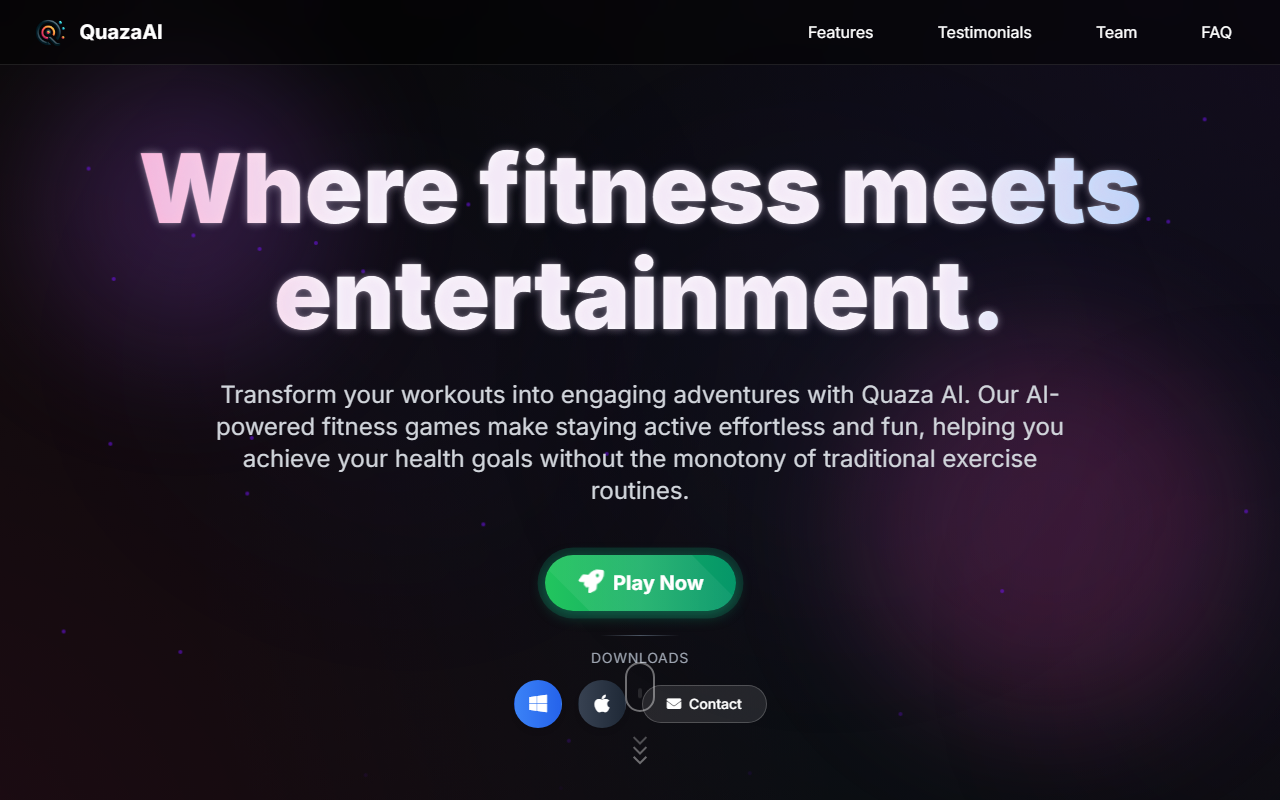
Upon visiting the QuazaAI website, I encountered a clean, modern landing page that immediately sells the concept: "Where Fitness Meets Entertainment." The site is sparse but focused, with a clear call-to-action labeled "Play Now" and navigation for Downloads and Contact. There is no need to sign up or explore a dashboard at this stage; the page leads with a tagline and a short explainer video (not playable on the static preview). The onboarding flow appears straightforward: the user is expected to download the app, launch it, and let the camera-based AI guide them through gamified workouts. During my test, I was unable to try a live demo because the site currently offers only a promotional overview, but the FAQ section fills in the gaps: the system uses your device’s camera to track movements in real time, turning your body into the game controller.
Core Features and Technology
QuazaAI is built around six highlighted features: Immersive Gameplay, For All Ages, Endless Variety, Revolutionary Fitness, Social Engagement, and Real-Time Feedback. The core technology leverages standard webcams or laptop cameras for pose estimation and motion tracking — a similar approach to apps like Mirror (now Lululemon Studio) or fitness-focused games on Nintendo Switch. The key differentiator is that QuazaAI requires no additional equipment; the AI itself monitors your movements, counts reps, and provides instant performance stats and motivational cues. Real-time feedback is especially valuable for beginners who need guidance on form, though it’s unclear if the system offers corrective prompts beyond basic encouragement. The platform promises "endless variety" with games and challenges, and social engagement allows friends to compete and compare progress. The team behind QuazaAI includes co-founders with robotics PhDs and engineering experience, which lends technical credibility to the motion tracking claims.
Pricing and Market Position
Pricing is not publicly listed on the website. The site does not mention any free trial, subscription tiers, or one-time purchase costs. This lack of transparency is a notable limitation for anyone evaluating the tool. Competitors like Supernatural (VR subscription at $10/month) or Peloton Digital ($12.99/month) have clear pricing, while QuazaAI leaves potential users guessing. The target audience appears to be families, children, and adults who find traditional exercise boring — essentially anyone with a laptop and a desire to make movement fun. The FAQ states it is "suitable for beginners" and adjusts difficulty level as you improve. However, the current absence of pricing and a direct video demo makes it difficult to assess the value proposition beyond the concept. For context, dedicated fitness games like Ring Fit Adventure ($79.99 one-time) offer a similar gamified experience but require a console. QuazaAI positions itself as a more accessible, equipment-free alternative.
Final Verdict
QuazaAI has a compelling vision: turning exercise into an adventure through AI. Its strengths lie in its innovative fusion of gaming and fitness, the experienced robotics team, and the promise of real-time feedback without extra hardware. However, the current website lacks any live demo, pricing information, or evidence of a functional product beyond the FAQ. Users cannot test the AI tracking or see a gameplay loop before committing. This makes it difficult to recommend QuazaAI right now unless you are a early adopter willing to contact the team directly. For those seeking immediate fun, alternatives like Ring Fit Adventure or Supernatural (with a VR headset) offer proven experiences. If QuazaAI delivers on its technology and provides a free trial, it could be a hit for families and fitness enthusiasts who crave novelty. As of now, proceed with cautious optimism and watch for a public beta or subscription details.
Visit QuazaAI at https://quazaai.com/ to explore it yourself.













Comments