

A Deep Dive Into Receptiviti: Reading Psychological Signals From Language
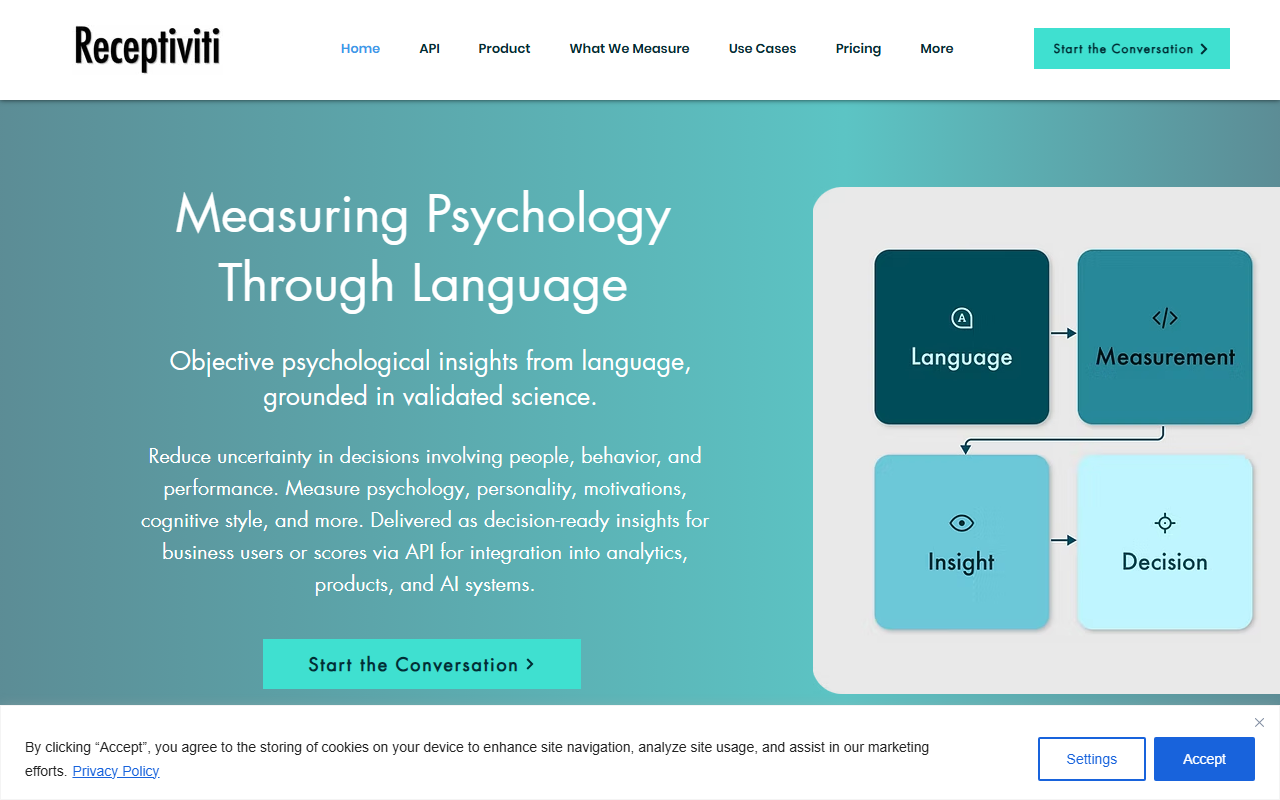
Upon visiting Receptiviti’s site, I immediately noticed the emphasis on scientific rigor. The homepage cites over 34,000 research citations and 200+ validated measures, which sets a serious tone. This isn’t another simple sentiment analyzer; it claims to decode personality, motivations, cognitive style, and emotional wellbeing from written text. The tool offers two main access points: the Receptiviti API for developers and data teams, and Loquent Applied Insights, a newer no-code interface designed for business users who want immediate psychological interpretation without building models.
When testing the available documentation, I was impressed by the depth. Receptiviti’s framework evolves from LIWC (Linguistic Inquiry and Word Count), a gold standard in behavioral science. The tool analyzes language along five core dimensions: Motivations & Values, Decision-making & Thinking Style, Communication & Social Dynamics, Emotions & Wellbeing, and Personality & Interpersonal Style. That’s considerably more sophisticated than typical text analysis tools that stop at sentiment or basic emotion detection.
What Receptiviti Does Best
Receptiviti solves a specific problem: turning raw text into objective psychological insights without requiring a psychology degree. For organizations, this reduces uncertainty in decisions involving people. The use cases are well-defined on the site: due diligence (assessing confidence, bias, integrity in financial communications), marketing (understanding audience motivations), HR (leadership assessment, team dynamics), sports (mental toughness, coachability), and even generative AI safety (measuring how AI interactions affect users over multi-turn conversations).
During my research, I found that the API provides access to “proprietary frameworks” that quantify these psychological signals. The Loquent interface appears to be a recent addition that makes these same signals accessible to analysts and business leaders directly. This dual approach is smart: one for integration, one for immediate use. Pricing is not publicly listed on the website, which is common for enterprise B2B tools that require consultation. However, the absence of transparent pricing can be a barrier for smaller teams wanting to evaluate the tool without a sales call.
Competitors in this space include older tools like IBM Watson Personality Insights (now deprecated) and newer ones like Grammarly’s tone detector, though those are far more superficial. Receptiviti’s scientific backing and breadth of measures set it apart. Unlike standard NLP services that classify sentiment or emotion, Receptiviti aims to measure enduring psychological traits, which is a harder problem. The 200+ validated measures suggest broad coverage, but the real-world accuracy depends heavily on the quality and length of input text. The site notes that the science is “repeatable,” implying reliability—a strong claim that warrants cautious optimism.
Strengths and Honest Limitations
Receptiviti’s strengths are clear: deep scientific validation, flexibility via API, a new no-code layer, and a wide range of psychological constructs. The fact that it covers personality, values, thinking style, and emotional wellbeing in one tool is a significant time-saver for researchers and HR teams. The company’s focus on generative AI safety—analyzing how AI conversations affect users psychologically—is forward-looking and addresses a pressing need.
However, limitations exist. First, the lack of public pricing makes it hard to assess cost-effectiveness. The tool appears enterprise-oriented, so smaller startups may find it out of reach. Second, while the science is robust, the platform requires users to understand what psychological measures mean. A raw score on “decision-making style” is only useful if you know how to act on it. The Loquent tool aims to bridge this gap, but I suspect onboarding still requires some expertise. Third, the website does not offer a sandbox or free trial without contacting sales, which reduces the ability to test real-world performance before committing.
Additionally, the tool might struggle with very short texts or non-English language (the site does not specify multilingual support). For casual users looking for a quick personality test from social media posts, Receptiviti is overkill; simpler tools like Crystal Knows or email-tone checkers would be more appropriate.
Final Verdict: Who Should Use It
Receptiviti is best suited for enterprise data teams, HR analytics professionals, market researchers, and custom application developers who need psychologically valid insights from text. If your organization works with large volumes of customer feedback, interviews, open-ended surveys, or investor communications, Receptiviti can add a layer of understanding that standard NLP misses. It is not for individuals or small teams who need a quick, free personality test or basic sentiment analysis.
For serious practitioners—especially those already familiar with LIWC or psycholinguistics—Receptiviti offers a state-of-the-art platform. I recommend starting with their introductory brochure (available on the site) and scheduling a demo to see the Loquent interface in action. Given the lack of public pricing, a direct conversation is essential to gauge fit. Visit Receptiviti at https://receptiviti.com/ to explore it yourself.













Comments