

First Impressions and Onboarding
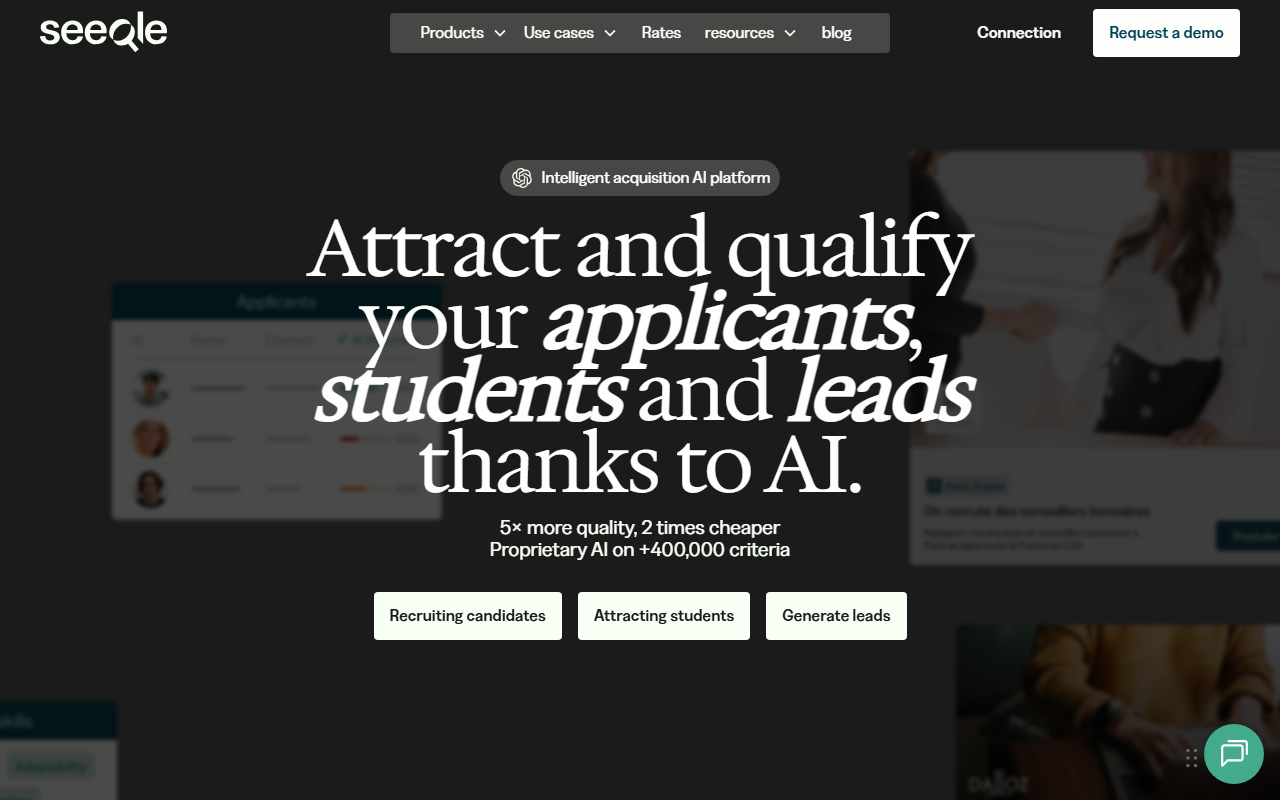
Upon visiting the Seeqle homepage at seeqle.com, the first thing I noticed is that the entire interface is in French. That immediately signals its primary target audience: French-speaking recruiters and HR teams in France, Belgium, Switzerland, and Canada. The layout is clean, with a prominent 'Demander une démo' (Request a demo) call-to-action. There is no free trial or self-service onboarding visible. Instead, the site guides visitors toward understanding three use cases: recruiting candidates, attracting students, and generating B2B leads. I observed that the menu offers 'Cas d’usage', 'Tarifs', and 'Ressources', but clicking 'Tarifs' does not lead to a pricing page—it simply scrolls down to a request-demo section again. This suggests that pricing is custom and not publicly listed.
Core Technology and Solutions
Seeqle’s value proposition revolves around a proprietary AI engine that analyzes over 400,000 criteria to automate the entire acquisition funnel—from visibility to qualification. The tool is split into two main solutions: Seeqle Attract and Seeqle Match. Attract handles discovery by automatically distributing job postings as targeted advertisements across the web, including social media, websites, and mobile apps. Match then enriches and pre-qualifies applicants using AI scoring, integrating directly into the user’s Applicant Tracking System (ATS). The claimed results are impressive: 53% qualified applications (versus under 10% industry average), 50% cost reduction, 76% boost in brand visibility, and 45% time savings on sourcing. During my review, I found a blog section with articles on programmatic recruitment and employer branding—useful for context but not a deep technical explanation of the model architecture. From a technical standpoint, Seeqle uses programmatic HR technology, essentially applying AI-driven ad buying to recruitment. While no specific model name is disclosed, the 400k-criteria dataset suggests a robust machine learning system trained on HR data.
Pricing, Alternatives, and Recommendation
As noted, pricing is not publicly listed. Users must book a demo to get a quote. This is common for enterprise B2B tools, but it makes it harder for smaller teams to evaluate upfront. Competitors in the AI recruitment space include Ideal (focuses on resume screening) and HireVue (video interviewing and assessment). Seeqle differentiates itself by owning the entire acquisition workflow from advertising to qualification, rather than just one step. A clear strength is the measurable quality lift—53% qualified application rate is well above industry benchmarks. However, a real limitation is the geographic and language focus: unless you operate in French-speaking markets, Seeqle may not be relevant. Additionally, without a self-service option, the onboarding process involves sales and likely requires a minimum commitment. I recommend Seeqle for HR teams and educational institutions in French-speaking regions that want to scale recruitment efficiently and improve employer branding through automated, data-driven advertising. For smaller startups or English-only operations, look elsewhere. Visit Seeqle at https://seeqle.com/ to explore it yourself.













Comments