

First Impressions and Onboarding
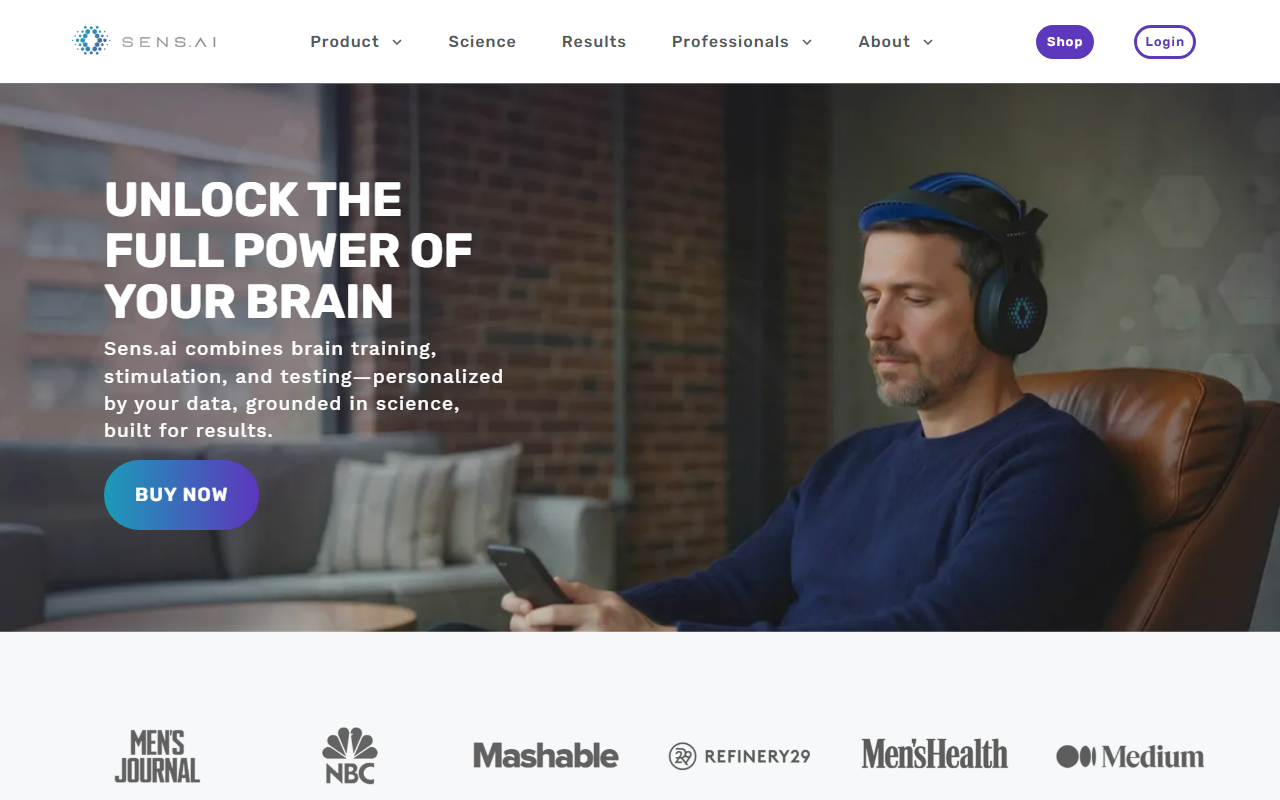
Upon visiting the Sens.ai website, I was immediately struck by its clean, science-forward design. The headline "Measure Your Brain. Train It. Change Your Trajectory." sets a high bar. There is no sign-up form on the landing page—instead, a prominent button invites you to "Start Your 60-Day Trial." Clicking through leads to a brief questionnaire about your goals (focus, sleep, stress reduction, etc.) and then a checkout page. Notably, pricing is not publicly listed on the website. You must begin the trial to see the cost, which is a friction point for transparency. The onboarding suggests you will receive a wearable headset (an EEG cap) shipped to you, paired with a mobile app for daily 15-minute sessions.
How Sens.ai Works: The Technology Behind the Claims
Sens.ai is not just another meditation app. It uses a combined EEG (electroencephalogram) and ERP (event-related potential) sensor to capture 643 biomarkers from your brain in a single session. The company has developed a metric called BrainYears™, developed in collaboration with the Buck Institute for Research on Aging. In a published cohort, participants showed a mean improvement of 5.1 BrainYears™ younger after 56 days. That is a compelling number, but the website does not disclose the sample size or peer-reviewed publication status. The system then builds a personalized program that adjusts session by session based on your real-time brain data. Unlike competitors like Muse or BrainTap, which focus on meditation guidance or light/sound stimulation, Sens.ai positions itself as a medical-grade cognitive training tool.
Strengths and Real Limitations
The strongest aspect of Sens.ai is its foundation in neuroscience. The use of EEG+ERP to track functional brain age is a significant leap beyond consumer EEG toys. The partnership with Stanford and the Buck Institute adds credibility. For users willing to commit 15 minutes daily, the potential for measurable cognitive improvement is real. However, limitations are equally real. First, the price: without transparent pricing, many potential users will bounce. Second, the hardware dependency—losing or damaging the headset ends the program. Third, the claims of "5.18 BrainYears younger in 56 days" come from a single controlled cohort; independent replication is missing. Finally, the platform is best suited for adults with specific cognitive decline concerns or high-performing individuals wanting an edge. It is not for casual users or those looking for a simple meditation aid.
Final Verdict: Who Should Try Sens.ai?
Sens.ai is an ambitious tool that merges neurofeedback with quantified self-tracking. If you are a biohacker, aging professional, or someone with mild cognitive complaints and are willing to invest both money and daily time, the 60-day trial is a low-risk way to test the claims. However, if you dislike wearing sensors, want instant results, or need a budget-friendly solution, look elsewhere—maybe start with a meditation app and a sleep tracker. The lack of public pricing and limited independent data are red flags that demand caution. For now, Sens.ai is a fascinating but niche option in the brain-training space. Visit Sens.ai at https://sens.ai/ to explore it yourself.













Comments