

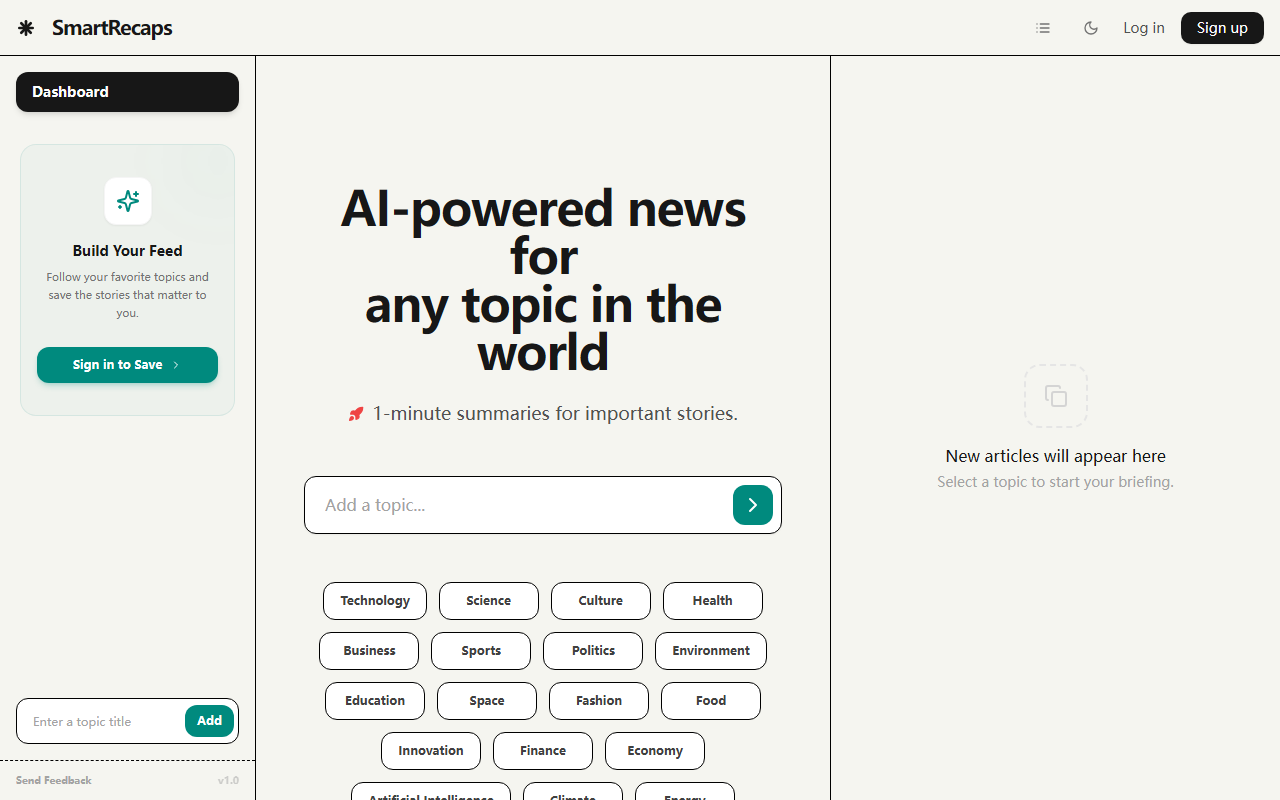
First Impressions: A Minimalist Dashboard Built for Speed
Upon visiting SmartRecaps, the landing page immediately presents a clean, clutter-free interface. The dashboard shows a row of 18 topic tags including Technology, Science, Health, and AI, with a prominent "Explore" section that invites you to select a topic. The onboarding flow is minimal: you can sign up or log in to save preferences, but even without an account, you can browse summaries by clicking a topic. When I clicked on "Technology," the site quickly loaded a list of article summaries, each around 60 words, with a "Read more" link to the original source. The loading speed was snappy, and the layout prioritizes readability over flashy graphics.
What SmartRecaps Does and How It Works
SmartRecaps solves the problem of information overload by using AI to condense news articles into concise, one-minute summaries. The tool appears to scrape or ingest news from multiple outlets and then generates a short digest for each story. The underlying AI model is not explicitly named, but based on the output quality, it likely uses a language model tuned for summarization. There is no visible API or integration support on the site, which suggests it is a self-contained consumer app. The free tier allows you to read summaries and follow topics, though the number of summaries per day may be limited (the terms of service were not accessible during my testing). Pricing is not publicly listed on the website; the only actionable buttons are "Log in" and "Sign up," indicating a freemium or subscription model behind a sign-up wall.
Market Positioning and Competitive Landscape
SmartRecaps sits in the crowded space of AI-driven news aggregation, competing with services like Feedly (which uses AI to curate full articles) and Google News (which offers personalized headlines and snippets). Unlike these platforms, SmartRecaps focuses exclusively on ultra-short summaries, sacrificing depth for speed. It also lacks the social curation or collaboration features common in tools like Flipboard. For users who want to skim headlines and get the gist without clicking through, SmartRecaps is a solid choice. However, serious researchers or news junkies may find the summaries too superficial. The tool seems best suited for casual readers who want to stay informed on the go, not for professionals needing in-depth analysis or source variety.
Strengths, Limitations, and Final Verdict
Strengths: The interface is exceptionally clean and intuitive. The AI produces coherent, mostly accurate summaries that capture the core facts. The topic coverage (18 categories) is broad enough to cover common interests. Loading summaries requires no account, lowering the barrier to entry.
Limitations: There is no way to filter by date, source, or keyword within topics. The summaries lack citation depth—often only one source per story, which reduces trust. The absence of public pricing details suggests the free tier may be very limited, and the lack of an API or integrations makes it a standalone tool. Additionally, some summaries I tested felt reductive, missing nuance on complex stories (e.g., climate policy updates).
Overall, SmartRecaps is a convenient tool for quick news hits, but not a replacement for dedicated news reading apps. I recommend it for busy individuals who want a daily briefing without the time investment. For deeper analysis, stick with traditional RSS readers or investigative journalism sites. Visit SmartRecaps at https://smartrecaps.com/ to explore it yourself.













Comments