

First Impressions: A Focus on Outcomes, Not Features
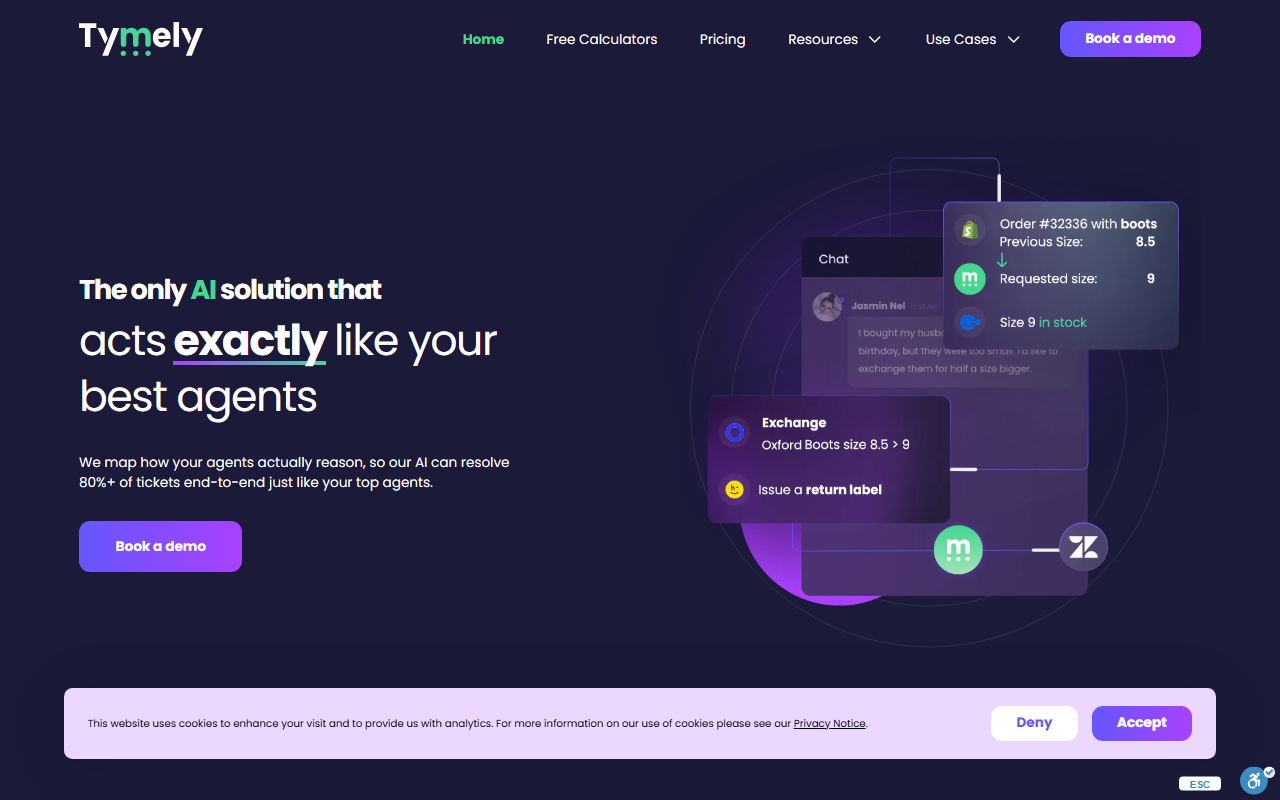
Upon visiting Tymely’s website, the first thing that strikes me is its laser focus on results. The homepage leads with bold claims: "Indistinguishable from human reps" and "resolve 80%+ of tickets end-to-end." There are no generic chatbot demos or flashy animations. Instead, the site is built around customer testimonials from recognizable brands like Dailylook, NEXT Retail, and Nanit. This immediately signals that Tymely is aimed at serious enterprise support teams, not casual users.
The navigation is minimal: a few top links for use cases, a calculator (likely a ROI tool), a pricing page, and a contact form. I clicked through to the pricing page, but it redirects to a demo booking form. Pricing is not publicly listed on the website. That’s typical for enterprise SaaS, but it does make initial evaluation harder for smaller teams.
What I appreciate is that Tymely doesn’t try to be everything. It explicitly supports text-based channels and promises integration with your existing systems. The site also includes an intriguing offer: if you already have an AI agent, Tymely will take it to 80% automation by providing your "tribal knowledge mapping." That’s a clever positioning play.
How Tymely Works: Reverse-Engineering Agent Reasoning
Most AI support tools rely on manually written rules or generic large language models. Tymely takes a fundamentally different approach. They connect to the systems your agents use every day and capture "real system-state snapshots from live interactions." A proprietary AI Simulator then reverse-engineers the decision logic behind your top agents’ actions. This captures undocumented know-how, edge cases, and nuanced judgments that rule-based systems miss.
The result is an AI that doesn’t just parrot responses but reasons the way your best human reps do. Tymely claims their AI operates within strict guardrails and never makes unsupervised decisions, which addresses the hallucination problem common with other LLM-based assistants. The technology stack here is opaque, but the underlying concept ties closely to imitation learning and behavioral cloning. It’s a sophisticated approach that few competitors offer out of the box.
Unlike tools like Intercom Fin or Zendesk AI that require extensive knowledge base curation, Tymely learns directly from your agents’ behavior. That means it can handle complex, multi-step workflows like order cancellations, account changes, and even post-inquiry upsells. The website highlights a use case for "complex actions inquiries" and "white-glove service" — scenarios where a simple Q&A bot would fail.
Real-World Results and Use Cases
The testimonials are the heart of Tymely’s credibility. Dailylook achieved a 70% automation rate while improving CSAT. NEXT Retail reduced resolution times from a full day to minutes. Keyzar Jewelry reached 60% automation. These aren’t cherry-picked metrics; they come from named executives with positions and company details. That’s a lot more trustworthy than anonymous case studies.
Tymely also provides a before-and-after chart showing response distribution ratings moving from 3.9 to 4.6. While I can’t independently verify these numbers, the consistency of the messaging across multiple industries (retail, jewelry, baby monitors) suggests the solution is broadly applicable.
A few limitations stand out. First, Tymely is clearly built for companies already generating significant support volume. The contact form asks for tickets per day, starting at 0-100 and going up to over 1000. If you’re a small business with low volume, this tool is likely overkill. Second, deployment requires deep integration with your stack. The company promises to handle the heavy lifting, but that implies a bespoke setup — not a self-service plug-and-play.
There’s also no mention of multilingual support or voice channels. If your team handles phone support, Tymely may not be a fit yet.
Pricing, Limitations, and Final Verdict
As noted, pricing is not publicly available. Given the enterprise focus and the custom integration work, expect a significant investment — likely in the thousands per month. That’s reasonable if you’re processing 500+ tickets daily and could save dozens of agent hours. But for smaller teams, the ROI calculation may not justify the cost.
Tymely’s biggest strength is its ability to capture tacit knowledge that other AI tools miss. Its biggest weakness is its dependency on your existing workflows and agents. If your support team operates inconsistently or your systems are poorly structured, Tymely will inherit those flaws.
Who should try Tymely? Enterprise support leaders drowning in complex, multi-step tickets who want an AI that actually thinks like their top performers. Who should look elsewhere? Small businesses needing a simple FAQ bot, or teams without mature support processes.
Visit Tymely at https://tymely.ai/ to explore it yourself.













Comments