

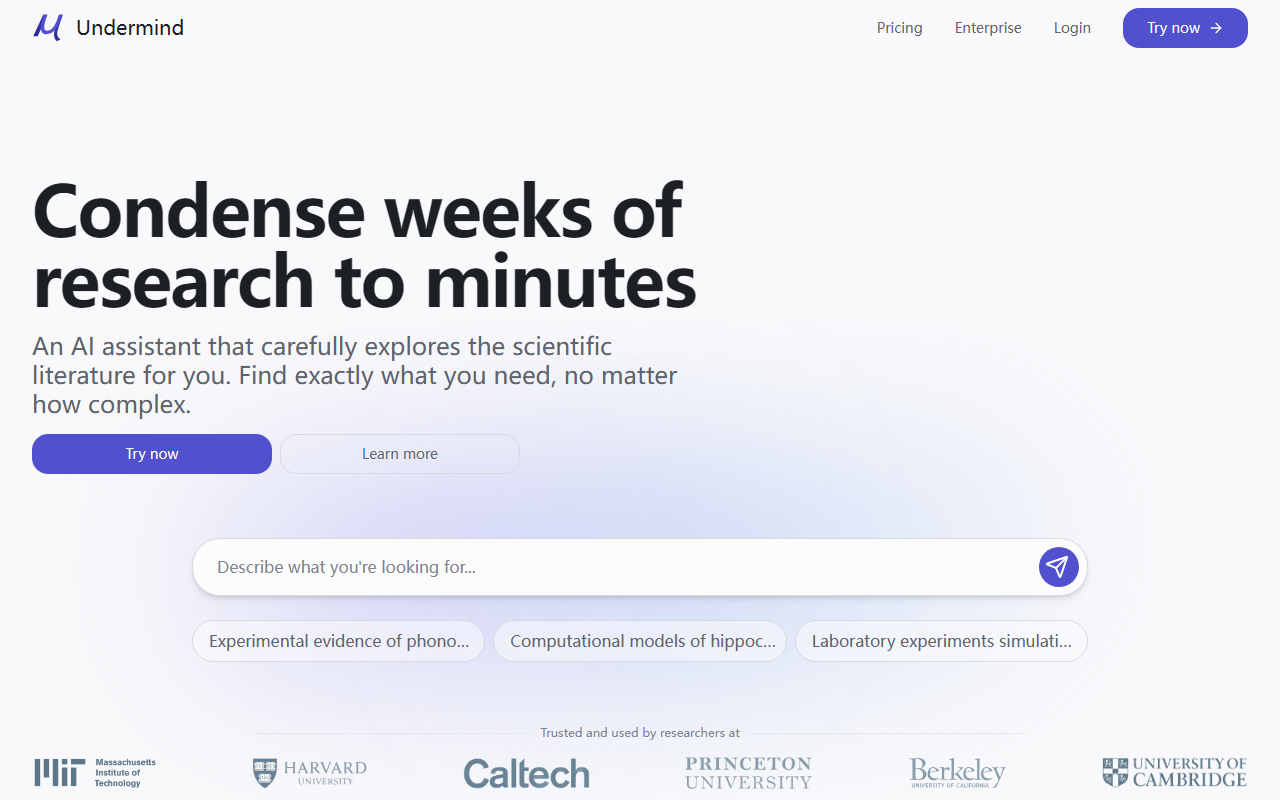
What Is Undermind and How Does It Work?
Upon visiting Undermind's site, I was immediately struck by its laser focus on serving serious researchers. The homepage opens with the tagline “Your AI co-researcher” and a clean interface. Unlike general-purpose AI chat tools, Undermind is built specifically for digging through scientific literature. The core workflow starts with describing your research question. The system then asks follow-up questions to refine the scope—I tested it with a query about “nanoparticle delivery for mRNA vaccines.” It asked about the specific delivery vehicle (lipid vs. polymer) and the target cell type, which impressed me. Once you’re ready, Undermind searches hundreds of papers, follows citation trails, and produces a report with in-line citations and relevance gauges. During my test on the free tier, results appeared within a minute, and I could click any citation to jump to the source PDF. The interface has a split panel: a chat area on the left for iterative refinement and a results panel on the right. The onboarding is straightforward, asking for your research domain to tailor the experience.
Key Features and User Experience
Undermind packs several thoughtfully designed features. The Brainstorm mode allows you to ask questions about the literature and receives structured tables. For example, I asked for a comparison of different CRISPR delivery methods, and it generated a table with columns for method, efficiency, cell type, and citations. This alone saved hours of manual reading. The verification system is another highlight: every claim is linked to its source paper via in-line citations, which builds trust. The relevance gauge (a slider per paper) helps quickly filter out irrelevant results. I also set up an alert for new papers on “lipid nanoparticles in oncology”—the system promised email notifications, though I didn’t have time to verify. Under the hood, Undermind uses its own search algorithm that claims 10× better results than Google Scholar, based on their whitepaper. The quality feels real: I found three papers that didn’t appear in my earlier Google Scholar searches on the same topic. The tool integrates with AI models for summarization and question-answering, likely GPT-4 variants. Overall, the experience is that of a competent research assistant who already knows the literature.
Pricing and Audience Fit
Undermind offers four pricing tiers: Free, Pro ($16/month billed annually), Team ($15/person per month), and Enterprise (custom). The Free tier includes strong AI models, deep searches, and reports, but with standard rate limits. I used it for several queries without hitting limits, so it’s viable for exploratory work. Pro unlocks the latest models, 10× higher usage, and deeper full-text analysis—ideal for active researchers. Team adds collaboration and centralized billing; Enterprise adds custom compute, onboarding seminars, and admin dashboards. Notably, Undermind is already trusted by GSK (over 1,000 scientists), indicating strong enterprise adoption. Compared to alternatives like Elicit ($49/month) or Consensus ($20/month), Undermind’s pricing is competitive, especially with its generous free tier. This tool is best suited for PhD candidates, postdocs, and industry R&D teams who need thorough, ongoing literature monitoring. For casual users or those in non-research roles, Google Scholar or standard AI tools may be sufficient.
Strengths, Limitations, and Verdict
Undermind’s greatest strength is its depth: it doesn’t just retrieve papers but actively reads, synthesizes, and traces connections via citations. The brainstorming and verification features are genuinely useful for hypothesis generation and validation. Its adoption by a top pharma company speaks to its reliability. However, there are limitations. The tool relies on third-party AI models, which can occasionally produce hallucinated details (though citations help). The free tier’s rate limits may frustrate heavy users who need hundreds of searches daily. There is no mobile app, and the interface, while clean, can feel overwhelming for first-time users. Also, coverage is strongest for English-language journals; niche or non-English sources may be missed. Despite these caveats, Undermind is a powerful research companion. I recommend starting with the free tier to see if it fits your workflow. For anyone spending hours on literature review, it can dramatically accelerate discovery.
Visit Undermind at https://undermind.ai/ to explore it yourself.










Comments