

First Impressions and Onboarding
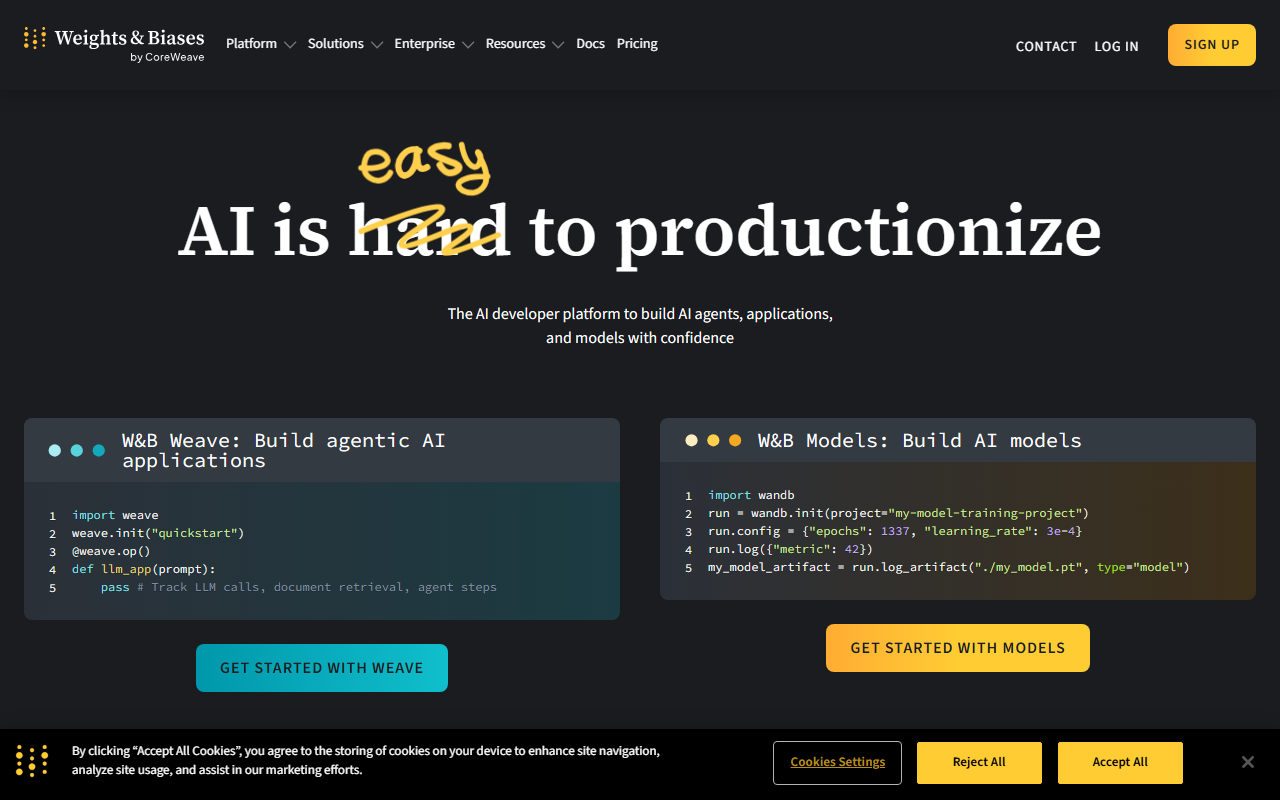
Upon visiting wandb.ai, I was greeted by a clean, modern dashboard that immediately showcases two core products: W&B Weave for agentic AI applications and W&B Models for training and managing AI models. The site emphasizes a single-line-of-code integration, which piqued my interest. I signed up for the free tier and was guided through a quickstart tutorial that walked me through initializing a project with wandb.init() and logging a simple metric. The onboarding flow is smooth, with code snippets ready to copy-paste for popular frameworks like PyTorch, TensorFlow, and Hugging Face Transformers. Within minutes, I had a run dashboard displaying real-time metrics. The mobile app for iOS (now available) is a nice touch for monitoring experiments on the go.
Core Capabilities: Experiment Tracking, Model Training, and Weave
Weights & Biases is primarily a platform for tracking machine learning experiments, managing model registries, and deploying fine-tuned models. Under the hood, it uses a cloud-based backend to log hyperparameters, metrics, artifacts, and code versions. During testing, I fine-tuned a small vision transformer using the free tier. The experiment tracking was seamless: I logged loss curves, learning rates, and model checkpoints with minimal boilerplate. The real-time updates and interactive plots (run.compare) made it easy to spot diverging runs. One standout feature is the Registry, which organizes datasets, models, prompts, and code in a single view. For teams building AI agents, Weave provides op-level tracing—I tested it with a simple OpenAI call and saw every API request logged with latency and token usage. This is invaluable for debugging agentic workflows. The platform also offers serverless RL training (in beta) and inference hosting, aligning with the shift toward production-grade AI.
Enterprise Readiness and Integrations
Weights & Bates differentiates itself from competitors like MLflow and Neptune.ai with its strong enterprise focus. The platform holds ISO/IEC 27001:2022, 27017:2015, 27018:2019 certifications, SOC 2, HIPAA compliance, and aligns with GDPR and NIST 800-53. This makes it a top choice for regulated industries. Integrations are extensive: PyTorch, TensorFlow, Keras, XGBoost, Scikit-learn, Lightning, LangChain, LlamaIndex, and OpenAI. The SDK is lightweight and the API is well-documented. Pricing is not publicly listed on the website; you must contact sales for enterprise tiers. However, the free tier (up to 100 GB of artifact storage and 100 projects) is generous enough for individual developers and small teams testing the waters.
Strengths and Limitations
The biggest strength of Weights & Biases is its unified approach: experiment tracking, artifact management, model registry, agent monitoring, and inference in one place. The UI is intuitive, and the collaboration features (shared reports, team workspaces) streamline cross-team workflows. On the downside, the platform can become expensive for large-scale teams once you exceed the free tier limits—especially if you need dedicated or customer‑managed deployment. Another limitation is the learning curve for Weave’s op‑decorator pattern, which may feel non‑standard for teams already using other logging tools. Additionally, the image AI category suggests a focus on computer vision, but the platform is truly model‑agnostic; there are no specialized image‑specific features (like bounding box annotation) out of the box. For teams that need a tightly integrated MLOps suite with strong enterprise compliance, Weights & Biases is a strong contender. It is best suited for organizations already working on multiple ML projects—especially those incorporating LLMs or agentic systems. Solo practitioners or very small startups might find the cost prohibitive for production use, but the free tier is excellent for experimentation.
Visit Weights & Biases at https://wandb.ai to explore it yourself.












Comments