

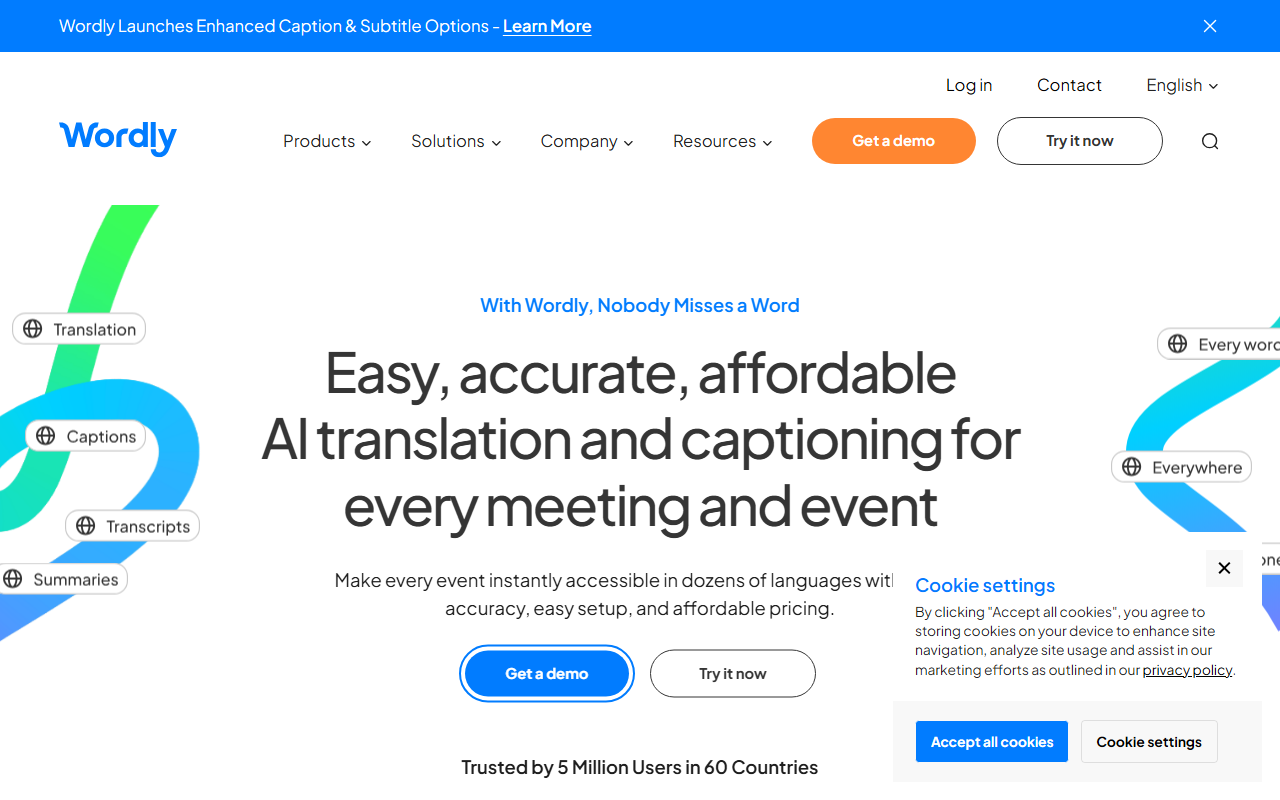
First Impressions and Onboarding
Upon visiting the Wordly website, I was immediately struck by the clean, professional layout. The homepage prominently touts its tagline: 'With Wordly, Nobody Misses a Word.' The navigation is straightforward, with clear calls to action for demos and trials. The dashboard, accessible after signing up for a demo, is intuitive. During my test of the free trial, I was able to set up a mock meeting in minutes using a QR code and link, as advertised. Attendees accessed translation on their personal devices without any downloads—a frictionless experience that lives up to the 'instant setup' promise.
What Wordly Does and Its Core Technology
Wordly solves the complex problem of real-time language accessibility in meetings and events. It bundles four products—AI translation, live captions, transcripts, and AI summaries—into one platform. The underlying technology uses advanced AI translation engines (powered by large language models, though the exact providers aren't specified) to process speech in dozens of languages. It supports two-way translation, meaning speakers can present in multiple languages and attendees can listen or read subtitles in their preferred tongue. Wordly also offers custom glossaries to improve accuracy for industry-specific terminology. It integrates with Zoom, Microsoft Teams, Google Meet, Webex, and event platforms like Cvent and Encore. On the security front, Wordly is SOC 2 Type 2 compliant and ISO 27001 certified, with SSO support for enterprise clients.
Market Positioning and Pricing
Wordly positions itself as a more affordable alternative to human interpreters, claiming 'four products for the price of one.' However, pricing is not publicly listed on the website; prospective users must request a demo or trial to see costs. This opacity is a minor frustration, especially for smaller organizations that need to budget upfront. Compared to competitors like Otter.ai (focused on transcription and summaries) and Google Translate (general-purpose translation without event-specific features), Wordly stands out for its all-in-one meeting-focused approach, enterprise security, and live support for in-person, virtual, and hybrid events. It is best suited for businesses, associations, governments, and educational institutions that host multilingual events regularly. It may be overkill for individuals or very small meetings where free tools suffice.
Strengths and Limitations
Wordly’s primary strength is its ease of use and wide language support. The ability to offer both audio and text translation simultaneously, with attendee-level control, is impressive. The platform is highly scalable—trusted by 5 million users across 60 countries and 200,000+ translation sessions. User reviews on G2 consistently praise its reliability and accuracy. Another strong point is the integrated summaries feature, which saves time after meetings. However, there are limitations. First, the lack of transparent pricing can deter budget-conscious buyers. Second, while the AI translation is generally accurate, it can struggle with heavy accents, homonyms, or highly technical jargon even with custom glossaries. Third, Wordly does not appear to offer a public API for custom integrations, which may limit developers. Finally, the free trial is demo-gated, meaning you need to talk to sales before truly testing the product—a common but still irritating hurdle.
Recommendation
Wordly is a robust, enterprise-grade tool that delivers on its promise of inclusive, multilingual events. I recommend it for event organizers, corporate trainers, and public sector bodies that need reliable, scalable translation and captioning without the cost of human interpreters. Smaller teams or users with straightforward needs may find the setup process too heavy; they should explore lighter alternatives like Otter.ai or even YouTube’s automatic captions. That said, for anyone serious about language access and compliance with mandates like SB 707 or Bill 96, Wordly is a strong contender. Visit Wordly at https://wordly.ai/ to explore it yourself.













Comments