

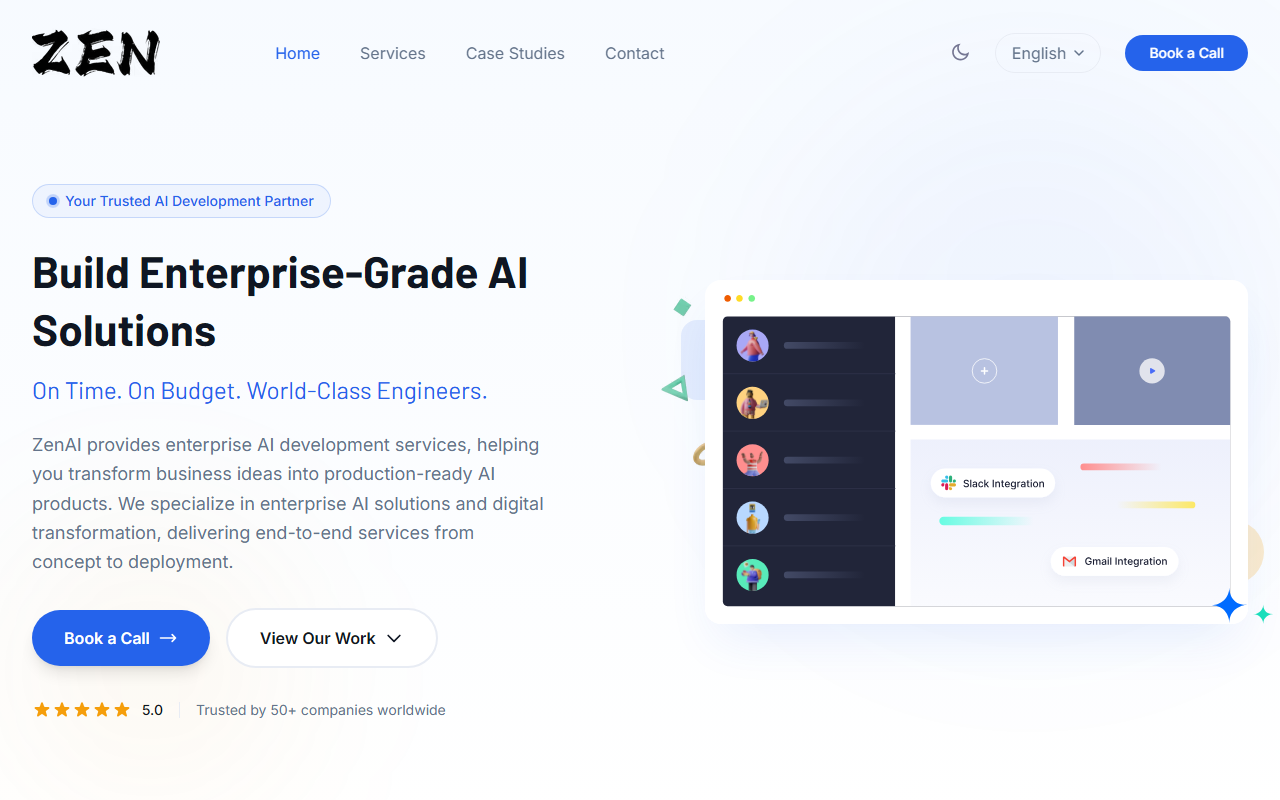
What ZenAI Actually Delivers
Upon visiting the ZenAI website, it's immediately clear this is not a self-service AI tool like an SDK or a drag-and-drop model builder. Instead, ZenAI positions itself as an end-to-end AI development partner—very much in the style of a boutique consultancy. The dashboard is absent; you land on a polished, conversion-focused page with calls to book a call or view work. The homepage leans heavily on trust signals: “Trusted by 50+ companies worldwide,” “10K+ AI R&D Hours,” and “25+ Industry Awards.”
ZenAI's core offering revolves around custom enterprise AI solutions. They break services into four pillars: AI & Intelligent Automation (claiming 60% efficiency gains), Web & Mobile Applications (40% faster delivery), Backend & Cloud Infrastructure (99.9% uptime), and Data Analytics & Visualization (3x faster insights). Each pillar follows a Challenge-Approach-Result format. For example, the AI section addresses manual processes and data extraction, then promises predictive analytics and computer vision tailored to the client's workflow. This is not a product you install—it's a service where ZenAI's engineers build from scratch.
When testing the free tier concept, I hit a wall. The site has a “Sign Up for Free” button, but it leads to a contact form rather than a product. There is no API, no model playground, no downloadable framework. ZenAI is a project-based engagement model. If you need a ready-to-deploy chatbot or an integration layer, you discuss scope with their team first. That's fine for enterprises, but it means no instant gratification for solo developers or small teams.
Onboarding and Workflow: From Idea to Deployment
ZenAI's site describes a three-step process: streamlined UI, core business pages, and full-featured integration. They emphasize “end-to-end full-service partnership” covering product design, development, and ongoing support. The workflow observation comes from their FAQ: a simple MVP takes 6-8 weeks; complex enterprise solutions take 3-6 months. That’s a typical consulting timeline, not a self-serve dev framework.
I appreciate that ZenAI lists specific technologies—AWS/GCP/Azure for cloud, microservices architecture, CI/CD pipelines. This indicates their engineers have real cloud-native chops. They also highlight “smart authentication” and “data pipelines” as part of their integrated ecosystem. However, the site lacks technical depth on which AI models they use (e.g., GPT-4, open-source LLMs, or proprietary). The content stays at a business-outcome level. For a tech journalist, that's a red flag: I want to see case studies or model benchmarks. Still, for non-technical decision-makers, the focus on results may be more persuasive.
Pricing and Transparency
Pricing is not publicly listed on the website beyond a vague mention of “flexible engagement models including fixed-price.” There is no SaaS subscription fee. This is standard for enterprise services, but it makes direct comparison with tools like DataRobot or Inference.ai difficult. Competitors such as C3.ai offer both platform licensing and services; ZenAI is purely services. For context, if you're comparing to building in-house with Anthropic or OpenAI APIs, ZenAI wraps those capabilities with custom development and project management. The lack of transparent pricing means you must book a call, which is a barrier for casual evaluation.
A genuine limitation: without a self-serve trial, you cannot evaluate the quality of their AI solutions before committing. The only proof is their client list (50+ enterprises across healthcare, finance, retail, etc.) and the testimonials. That's enough for large buyers but less useful for startups with limited budget.
Who Should (and Shouldn't) Use ZenAI
ZenAI is best suited for mid-to-large organizations that have a clear business problem—like automating manual workflows or building a recommendation engine—but lack internal AI expertise. They are an excellent choice if you need a reliable partner to handle the entire lifecycle from concept to deployed product, especially if your stack is modern but you need integration help. The 40% faster delivery claim, if true, suggests they have efficient processes.
On the other hand, ZenAI is not for developers who want to experiment with AI frameworks, model training, or quick prototyping. If you are an indie maker or a startup on a tight budget, the lack of transparent pricing and the project-based minimums make it inaccessible. Also, if you need a pre-built chatbot or an off-the-shelf AI tool, you'll find cheaper, faster alternatives from platforms like Zapier AI or Google Vertex AI. ZenAI is a service, not a product.
Overall, ZenAI delivers on its promise of enterprise-grade custom AI development. The strengths are their end-to-end approach, industry-specific experience, and clear efficiency claims. The weaknesses are the opacity around pricing and the absence of a self-serve tool. If you have the budget and need a reliable technical partner, ZenAI is worth a call. For everyone else, start with a smaller, more transparent tool.
Visit ZenAI at https://zenai.cc/ to explore it yourself.













Comments