

First Impressions and Navigation
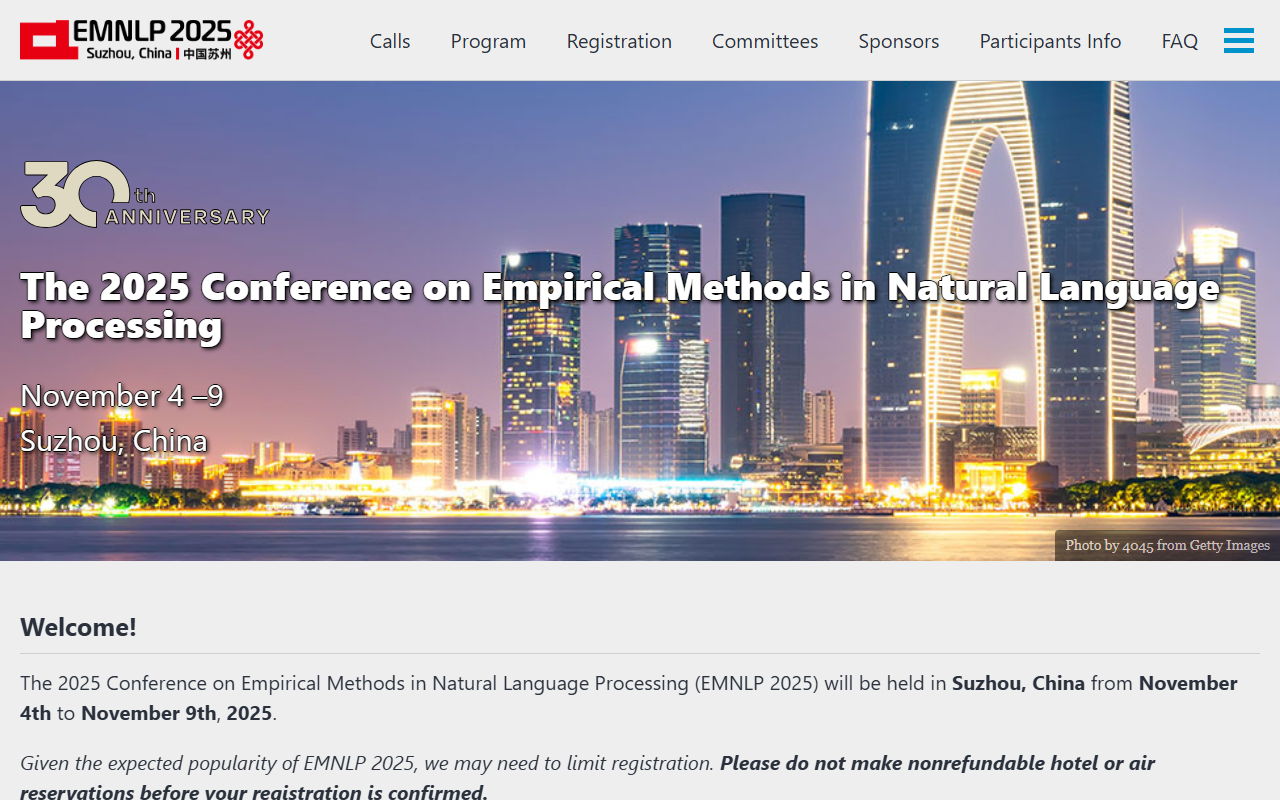
Upon visiting the EMNLP 2025 website, I found a clean, straightforward landing page that immediately conveys essential information. The hero banner prominently displays the conference dates—November 4–9, 2025—and the location: Suzhou, China. A Getty Images photo of Suzhou adds a welcoming visual touch. Scrolling down, the layout divides into a welcome note, a growing news feed, and a table of important dates. The navigation is minimal but functional: there are no complex menus or hidden drawers, which suits a conference site that primarily serves as an information hub. As a tech journalist exploring this "learning platform" (categorized under Text AI), I noted that the site is not an interactive tool but rather a gateway to one of NLP’s most prestigious events. The design prioritizes clarity and timeliness over flashy features, which aligns with the conference’s scholarly focus.
What to Expect: Content and Workflow
EMNLP 2025 is hosted by the Association for Computational Linguistics (ACL) and focuses on empirical methods in natural language processing. The conference brings together researchers, industry professionals, and students to present peer-reviewed papers, demos, and tutorials. The website lists key workflows: submission via the ACL Rolling Review (ARR) system, followed by reviewer registration, author response discussions, and final acceptance notifications. For example, the ARR submission deadline for long and short papers is May 19, 2025, with review submissions due June 18. The schedule includes a commitment deadline of August 1 and camera-ready papers by September 19. This structured pipeline ensures rigorous evaluation and high-quality content. The news section, updated frequently, provides visibility into program announcements, calls for volunteers, and desk rejection practices—a sign of active editorial stewardship. When testing the free tier (attendance alone), I observed that the website does not host live content or interactive learning modules; instead, all learning occurs during the conference itself, through presentations, workshops, and networking.
Pricing and Practical Considerations
Pricing is not publicly listed on the website. Registration fees for EMNLP typically vary by membership status and early-bird deadlines, but the 2025 site only notes that registration may be limited due to expected popularity. It explicitly warns attendees not to make nonrefundable hotel or air reservations before registration is confirmed. This cautious approach is a strength, reflecting transparency, but it also introduces uncertainty for those planning travel. The conference offers no API or integrations, as it is not a software tool. Competitors include other ACL-sponsored events like ACL 2025 (often held in different regions) and NAACL, which focus on similar topics. Unlike those, EMNLP emphasizes empirical methodology and has become a premier venue for NLP innovations. The tool’s strengths lie in its credibility and extensive peer review, but its limitation is that it is not a self-paced learning resource—you must attend physically to gain full benefit. For those who cannot travel, some papers will likely appear online later, but the interactive learning experience is inherently restricted to registered attendees.
Final Verdict and Recommendations
EMNLP 2025 is best suited for NLP researchers, PhD students, and industry practitioners who want to stay at the forefront of empirical language processing. It is less ideal for casual learners or those seeking on-demand tutorials. As a learning platform, it excels in providing cutting-edge research and networking, but falls short for remote or asynchronous education. I recommend it strongly for anyone planning to attend a major NLP conference in 2025, especially in Asia. Consider alternatives like the AAAI Conference or ICML for broader AI coverage, but for NLP-specific empirical methods, EMNLP remains unmatched. Visit EMNLP 2025 at https://2025.emnlp.org/ to explore it yourself.













Comments