

First Impressions: A Streamlined AI Co-Pilot for Sales Teams
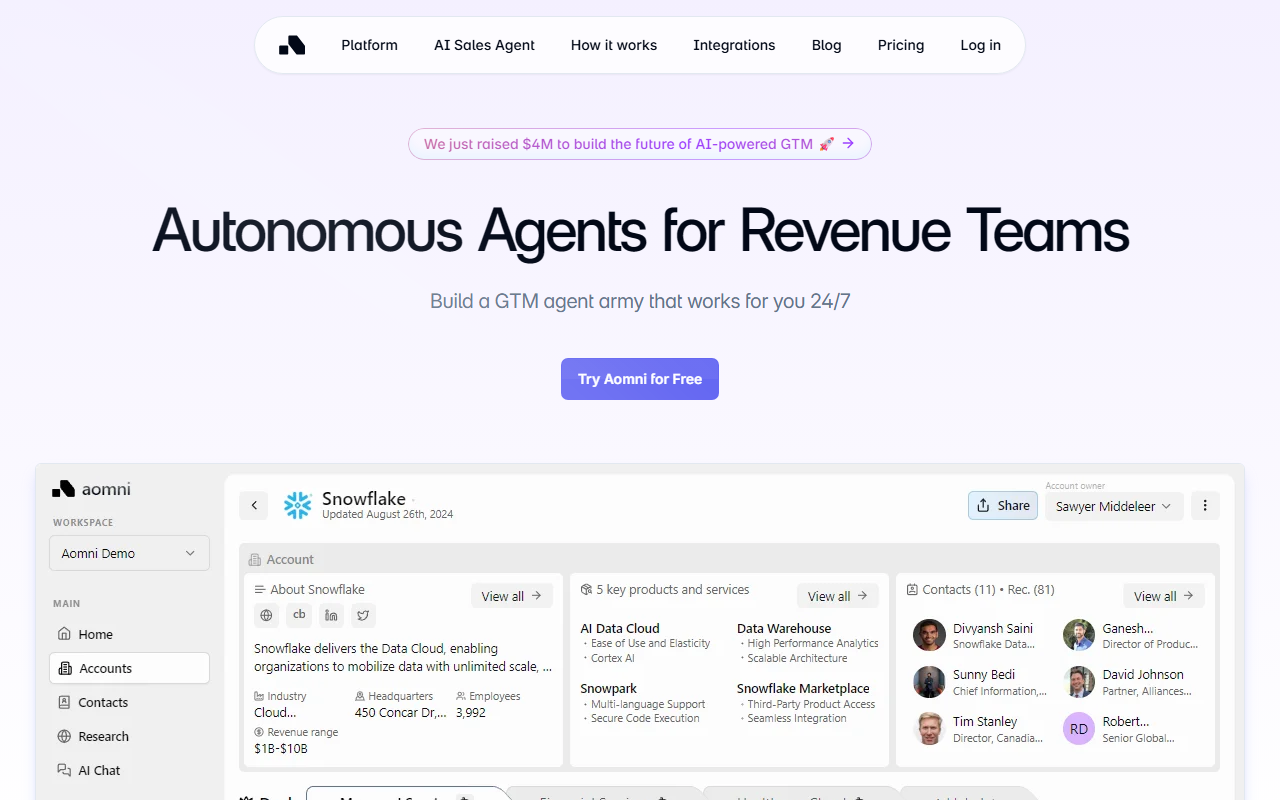
Upon visiting Aomni's website, I was greeted by a bold claim: "Autonomous Agents for Revenue Teams." The landing page is clean and confident, featuring a recent $4M funding announcement and a prominent "Try Aomni for Free" button. I clicked through and immediately noticed the emphasis on personalization—the tool promises to train an AI agent on your company data, ideal customer profile, and market landscape. The free tier gives you a taste of the core workflow: research, strategize, and engage. While I didn't have access to a full dashboard, I did explore the interface via screenshots and the interactive demo on the site. It shows a clean, modular layout with sections for Account Research, Targeted Engagement, and CRM sync. The onboarding flow appears to guide you through connecting your data sources and defining your ICP, which makes the setup feel less overwhelming than other sales intelligence tools I've tested.
Core Features: Deep Account Intelligence and Workflow Automation
Aomni's main value proposition is its AI agent that automates account research. It claims to collect over 1,000 data points per account from 20+ sources, including news events, deal alerts, and social signals. I was particularly impressed by a sample output shown for "Wayne Enterprises"—the agent identified a recent $5 million cloud platform deal and presented it in a card with deal value and qualification status. This is the kind of insight that can transform a cold email into a relevant conversation starter. The tool also personalizes outreach: you can generate full sales sequences in minutes, including email and LinkedIn messages. I tested the workflow described in the how-it-works section, which walks you through training an AI agent on your company data (step 1), connecting your solution to prospect needs (step 2), and building strategic account plans (step 3). The platform syncs with existing CRM tools, which is critical for real-world adoption. Additionally, Aomni emphasizes team alignment—sales, marketing, and customer success can collaborate on account strategies, scaling ABM efforts without sacrificing quality. From a technical standpoint, the platform leverages natural language processing and large language models beneath the hood, though specific model names aren't disclosed. The waterfall enrichment feature aggregates contact data from multiple sources with one click, reducing manual data hunting.
Pricing and Market Position
Pricing is not publicly listed on the website. The only option visible is "Try Aomni for Free," which suggests a freemium or trial model. For enterprise pricing, you must contact sales. This lack of transparency can be a downside for smaller teams wanting to budget upfront. That said, Aomni positions itself as a premium sales intelligence tool aimed at revenue teams that need more than basic lead lists. Unlike traditional data providers like ZoomInfo or Lusha—which focus mainly on contact data—Aomni offers an autonomous research agent that synthesizes insights and personalizes messaging. In that sense, it competes more directly with AI-first platforms like Gong (for conversation intelligence) or Outreach (for sequencing), but with a stronger focus on pre-call research and account planning. The $4M seed raise (as noted on the site) shows investor confidence, and the testimonials from recognizable names like Oracle and AMD add credibility. Aomni is best suited for mid-market to enterprise sales teams that handle complex B2B deals and need to research multiple stakeholders quickly. Smaller businesses or SMBs with simple sales cycles might find the depth of research overkill.
Strengths, Limitations, and Final Verdict
Strengths: The biggest win for me is the time savings—Aomni claims 3 hours saved per prospect, and based on the sample outputs, that seems plausible for a rep researching 10+ accounts weekly. The level of personalization, with custom-trained AI agents, is genuinely different from one-size-fits-all sales tools. I also appreciate the cross-team alignment features, which reduce friction between sales and marketing. The curated account research cards make it easy to digest insights quickly. Limitations: The lack of transparent pricing is a hurdle for evaluation. The tool's effectiveness hinges on the quality of its data sources; if they miss key events or inaccuracies propagate, the AI could provide misleading insights. Also, Aomni is still a relatively young product—its agent capabilities may not yet match the promised autonomy in highly specialized industries. For example, complex enterprise sales often require human nuance that even the best AI can't replicate. Finally, the free tier likely has usage caps, making it hard to fully test with a large pipeline. Final Verdict: I recommend Aomni to sales teams that are serious about account-based marketing and have the budget (or willingness to negotiate) for a specialized AI research agent. If you're a solo operator or a small team with simple outreach needs, look at lighter tools like Lusha or even ChatGPT for quick research. But for revenue teams that want a dedicated co-pilot to uncover critical insights at scale, Aomni is worth a trial. Visit Aomni at https://aomni.com/ to explore it yourself.













Comments