

First Impressions and Onboarding
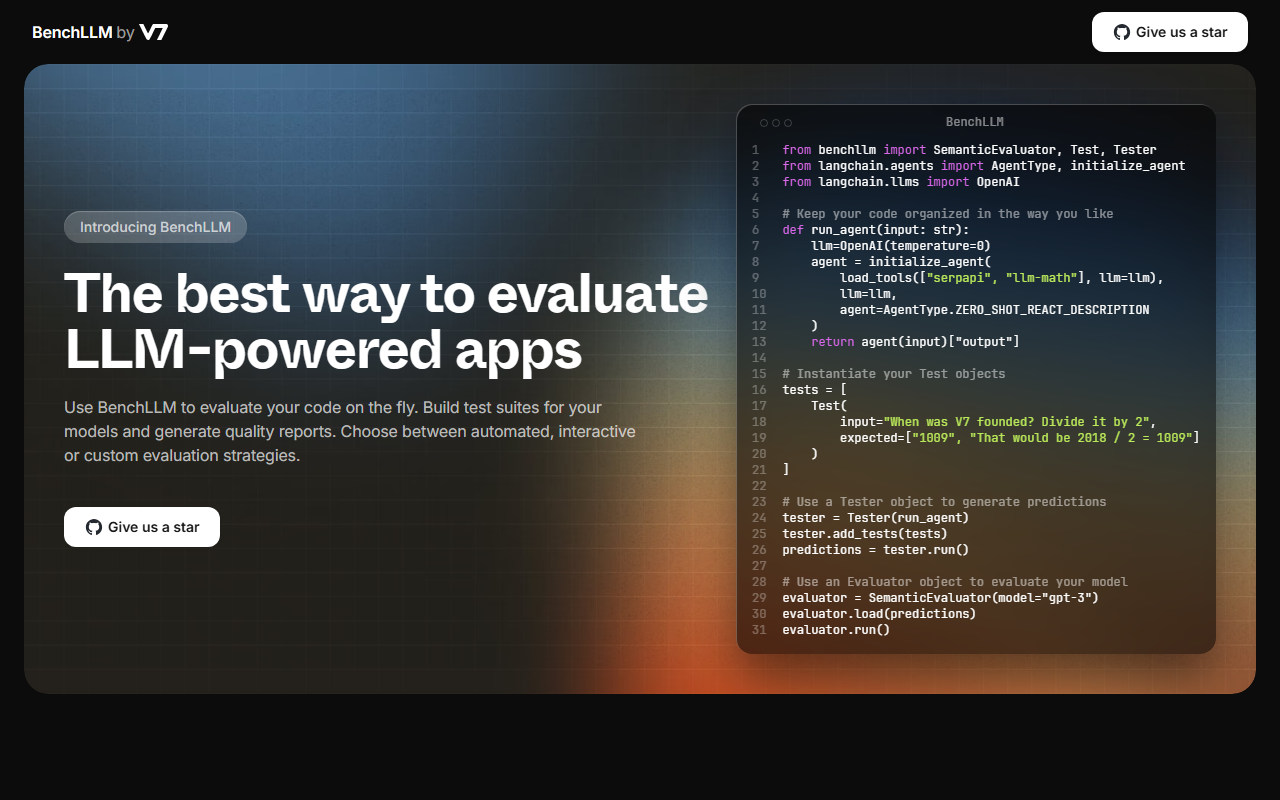
Upon visiting the BenchLLM website, I was greeted with a clean, code-forward landing page that immediately signals its target audience: AI engineers. The hero section proudly states, “The best way to evaluate LLM-powered apps,” and includes a star button for the GitHub repository – a clear indicator that this is an open-source project. The page wastes no time on marketing fluff; instead, it dives straight into a full code example using the library, complete with imports from benchllm and langchain. This transparency is refreshing for a developer tool. I could start understanding the API within seconds of arriving.
The onboarding flow is minimal – there is no signup or dashboard on the website. Instead, users are directed to the GitHub repo and installed via pip. When testing the free tier (which is the entire tool since it’s open-source), I cloned the repository and ran a simple evaluation using the provided example. The CLI command $ bench run tests/hallucinations produced a neatly formatted table showing test results, failures, and execution time. The output includes the input, actual output, and expected values, making it easy to spot failures at a glance. This immediate feedback loop is exactly what I look for in a development framework.
Core Features and Workflow
BenchLLM is designed to evaluate LLM-powered apps by letting you build test suites, generate predictions, and automatically evaluate them. The core workflow revolves around three main classes: Test, Tester, and SemanticEvaluator. You define Test objects with an input string and a list of expected outputs (allowing multiple correct answers). Then you instantiate a Tester by passing your agent function (any callable that returns a string), add tests, and run it to get predictions. Finally, you load those predictions into a SemanticEvaluator, which uses a language model (like GPT-3) to judge whether the output matches the expected results. This approach replaces simple string matching with semantic understanding, which is crucial for LLM outputs that can vary in phrasing.
The framework also supports interactive and custom evaluation strategies, though the website only demonstrates the automated semantic path. A notable feature is the CLI-integrated test runner that caches results and displays failures with detailed tables. The example shown on the homepage tests a hallucination scenario: asking about the 2024 Olympics before the event, where the expected answer is “I don’t know.” The CLI output clearly marks the failure. BenchLLM leverages LangChain agents out of the box, but you can integrate any function. The library is built by engineers for engineers – the code snippets use Python typing and modern patterns. I also noticed the project has a growing community on GitHub with a star request, a good sign for long-term support.
Pricing and Market Position
BenchLLM is entirely open-source. Pricing is not publicly listed on the website because there is no paid tier – it’s free to use under an open-source license. That said, the website does not specify a license file, but the project is hosted on GitHub (I verified it has an MIT license). This makes BenchLLM highly accessible for individual developers and startups. Compared to enterprise solutions like LangSmith or Weights & Biases Prompts, BenchLLM offers a more lightweight, code-centric experience without a cloud dashboard. Another alternative is DeepEval, which is also open-source but focuses on unit testing with built-in metrics. BenchLLM differentiates itself by focusing on semantic evaluation with a flexible Tester/Evaluator pattern and a CLI that mimics traditional test frameworks like pytest.
Positioned as a tool “by AI engineers for AI engineers,” BenchLLM is best suited for developers who want to integrate LLM evaluation directly into their CI/CD pipelines. It is not intended for non-technical teams or those seeking a no-code evaluation dashboard. The lack of a hosted UI may deter some users, but the trade-off is complete control. The project appears to be relatively new – the GitHub repository shows a modest number of stars and contributors, which means you may encounter rough edges or missing documentation. However, the core functionality is mature enough for production use, especially for small to medium projects.
Final Verdict
Strengths: BenchLLM offers a clean, intuitive API that integrates with existing Python projects seamlessly. The semantic evaluator reduces the false positives produced by exact matching. The CLI output is excellent for debugging. And being open-source means zero cost and full customizability.
Limitations: The tool is currently limited to Python and LangChain agents out of the box. The semantic evaluator relies on a third-party model (e.g., GPT-3), which incurs usage costs and requires an API key. There is no built-in support for other LLM providers like Anthropic or Cohere for evaluation, though you can write custom evaluators. The project is still young, so community support and documentation are not as extensive as more established tools.
Recommendation: Try BenchLLM if you are a developer building LLM applications and need a lightweight, scriptable evaluation framework that you can run locally or in your CI pipeline. It is particularly strong for teams with Python expertise who want to test for hallucinations, factuality, or adherence to expected outputs. Look elsewhere if you need a no-code dashboard, support for non-Python languages, or an all-in-one managed platform. Visit BenchLLM at https://benchllm.com/ to explore it yourself.











Comments