

First Impressions and Core Functionality
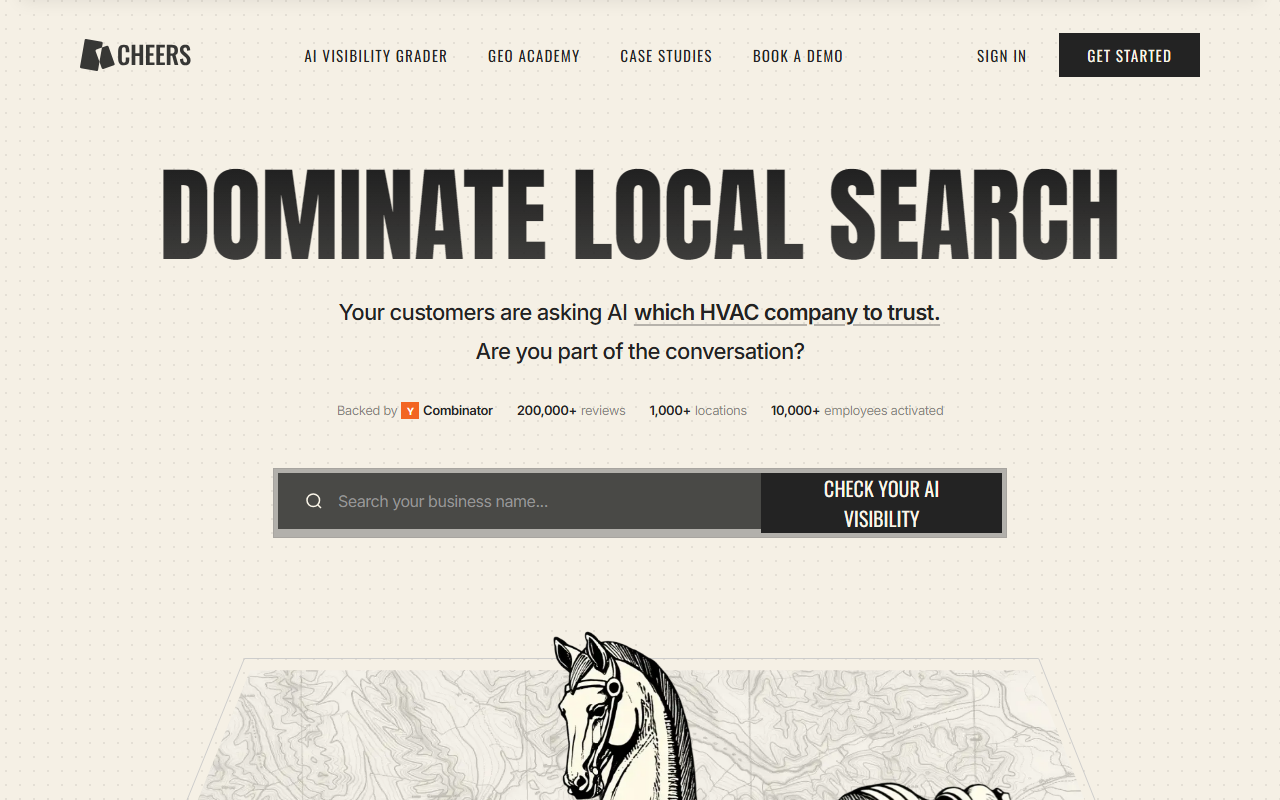
Visiting Cheers’ site, I was immediately struck by its laser focus: it’s not another generic review aggregator. The dashboard previews an “AI Visibility Score” and a real-time team leaderboard—a far cry from typical reputation management tools. Upon testing the free AI Visibility Grader, I entered a business location and saw a side-by-side comparison with competitors across ChatGPT, Gemini, and Perplexity. The tool scans 50+ directories and review platforms, highlighting exactly where your business is invisible. Cheers is purpose-built for multi-location operators (home services, hospitality, retail) who need each location to appear in AI-driven local queries. Its core pitch: manage the signals—review content, velocity, directory accuracy—that determine whether an AI assistant recommends you over a competitor.
Behind the scenes, Cheers uses NFC badges and quick links for effortless review collection. Employees tap a badge at the point of service, and customers leave a review without downloading an app. Every review is attributed to the specific employee who earned it. The platform then tracks AI recommendation rankings over time, showing which actions improve visibility. It’s a closed loop: collect more reviews → improve AI signals → win more recommendations → get more calls.
Key Strengths: What Sets Cheers Apart
The most compelling feature is employee-level attribution. Unlike standard tools that show aggregate company ratings, Cheers ties each review to the individual technician or front-desk staff who delivered the service. In the case study with Vivint, this drove a 17x increase in review velocity across 400+ locations. Managers can see that Marcus R. earned 127 five-star reviews this month, while Sarah K. earned 98—enabling targeted coaching and rewards.
Another standout is the AI Visibility Score itself. Most reputation tools are built for Google’s algorithm, but Cheers directly addresses the growing share of local search happening inside ChatGPT, Perplexity, and Gemini. The platform provides a per-location score and actionable steps: “Your directory listing is missing hours on Yelp” or “Your review velocity is below the 75th percentile for your zip code.” This moves beyond guessing into data-driven optimization.
Finally, the NFC tap collection is frictionless. Customers don’t need to type a URL or download an app—just tap their phone against a sticker or badge and they’re on the review page. For industries like plumbing or HVAC where the technician is already on-site with tools, this turns every service call into a reputation-building moment.
Limitations and Practical Considerations
Cheers is not a general-purpose AI writing tool. It’s a specialized platform for businesses that already have a physical presence and need to dominate local AI search. If you run a single-location e-commerce store or a SaaS company, this tool offers little value. The onboarding assumes you already manage a Google Business Profile and have existing review platforms to connect—setup is “days, not months,” but you’ll need that infrastructure ready.
Pricing is not publicly listed on the website. You must book a demo or use the free AI Visibility Grader and then get a sales conversation. This lack of transparency is a deterrent for smaller operators who want a quick, self-serve subscription. I estimate it likely targets medium-to-large enterprises with multiple locations (10+), given the custom deployment and dedicated support hinted at by case studies. For context, competitors like Birdeye or Broadly offer similar review management but without the AI visibility tracking. Unlike those platforms, Cheers is narrower—it focuses exclusively on generating reviews and tracking AI recommendations, without broader marketing automation features.
Another limitation: the AI recommendation shifts occur slowly—60 to 90 days. Businesses expecting instant results will be disappointed. The tool also requires ongoing employee participation; if your team isn’t consistently using NFC badges, review velocity won’t sustain.
Final Verdict: Who Should Use Cheers
Cheers is best suited for multi-location service businesses (home services, hospitality, retail chains) that are serious about being found by AI assistants. Companies like Vivint, with 400+ locations, have proven the model works. If you’re an operator with boots on the ground—plumbers, electricians, hoteliers—who can train staff to tap a badge after every service, Cheers will likely deliver a clear ROI. For single-location businesses or digital-only brands, look elsewhere; the focus on employee attribution and NFC taps doesn’t apply. Also, if you need a full CRM or email marketing suite, consider combining Cheers with a platform like HubSpot. Cheers excels at one thing: converting real-world interactions into AI-friendly reviews. Given Y Combinator’s backing and the growing shift toward AI search, it’s a timely investment for those who qualify.
Visit Cheers at https://cheers.tech/ to explore it yourself.













Comments