

First Impressions and Onboarding
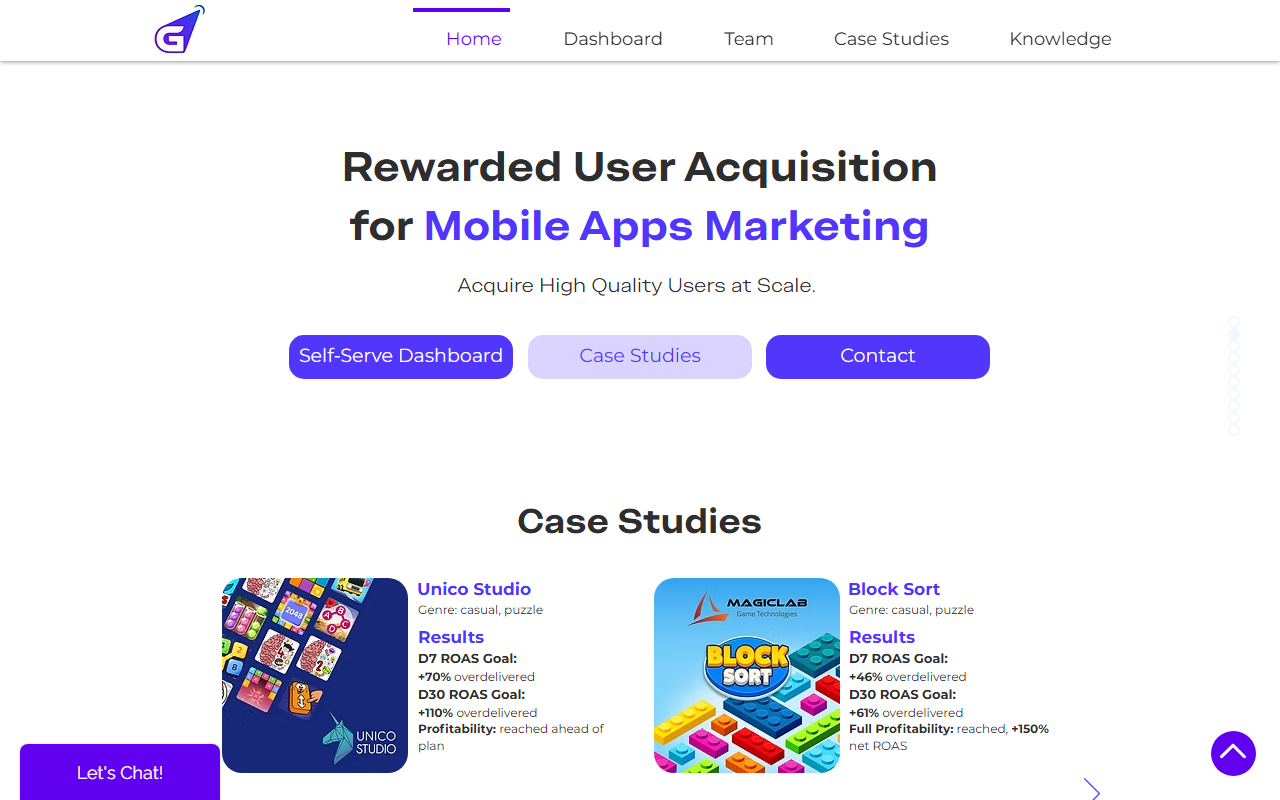
Upon visiting the Gamelight website, I was greeted with a clean, minimal interface that immediately positions the tool as a specialist in user acquisition for mobile games. The homepage emphasizes "Rewarded User Acquisition" and lists four key features: playtime rewards, event rewards, a self-serve dashboard, and an ROAS algorithm. There is no public sign-up flow or demo visible; instead, the site funnels visitors toward a contact form or a direct email to [email protected]. This suggests that Gamelight operates on a B2B model, likely requiring initial consultation before granting dashboard access. The case studies section highlights testimonials from UA managers who praise the platform for delivering high-quality users and strong retention. While I could not test the dashboard firsthand, the structure implies a relatively straightforward onboarding process once a partnership is established.
Core Features and Technology
Gamelight's value proposition centers on four integrated components. Playtime Rewards incentivize users to spend more time in-game, which directly boosts session length and retention. Event Rewards target key milestones (e.g., level completions, in-app purchases), driving deeper engagement. The Self-serve Dashboard gives UA managers full control over targeting, budgets, and optimization—critically important for scaling campaigns without relying on account managers. Finally, the ROAS Algorithm automatically adjusts bids toward users who demonstrate the highest return on ad spend, leveraging machine learning to optimize in real time. The platform appears to use its own AI models rather than third-party model providers; the algorithm is trained on engagement signals like playtime and conversion events. Integration with major ad networks and MMPs is hinted at but not detailed on the site. For developers, this means a unified system that blends incentivized engagement with data-driven bidding.
Pricing, Positioning, and Competition
Pricing is not publicly listed on the website. Gamelight likely operates on a CPA or CPE (cost per engagement) model, but exact rates would require a direct conversation. This lack of transparency is a limitation for smaller developers who need upfront cost visibility. In terms of market positioning, Gamelight competes with other rewarded UA platforms such as Tapjoy, ironSource's Offerwall, and Unity Ads' rewarded video. Unlike these broad ad networks, Gamelight focuses exclusively on mobile games and emphasizes “playtime” as a reward currency, which can lead to higher-quality users than standard incentivized installs. The platform is best suited for mobile game studios that already have a UA team and are looking to scale efficiently with an engagement-focused strategy. Small indie developers may find the opaque pricing and required partnership onboarding a barrier. There is no mention of a free tier or trial, reinforcing that Gamelight is aimed at mid-to-enterprise level clients.
Final Verdict
Gamelight presents a compelling option for mobile game UA managers who want to move beyond simple install campaigns and focus on rewarded engagement. Its strengths include a clear value chain—rewarding playtime and events—that aligns incentives between users and developers, an AI-driven optimization engine that adapts to performance, and a self-serve dashboard that empowers data-driven decision making. The biggest drawbacks are the lack of public pricing and the closed onboarding process, which may deter smaller teams. Additionally, the platform's reliance on rewarded traffic means it may not suit games with purely organic growth strategies. Overall, if you have the budget and are committed to a quality-over-quota UA approach, Gamelight is worth exploring. Visit Gamelight at https://gamelight.io/ to explore it yourself.













Comments