

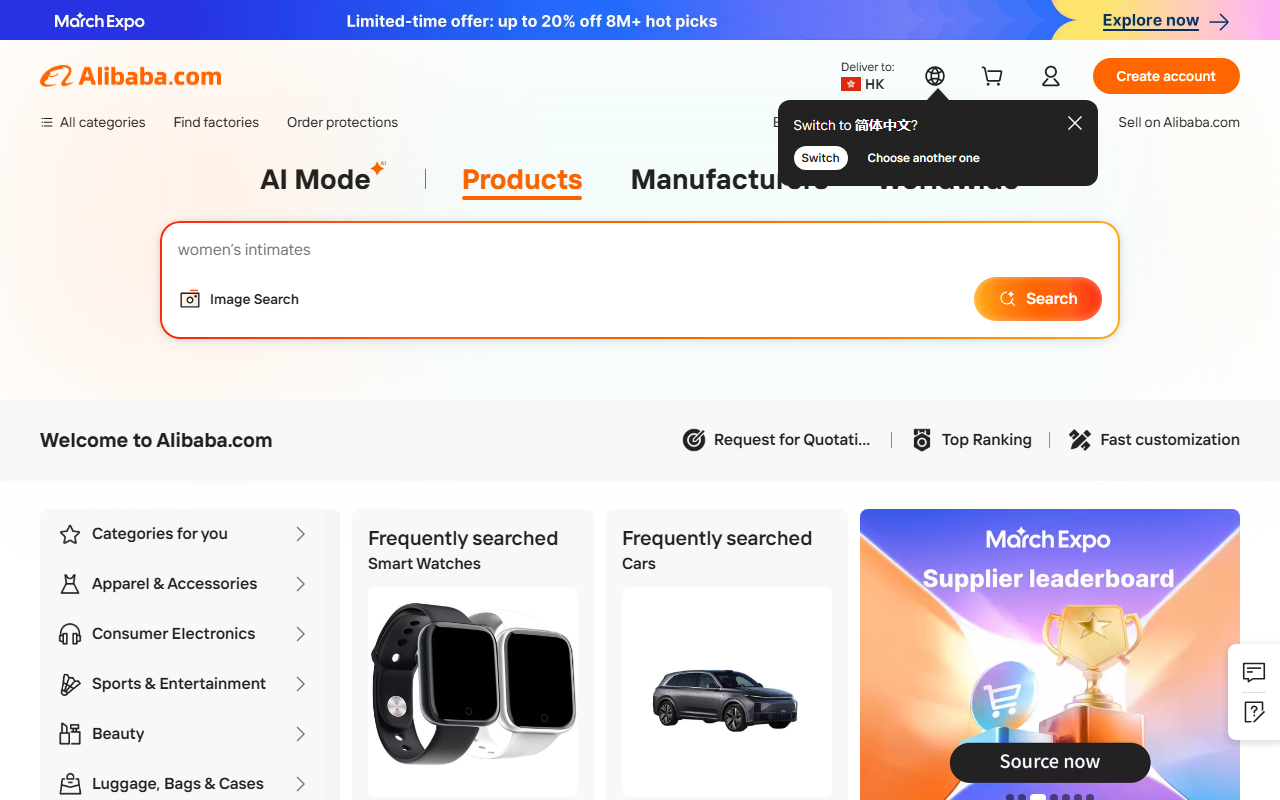
First impressions and onboarding
Upon visiting the Alibaba.com homepage via the provided URL, the dominant feature is a vast grid of product categories — from apparel and electronics to machinery and raw materials. The layout prioritizes search and discovery, with a prominent search bar and dynamically updated "frequently searched" terms. As a B2B marketplace, the onboarding flow is straightforward: users can immediately start browsing without registration, though creating an account unlocks ordering, messaging, and negotiation tools. The interface is dense and information-rich, which suits experienced buyers but may overwhelm newcomers. Notably, there is no explicit "AI tool" branding on the main page; instead, the AI capabilities are embedded in the platform's backend — powering product recommendations, language translation, and supplier verification algorithms.
AI features and technology
Alibaba.com leverages artificial intelligence across several core functions. The search engine uses machine learning to interpret natural language queries and return relevant suppliers, even when terms are imperfectly translated. For example, typing "automotive parts for electric vehicles" surfaces filtered results from verified manufacturers. An image search feature, powered by computer vision, lets users upload photos to find visually similar products — a boon for cross-border sourcing where language barriers exist. The platform also employs AI for trade risk assessment, assigning supplier trust scores based on transaction history, certification checks, and real-time delivery data. While the underlying models are not publicly detailed, Alibaba Group's investment in AI (e.g., their own large language models and cloud services) suggests that the marketplace benefits from continuous optimization. Integrations exist for ERP and logistics systems via APIs, though these are primarily offered to larger enterprise clients.
Strengths and limitations
Strengths: The platform's scale is unmatched — millions of products across 40+ categories. AI-driven search significantly reduces the time needed to find niche suppliers, especially for industrial goods. The inclusion of Trade Assurance, an AI-monitored protection system, adds a layer of trust that many competitors lack. Translation tools (both text and image-based) lower the friction of international communication.
Limitations: Despite AI filtering, the sheer volume of listings can still feel overwhelming. Supplier quality varies dramatically, and the algorithms are not foolproof — unverified sellers sometimes slip through. The interface prioritizes bulk purchases, making it less suitable for small-quantity sampling. Furthermore, the "AI" aspect is not front-and-center; users seeking a dedicated AI tool (e.g., a chatbot for sourcing advice) may find the experience purely transactional. Compared to platforms like Global Sources or ThomasNet, Alibaba's AI is more integrated but less transparent about its decision-making criteria.
Pricing and target audience
Pricing for Alibaba.com is not publicly listed as a fixed tier for buyers; the marketplace itself is free to browse and contact suppliers. Supplier-side membership costs vary (e.g., basic packages around $2,000/year for gold supplier status), but these fees are not shown on the main site. The platform generates revenue through advertising and service fees. This model suits small-to-medium enterprises and large procurement teams engaged in regular cross-border trade. It is less ideal for individuals seeking single-item purchases (AliExpress serves that segment) or for buyers who need a pure AI conversation agent rather than a comprehensive marketplace. For those comfortable navigating a high-volume ecosystem with AI assistance, Alibaba.com remains the dominant choice.
In summary, Alibaba.com functions as an AI-augmented B2B marketplace rather than a standalone AI tool. Its strengths lie in scale and embedded intelligence, while its primary weakness is the variable quality of suppliers that the AI must manage. Recommended for serious importers and exporters who can leverage its search and verification features. Visit Alibaba.com at https://sale.alibaba.com/ to explore it yourself.













Comments