

First Impressions and Onboarding
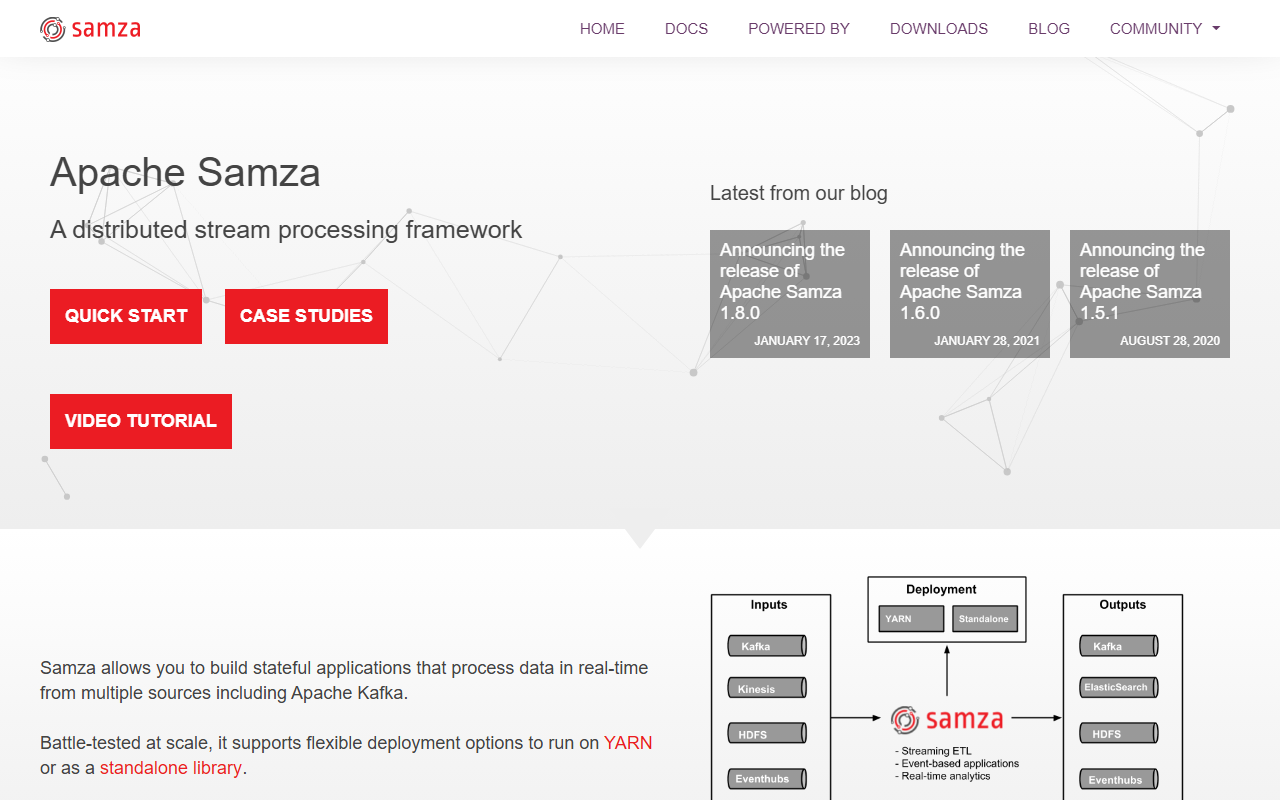
Upon visiting the Apache Samza website at samza.apache.org, I was greeted with a clean, documentation-first interface. The landing page immediately highlights the framework's core promise: building stateful applications that process data in real-time from multiple sources, including Apache Kafka. There's a prominent "Quick Start" button, which I clicked to dive in. The Quick Start guide walks you through setting up a local Samza job using a simple word-count example—essentially the "Hello World" of stream processing. I followed the steps: cloning the repo, running a Gradle build, and launching a standalone Samza application that consumes from a Kafka topic and writes results to another. The entire process took about 15 minutes, but it assumes you already have Java, Maven/Gradle, and a running Kafka instance. For newcomers, the lack of a sandbox or hosted trial means you must set up the infrastructure yourself—a notable barrier compared to managed services like Confluent Cloud.
Core Technology and Architecture
Apache Samza is a distributed stream processing framework originally developed at LinkedIn and now an Apache top-level project. It is designed for high-throughput, low-latency, stateful processing of streams. The underlying engine uses a pluggable architecture that integrates with Apache Kafka as the primary messaging layer, but also supports HDFS, AWS Kinesis, Azure Event Hubs, key-value stores, and ElasticSearch. Samza runs on YARN, Kubernetes, or as a standalone library—flexibility that makes it attractive for organizations already using these orchestrators. The framework provides multiple API layers: a low-level API for fine-grained control, a Streams DSL for common operations, Samza SQL for SQL-like queries, and an Apache Beam runner for portability. During testing, I found the Streams DSL intuitive for building simple pipelines, but the documentation warns that advanced state management requires diving into the low-level API. Samza uses incremental checkpointing and host-affinity to scale state to terabytes, which the website claims is battle-tested at scale (e.g., LinkedIn processes billions of messages daily).
Pricing and Market Positioning
Apache Samza is completely free and open-source under the Apache 2.0 license. There are no paid tiers or enterprise editions—it's a community-driven project. Pricing is not publicly listed on the website beyond being open source, but you'll incur infrastructure costs for running your own clusters. In the competitive stream processing landscape, Samza directly rivals Apache Flink and Kafka Streams. Unlike Flink, which emphasizes event-time processing and a richer SQL layer, Samza shines in its tight Kafka integration and pluggable deployment. Kafka Streams is lighter and easier to embed, but Samza offers more robust state management and isolation via separate processing containers. Samza is best suited for teams already invested in the Hadoop ecosystem (YARN) or those needing to process massive streams with deterministic state. It is less ideal for small projects or teams without strong Java/Scala expertise.
Strengths, Limitations, and Final Verdict
Strengths: Apache Samza is mature, having been battle-tested at LinkedIn and other major enterprises. Its low-latency, high-throughput capabilities are well-documented. The pluggable architecture means you can swap out underlying storage and messaging systems without rewriting your processing logic. The support for multiple APIs (DSL, SQL, Beam) gives flexibility to different developer preferences. Deployment on YARN or Kubernetes aligns with modern infrastructure practices. Community activity is moderate—the latest stable release (1.8.0) came out in January 2023, and the blog shows consistent updates.
Limitations: The steep learning curve is the biggest drawback. The framework assumes familiarity with distributed systems, Java, and stream processing concepts. The documentation, while thorough, can be dense and lacks beginner-friendly tutorials beyond the Quick Start. There is no cloud-hosted sandbox to test without setup. Compared to Flink, Samza's SQL support is less sophisticated, and its API consistency across languages is limited to JVM languages. Additionally, the ecosystem around monitoring and debugging is not as rich as that of managed services.
Recommendation: I would recommend Apache Samza to engineering teams that need a reliable, high-performance stream processing framework for production use, especially if they already run Kafka and YARN/Kubernetes. It's also a strong choice for stateful applications that require incremental checkpointing at terabyte scale. If you are a solo developer or a small team looking for rapid prototyping, consider Apache Flink or Kafka Streams for a gentler onboarding. Overall, Samza is a solid, open-source workhorse for serious stream processing workloads.
Visit Apache Samza at https://samza.apache.org/ to explore it yourself.










Comments